

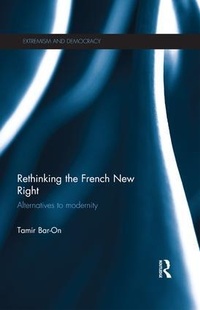
Rethinking the French New Right
Alternatives to Modernity
1st Edition
Published on 21. April 2016
Book
Paperback/Softback
280 pages
978-1-138-67625-1 (ISBN)
Description
This book focuses on the philosophy, politics and impact of the 'New Right' which originated in France and has since influenced activism, ideology and policy in a number of European countries.
This book explores the idea that revolutionaries do not necessarily need to come from the left, nor use arms in order to overturn liberal democracy. In the post-World War Two era, the extremists of the revolutionary right took three different paths: 1) parliamentary; 2) extra-parliamentary; and 3) metapolitical. The New Right (nouvelle droite - ND in France) took the metapolitical path, but that did not mean it abandoned its revolutionary desire to smash liberal democracy throughout Europe.
The book examines four interpretations of the New Right. These interpretations include the following: 1) The New Right as a fascist or quasi-fascist movement; 2) The New Right as a challenge to the traditional right-left dichotomy, which has structured European political debates for more than 200 years; 3) The New Right as an alternative modernist movement, which rejects liberal and socialist narratives of modernity; accepts the technical but not political or cultural effects of modernity; and longs for a pan-European political framework abolishing liberal multiculturalism and privileging ethnic dominance of so-called original Europeans; and 4) The New Right as a variant of political religion and conversionary processes. The book concludes by analysing the positions, cultural and political impact, and relationship to democracy of the New Right.
This work will be of great interest to students and scholars of racism, fascism, extremism, European politics, French politics and contemporary political theory.
This book explores the idea that revolutionaries do not necessarily need to come from the left, nor use arms in order to overturn liberal democracy. In the post-World War Two era, the extremists of the revolutionary right took three different paths: 1) parliamentary; 2) extra-parliamentary; and 3) metapolitical. The New Right (nouvelle droite - ND in France) took the metapolitical path, but that did not mean it abandoned its revolutionary desire to smash liberal democracy throughout Europe.
The book examines four interpretations of the New Right. These interpretations include the following: 1) The New Right as a fascist or quasi-fascist movement; 2) The New Right as a challenge to the traditional right-left dichotomy, which has structured European political debates for more than 200 years; 3) The New Right as an alternative modernist movement, which rejects liberal and socialist narratives of modernity; accepts the technical but not political or cultural effects of modernity; and longs for a pan-European political framework abolishing liberal multiculturalism and privileging ethnic dominance of so-called original Europeans; and 4) The New Right as a variant of political religion and conversionary processes. The book concludes by analysing the positions, cultural and political impact, and relationship to democracy of the New Right.
This work will be of great interest to students and scholars of racism, fascism, extremism, European politics, French politics and contemporary political theory.
More details
Series
Language
English
Place of publication
London
United Kingdom
Publishing group
Taylor & Francis Ltd
Target group
College/higher education
Product notice
Paperback (trade)
Unsewn / adhesive bound
Dimensions
Height: 234 mm
Width: 156 mm
Weight
520 gr
ISBN-13
978-1-138-67625-1 (9781138676251)
Copyright in bibliographic data and cover images is held by Nielsen Book Services Limited or by the publishers or by their respective licensors: all rights reserved.
Schweitzer Classification
Other editions
Additional editions
E-Book
04/2013
1st Edition
Routledge
€72.49
Available for download
E-Book
04/2013
1st Edition
Routledge
€72.49
Available for download
Book
04/2013
1st Edition
Routledge
€223.21
Shipment within 15-20 days
Person
Dr. Tamir Bar-On is a Full Professor in the Department of International Relations and Humanities at the Monterrey Institute of Technology and Higher Education (Tecnologico de Monterrey), Campus Queretaro (Mexico). He is the author of Where Have All The Fascists Gone? (2007). Bar-On received his PhD from McGill University and previously taught political science at Wilfrid Laurier University, University of Windsor, University of Toronto, and George Brown College.
Content
Introduction 1. The French New Right's transnationalism 2. Neither right, nor left? 3. Modern, postmodern, premodern 4. The search for alternative modernity 5. The quest for a new religion of politics 6. 'Europe for Europeans' 7. Analyzing the New Right for the Year 2000 8. Three key messengers 9. Ties to radical right populist parties Conclusion