

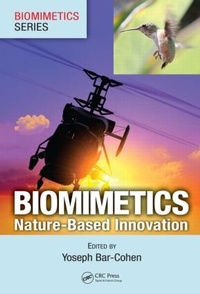
Biomimetics
Nature-Based Innovation
1st Edition
Published on 21. September 2011
Book
Hardback
788 pages
978-1-4398-3476-3 (ISBN)
Description
Mimicking nature - from science fiction to engineering reality
Humans have always looked to nature's inventions as a source of inspiration. The observation of flying birds and insects leads to innovations in aeronautics. Collision avoidance sensors mimic the whiskers of rodents. Optimization algorithms are based on survival of the fittest, the seed-picking process of pigeons, or the behavior of ant colonies. In recent years these efforts have become more intensive, with researchers seeking rules, concepts, and principles of biology to inspire new possibilities in materials, mechanisms, algorithms, and fabrication processes. A review of the current state of the art, Biomimetics: Nature Based Innovation documents key biological solutions that provide a model for innovations in engineering and science.
Leading experts address a wide range of topics, including:
Artificial senses and organs
Mimicry at the cell-materials interface
Multiscale modeling of plant cell wall architecture and tissue mechanics
The making of biomimetic composites
Electroactive polymer (EAP) actuators as artificial muscles
EAP-based refreshable braille displays
Biomimetic optics from the angles of biology and plants
Biomimicry of flying birds, insects, and marine biology
Applications of biomimetics in manufacturing, products, and medicine
Robotics, including the development of human-like robots
Biologically inspired design as a tool for interdisciplinary education
The biomimetic process in artistic creation
The final chapter outlines the challenges to biomimetic-related innovation and offers a vision for the future.
A follow-up to Biomimetics: Biologically Inspired Technologies (2005), this comprehensive reference methodically surveys the latest advances in this rapidly emerging field. It features an abundance of illustrations, including a 32-page full-color insert, and provides extensive references for engineers and scientists interested in delving deeper into the study of biomimetics.
Humans have always looked to nature's inventions as a source of inspiration. The observation of flying birds and insects leads to innovations in aeronautics. Collision avoidance sensors mimic the whiskers of rodents. Optimization algorithms are based on survival of the fittest, the seed-picking process of pigeons, or the behavior of ant colonies. In recent years these efforts have become more intensive, with researchers seeking rules, concepts, and principles of biology to inspire new possibilities in materials, mechanisms, algorithms, and fabrication processes. A review of the current state of the art, Biomimetics: Nature Based Innovation documents key biological solutions that provide a model for innovations in engineering and science.
Leading experts address a wide range of topics, including:
Artificial senses and organs
Mimicry at the cell-materials interface
Multiscale modeling of plant cell wall architecture and tissue mechanics
The making of biomimetic composites
Electroactive polymer (EAP) actuators as artificial muscles
EAP-based refreshable braille displays
Biomimetic optics from the angles of biology and plants
Biomimicry of flying birds, insects, and marine biology
Applications of biomimetics in manufacturing, products, and medicine
Robotics, including the development of human-like robots
Biologically inspired design as a tool for interdisciplinary education
The biomimetic process in artistic creation
The final chapter outlines the challenges to biomimetic-related innovation and offers a vision for the future.
A follow-up to Biomimetics: Biologically Inspired Technologies (2005), this comprehensive reference methodically surveys the latest advances in this rapidly emerging field. It features an abundance of illustrations, including a 32-page full-color insert, and provides extensive references for engineers and scientists interested in delving deeper into the study of biomimetics.
Reviews / Votes
"... a convenient source of examples and literature references for engineering students interested in how natural patterns can be exploited in mechanical and materials engineering. ... will be of most interest to roboticists, who can profitably exploit many of the mechanisms it describes."- Computing Reviews, June 2012More details
Series
Language
English
Place of publication
Bosa Roca
United States
Publishing group
Taylor & Francis Inc
Target group
College/higher education
Academic
Illustrations
512 s/w Abbildungen, 12 s/w Tabellen
12 Tables, black and white; 512 Illustrations, black and white
Dimensions
Height: 254 mm
Width: 178 mm
Weight
1632 gr
ISBN-13
978-1-4398-3476-3 (9781439834763)
Copyright in bibliographic data and cover images is held by Nielsen Book Services Limited or by the publishers or by their respective licensors: all rights reserved.
Schweitzer Classification
Other editions
Additional editions
E-Book
04/2016
1st Edition
CRC Press
€265.99
Available for download
Person
Dr. Yoseph Bar-Cohen is the Supervisor of the Electroactive Technologies Group at JPL, as well as a Senior Scientist there. He has (co) edited 10 books, co-authored over 390 publications, co-chaired 50 conferences, and has 36 registered patents. His books and other publications cover such topics as humanlike robots, biomimetics, nondestructive evaluation using ultrasonics and robotics and materials, etc. Business Week named him in 2003 as one of the five technology gurus who are "Pushing Tech's Boundaries." He is a NASA Fellow and Honors Award Winner, has two SPIE Lifetime Achievement Awards, and is the recipient of JPL's prestigious Magellan Award and many other honors and awards.
Content
Introduction: Nature as a Source for Inspiration of Innovation. Artificial Senses and Organs-Natural Mechanisms and Biomimetic Devices. Biomimicry at the Cell-Material Interface. Multiscale Modeling of Plant Cell Wall Architecture and Tissue Mechanics for Biomimetic Applications. Biomimetic Composites. Electroactive Polymer Actuators as Artificial Muscles. Refreshable Braille Displays Actuated by Electroactive Polymers. Biological Optics. Biomimicry of the Ultimate Optical Device-The Plant. Biologically Inspired Design: A Tool for Interdisciplinary Education. Self-reproducing Machines and Manufacturing Processes. Biomimetic Products. Biomimetics for Medical Implants. Application of Biomimetics in the Design of Medical Devices. Affective Robotics: Human Motion and Behavioural Inspiration for Safe Cooperation between Humans and Humanoid Assistive Robots. Humanlike Robots-Capabilities, Potentials, and Challenges. Biomimetic Swimmer Inspired by the Manta Ray. Biomimetics and Flying Technology. The Biomimetic Process in Artistic Creation. Biomimetics-Reality, Challenges, and Outlook. Index.