

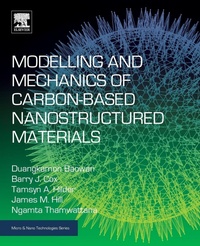
Modelling and Mechanics of Carbon-based Nanostructured Materials
Published on 18. January 2017
Book
Paperback/Softback
386 pages
978-0-12-812463-5 (ISBN)
Description
Modelling and Mechanics of Carbon-based Nanostructured Materials sets out the principles of applied mathematical modeling in the topical area of nanotechnology. It is purposely designed to be self-contained, giving readers all the necessary modeling principles required for working with nanostructures.
The unique physical properties observed at the nanoscale are often counterintuitive, sometimes astounding researchers and thus driving numerous investigations into their special properties and potential applications. Typically, existing research has been conducted through experimental studies and molecular dynamics simulations. This book goes beyond that to provide new avenues for study and review.
The unique physical properties observed at the nanoscale are often counterintuitive, sometimes astounding researchers and thus driving numerous investigations into their special properties and potential applications. Typically, existing research has been conducted through experimental studies and molecular dynamics simulations. This book goes beyond that to provide new avenues for study and review.
More details
Series
Language
English
Place of publication
Norwich
United States
Target group
Professional and scholarly
Product notice
Paperback (trade)
Dimensions
Height: 235 mm
Width: 191 mm
Thickness: 20 mm
Weight
666 gr
ISBN-13
978-0-12-812463-5 (9780128124635)
Copyright in bibliographic data and cover images is held by Nielsen Book Services Limited or by the publishers or by their respective licensors: all rights reserved.
Schweitzer Classification
Other editions
Additional editions
Duangkamon Baowan | Barry J. Cox | Tamsyn A. Hilder
Modelling and Mechanics of Carbon-based Nanostructured Materials
E-Book
02/2017
William Andrew
€85.95
Available for download
Persons
Duangkamon Baowan is Associate Professor of Applied Mathematics at Mahilodi University, Thailand, having previously worked at the University of Wollongong, Australia. Her research is focused on the mechanics of nanoscaled materials Barry J. Cox is Senior Lecturer in Applied Mathematics at the University of Adelaide, Australia. His research interests include nanoscaled oscillating systems, modelling nanoscale devices using continuum mechanics and predicting properties of nanomaterials using analytical techniques. He is a member of several professional bodies, including the Australian Nanotechnology Network. Tamsyn Hilder is a Lecturer in Computational Chemistry at Victoria University of Wellington, New Zealand. Her research focuses on computational biophysics of membrane proteins and nanomaterials, and the interaction between nano and biological materials. James M. Hill is Professor of Theoretical Mechanics and Group Director of the Nanomechanics Group at the University of Adelaide, Australia. He has previously written five books and published over 300 research publications in peer-reviewed journals. Ngamta Thamwattana is Associate Professor at the School of Mathematics and Applied Statistics at the University of Wollongong, Australia. Her research focuses on mathematical modelling in nanotechnology.
Author
Associate Professor of Applied Mathematics, Mahilodi University, Thailand
Senior Lecturer in Applied Mathematics, University of Adelaide, Australia
Lecturer in Computational Chemistry, Victoria University of Wellington, New Zealand
Professor of Theoretical Mechanics and Group Director of the Nanomechanics Group, University of Adelaide, Australia
Associate Professor, School of Mathematics and Applied Statistics, University of Wollongong, Australia
Content
1. Geometry and Mechanics of Carbon Nanostructures2. Mathematical Preliminaries3. Evaluation of Lennard-Jones Potential Fields4. Nested Carbon Nanostructures5. Acceptance Condition and Suction Energy6. Nano-oscillators7. Mechanics of More Complicated Structures: Nanopeapods and Spheroidal Fullerenes8. Nanotubes as Drug Delivery Vehicles9. New Formulae for the Geometric Parameters of Carbon Nanotubes10. Two Discrete Approaches for Joining Carbon Nanostructures11. Continuous Approach for Joining Carbon Nanostructures