

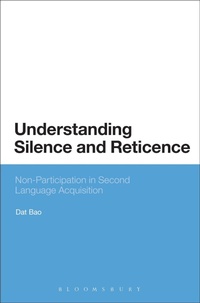
Understanding Silence and Reticence
Ways of Participating in Second Language Acquisition
Published on 27. August 2015
Book
Paperback/Softback
256 pages
978-1-4742-5306-2 (ISBN)
Description
What is the state of that which is not spoken? This book presents empirical research related to the phenomenon of reticence in the second language classroom, connecting current knowledge and theoretical debates in language learning and acquisition.
Why do language learners remain silent or exhibit reticence? In what ways can silence in the language learning classroom be justified? To what extent should learners employ or modify silence? Do quiet learners work more effectively with quiet or verbal learners? Looking at evidence from Australia, China, Japan, Korea, and Vietnam, the book presents research data on many internal and external forces that influence the silent mode of learning in contemporary education. This work gives the reader a chance to reflect more profoundly on cultural ways of learning languages.
Why do language learners remain silent or exhibit reticence? In what ways can silence in the language learning classroom be justified? To what extent should learners employ or modify silence? Do quiet learners work more effectively with quiet or verbal learners? Looking at evidence from Australia, China, Japan, Korea, and Vietnam, the book presents research data on many internal and external forces that influence the silent mode of learning in contemporary education. This work gives the reader a chance to reflect more profoundly on cultural ways of learning languages.
Reviews / Votes
Bao's book is a worthy contribution to the literature. Written in a clear style, it stresses the usefulness of silence and engages the reader to reassess his/her view of silence in SLA ... This book offers excellent insights for both the novice SLA student and the seasoned researcher. * Studies in Applied Linguistics & TESOL * This is an important and original book which deserves wide attention ... both among researchers and teachers. * ELT Journal * 'Speech is silver, silence is golden' is an age old adage forgotten in the modern day education. Dat Bao explores the potential role silence has in the classroom by analysing its types and functions both for the learners and the teacher. The book is a new concept in pedagogy well conceived and articulated. -- Mohanraj Sathuvalli, Professor in the Department of Training and Development, The English and Foreign Languages University, India Written in a highly readable, non-technical language, this book tells us that silence has a special place in the language learning process; it supports learning in ways that often escape our attention. Silence is not to be frowned upon, the author says. Rather it has to be skilfully managed to improve learning. -- Willy A Renandya, Senior Lecturer of English Language and Literature, National Institute of Education, Nanyang Technological University, SingaporeMore details
Language
English
Place of publication
London
United Kingdom
Publishing group
Bloomsbury Publishing PLC
Target group
College/higher education
Dimensions
Height: 234 mm
Width: 156 mm
Thickness: 13 mm
Weight
371 gr
ISBN-13
978-1-4742-5306-2 (9781474253062)
Copyright in bibliographic data and cover images is held by Nielsen Book Services Limited or by the publishers or by their respective licensors: all rights reserved.
Schweitzer Classification
Other editions
Additional editions
E-Book
02/2014
1st Edition
Bloomsbury Academic USA
€42.99
Available for download
E-Book
02/2014
1st Edition
Bloomsbury Academic USA
€42.99
Available for download
Person
Dat Bao lectures in the Faculty of Education, Monash University, Australia and has worked closely with universities in the US, the UK, Thailand, Singapore and Vietnam.
Content
Foreword
Acknowledgements
1: Repositioning silence
2: Australian perspectives on silence
3: Chinese perspectives on silence
4: Japanese perspectives on silence
5: Korean perspectives on silence
6: Philippine teachers' use of silence
7: Vietnamese perspectives on silence
8: Implications of silence for SLA and pedagogy
References
Index
Acknowledgements
1: Repositioning silence
2: Australian perspectives on silence
3: Chinese perspectives on silence
4: Japanese perspectives on silence
5: Korean perspectives on silence
6: Philippine teachers' use of silence
7: Vietnamese perspectives on silence
8: Implications of silence for SLA and pedagogy
References
Index