

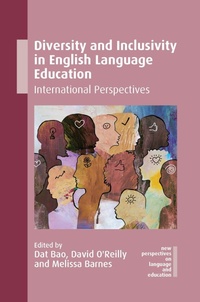
Diversity and Inclusivity in English Language Education
International Perspectives
Will be published approx. on 10. March 2026
Book
Hardback
267 pages
978-1-80041-889-9 (ISBN)
Description
Demonstrates the importance of embracing inclusivity and diversity in order to improve the teaching and learning of English.
This book addresses the twin themes of diversity and inclusivity in classrooms where English is taught as a foreign, second, additional or international language. The chapters cover theory, empirical research, and practice in order to support researchers, teacher educators, teachers, policymakers and materials developers who wish to make English language education more effective, inclusive and innovative.
The chapters explore a wide range of international contexts and a variety of educational contexts, and address issues including power structures, learner positionality, decolonised English standards, neurodiversity, marginalised silence, student agency in curriculum reform, task design for all learners, and collaboration drawing on diversity as a resource. The book offers an unusually intricate picture of issues that are at the forefront of the minds of educators around the world.
This book addresses the twin themes of diversity and inclusivity in classrooms where English is taught as a foreign, second, additional or international language. The chapters cover theory, empirical research, and practice in order to support researchers, teacher educators, teachers, policymakers and materials developers who wish to make English language education more effective, inclusive and innovative.
The chapters explore a wide range of international contexts and a variety of educational contexts, and address issues including power structures, learner positionality, decolonised English standards, neurodiversity, marginalised silence, student agency in curriculum reform, task design for all learners, and collaboration drawing on diversity as a resource. The book offers an unusually intricate picture of issues that are at the forefront of the minds of educators around the world.
Reviews / Votes
Diversity and inclusion are not peripheral ideals; they are, in fact, the very heart of meaningful English language education. This volume thoughtfully engages with both concepts across multifarious contexts and levels. Its conceptual richness and practical relevance are striking, which makes it a must-read for all stakeholders in the field. * Takaaki Hiratsuka, Ryukoku University, Japan * Drawing on voices from around the world, this timely volume showcases the commitment of educators who are advancing diversity and inclusion in English language education. The authors offer critical and compelling insights that invite us to recognize and resist deficit narratives and embrace our ethical responsibility to cultivate equitable, linguistically responsive learning communities as spaces of belonging and transformative possibility. * Rai Farrelly, University of Colorado Boulder, USA *More details
Series
Language
English
Place of publication
Bristol
United Kingdom
Target group
College/higher education
Dimensions
Height: 240 mm
Width: 161 mm
Thickness: 21 mm
Weight
617 gr
ISBN-13
978-1-80041-889-9 (9781800418899)
DOI
10.21832/BAO8899
Copyright in bibliographic data and cover images is held by Nielsen Book Services Limited or by the publishers or by their respective licensors: all rights reserved.
Schweitzer Classification
Other editions
Additional editions
Dat Bao | David O'Reilly | Melissa Barnes
Diversity and Inclusivity in English Language Education
International Perspectives
E-Book
03/2026
Multilingual Matters
€24.49
Available for download
Persons
Dat Bao works at Monash University, Australia. He is the editor of the Journal of Silence Studies in Education. Engaging in silence studies, creative pedagogy, and curriculum design, Dat has produced over 100 academic publications.
David O'Reilly works at the University of York, UK where he is the Deputy Leader for the Centre for Advanced Studies in Language and Education (CASLE). He researches metaphoric competence, language play and grammar processing, and promotes Open Research practice.
Melissa Barnes is an Associate Professor and Associate Dean of Learning and Teaching at La Trobe University, Australia. Her work addresses system-wide change in instructional and assessment practices in schools and teacher education.
David O'Reilly works at the University of York, UK where he is the Deputy Leader for the Centre for Advanced Studies in Language and Education (CASLE). He researches metaphoric competence, language play and grammar processing, and promotes Open Research practice.
Melissa Barnes is an Associate Professor and Associate Dean of Learning and Teaching at La Trobe University, Australia. Her work addresses system-wide change in instructional and assessment practices in schools and teacher education.
Content
David O'Reilly, Dat Bao and Melissa Barnes: Introduction: Diversity and Inclusion in English Language Education: Theory, Research and Practice
PART 1: PERSPECTIVES ON DIVERSITY AND INCLUSIVITY
Chapter 1. Anne Burns: Exploring Diversity and Inclusivity for Sustainability: A Language Practitioner Research Perspective
Chapter 2. Melissa Barnes and Ekaterina Tour: Re-Positioning Language Learners from Refugee Backgrounds as Powerful Meaningful Makers: A Case Study in an Australian Primary School
Chapter 3. Jennifer Yphantides: From Disabled to Enabled: Tracing the History of the Neurodiversity Movement and Shifting EFL Classroom Culture Towards Inclusion
Chapter 4. Ilse Fouche: Breaking Boundaries: Decolonising a South African Academic Literacy Curriculum through Action Learning
Chapter 5. Le Van Canh: A Descriptive Content Analysis of Diversity and Inclusivity in the Vietnamese ELT Teacher Preparation Curricula: Toward a Pedagogy of Understanding
PART 2: RESEARCH ON DIVERSITY AND INCLUSIVITY
Chapter 6. David O'Reilly: Students' Views on the Diversity and Suitability of Assessments in UK Postgraduate English Language Education (PELE) Programmes
Chapter 7. Agnieszka Kaldonek-Crnjakovic: Pre-Service English as a Foreign Language Teachers and Students with Special Educational Needs: Self-Perceived Knowledge, Skills, Efficacy, Beliefs and Emotions
Chapter 8. Benedict J.L. Rowlett and Simon Wang: Communicating Citizenship in Language Education by Writing for the Public
Chapter 9. Hai Ha Vu and Nha Uyen Nguyen: Teaching English to Vietnam Attention Deficit Hyperactivity Disorder Primary Students Inclusively: Challenges and Practices
Chapter 10. Yang Gao, Quan Quan, Xiaochen Wang and Jianing Feng: Exploring the Relationship between Chinese EFL Teachers' Beliefs and Reported Practices of Cultural Diversity and Inclusion in Language Teaching
Chapter 11. Tran Thi Tuyet and Le Van Canh: Decoding Wellbeing: Critical Insights into the Lives of Vietnamese EFL Lecturers
Chapter 12. Gary Bonar, Anne Keary, Yvette Slaughter and Tanya Davies: Understanding the Pedagogical Challenges in Online Learning for EAL Students
PART 3: PRACTICE IN DIVERSITY AND INCLUSIVITY
Chapter 13. Brian Tomlinson: Activities for All
Chapter 14. Dat Bao: Designing Language Tasks for Inclusive Silence
Chapter 15. Jessica Premier: Using Music to Enhance English Language Learning
Chapter 16. George M. Jacobs and Willy A. Renandya: Collaboration in the Service of Diversity and Inclusion in ELT
Chapter 17. Chikae Kaihara and Kuniomi Shibata: How have Children with Disabilities Learned English in School in Japan?: A Qualitative Study Focusing on Difficulties in English Learning and the English Education Environment
Chapter 18. Tony Waterman: ELT Materials and Activities which Promote Diversity and Inclusivity
Melissa Barnes, Dat Bao and David O'Reilly: Conclusion: Key Contributions and Directions to Enhance Diversity and Inclusivity in Education
PART 1: PERSPECTIVES ON DIVERSITY AND INCLUSIVITY
Chapter 1. Anne Burns: Exploring Diversity and Inclusivity for Sustainability: A Language Practitioner Research Perspective
Chapter 2. Melissa Barnes and Ekaterina Tour: Re-Positioning Language Learners from Refugee Backgrounds as Powerful Meaningful Makers: A Case Study in an Australian Primary School
Chapter 3. Jennifer Yphantides: From Disabled to Enabled: Tracing the History of the Neurodiversity Movement and Shifting EFL Classroom Culture Towards Inclusion
Chapter 4. Ilse Fouche: Breaking Boundaries: Decolonising a South African Academic Literacy Curriculum through Action Learning
Chapter 5. Le Van Canh: A Descriptive Content Analysis of Diversity and Inclusivity in the Vietnamese ELT Teacher Preparation Curricula: Toward a Pedagogy of Understanding
PART 2: RESEARCH ON DIVERSITY AND INCLUSIVITY
Chapter 6. David O'Reilly: Students' Views on the Diversity and Suitability of Assessments in UK Postgraduate English Language Education (PELE) Programmes
Chapter 7. Agnieszka Kaldonek-Crnjakovic: Pre-Service English as a Foreign Language Teachers and Students with Special Educational Needs: Self-Perceived Knowledge, Skills, Efficacy, Beliefs and Emotions
Chapter 8. Benedict J.L. Rowlett and Simon Wang: Communicating Citizenship in Language Education by Writing for the Public
Chapter 9. Hai Ha Vu and Nha Uyen Nguyen: Teaching English to Vietnam Attention Deficit Hyperactivity Disorder Primary Students Inclusively: Challenges and Practices
Chapter 10. Yang Gao, Quan Quan, Xiaochen Wang and Jianing Feng: Exploring the Relationship between Chinese EFL Teachers' Beliefs and Reported Practices of Cultural Diversity and Inclusion in Language Teaching
Chapter 11. Tran Thi Tuyet and Le Van Canh: Decoding Wellbeing: Critical Insights into the Lives of Vietnamese EFL Lecturers
Chapter 12. Gary Bonar, Anne Keary, Yvette Slaughter and Tanya Davies: Understanding the Pedagogical Challenges in Online Learning for EAL Students
PART 3: PRACTICE IN DIVERSITY AND INCLUSIVITY
Chapter 13. Brian Tomlinson: Activities for All
Chapter 14. Dat Bao: Designing Language Tasks for Inclusive Silence
Chapter 15. Jessica Premier: Using Music to Enhance English Language Learning
Chapter 16. George M. Jacobs and Willy A. Renandya: Collaboration in the Service of Diversity and Inclusion in ELT
Chapter 17. Chikae Kaihara and Kuniomi Shibata: How have Children with Disabilities Learned English in School in Japan?: A Qualitative Study Focusing on Difficulties in English Learning and the English Education Environment
Chapter 18. Tony Waterman: ELT Materials and Activities which Promote Diversity and Inclusivity
Melissa Barnes, Dat Bao and David O'Reilly: Conclusion: Key Contributions and Directions to Enhance Diversity and Inclusivity in Education