

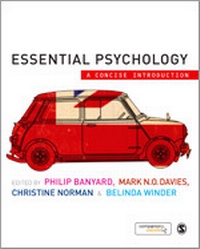
Essential Psychology
A Concise Introduction
1st Edition
Published on 17. February 2010
Book
Paperback/Softback
472 pages
978-1-84787-538-9 (ISBN)
Description
Electronic Inspection Copy available for instructors here
`The distinctive contribution of this text is to provide a far-reaching and up-to-date analysis of key issues in psychology in a highly accessible format. This reflects the authors' considerable skills as scholars who are highly attuned to the needs of both students and teachers. Their text succeeds admirably in bringing psychology to life and life to psychology' -
S. Alexander Haslam, Professor of Psychology, University of Exeter
For students studying psychology for the first time Essential Psychology: A Concise Introduction represents a fresh alternative to the range of expensive, US-oriented titles on the market that are full of topics you need but also many you don't need on your course.
This UK team-authored textbook is written by psychologists who specialize in each of the subject areas covered in their research and teaching. Spanning 18 chapters, but concentrating on the six fundamental topic areas taught at introductory level - Conceptual and Historical Issues in Psychology, Cognitive Psychology, Biological Psychology Social Psychology, Developmental Psychology and The Psychology of Individual Differences.
This textbook has everything students need to know inside, is stylish and colourful, and has an abundance of learning features to make the start of the student journey an enjoyable and successful one too. A range of reflective devices encourage critical thinking about these topics to provide a handy companion as students progress.
Visit the companion website at www.sagepub.co.uk/banyard
`The distinctive contribution of this text is to provide a far-reaching and up-to-date analysis of key issues in psychology in a highly accessible format. This reflects the authors' considerable skills as scholars who are highly attuned to the needs of both students and teachers. Their text succeeds admirably in bringing psychology to life and life to psychology' -
S. Alexander Haslam, Professor of Psychology, University of Exeter
For students studying psychology for the first time Essential Psychology: A Concise Introduction represents a fresh alternative to the range of expensive, US-oriented titles on the market that are full of topics you need but also many you don't need on your course.
This UK team-authored textbook is written by psychologists who specialize in each of the subject areas covered in their research and teaching. Spanning 18 chapters, but concentrating on the six fundamental topic areas taught at introductory level - Conceptual and Historical Issues in Psychology, Cognitive Psychology, Biological Psychology Social Psychology, Developmental Psychology and The Psychology of Individual Differences.
This textbook has everything students need to know inside, is stylish and colourful, and has an abundance of learning features to make the start of the student journey an enjoyable and successful one too. A range of reflective devices encourage critical thinking about these topics to provide a handy companion as students progress.
Visit the companion website at www.sagepub.co.uk/banyard
Reviews / Votes
`Banyard and Co have produced a highly enjoyable book that will be far more palatable than many of its competitors' -Patrick L. Hylton,
University of Lincoln, Lincoln, UK
'Despite the complexity of the material presented, the text is easy to read and gives a comprehensive overview of the area. Research and debate are covered alongside factual information in key study boxes and thought provoking question boxes' -
Caroline Brown,
University of the West of England, Bristol, UK
More details
Language
English
Place of publication
London
United Kingdom
Target group
College/higher education
Dimensions
Height: 232 mm
Width: 186 mm
Weight
937 gr
ISBN-13
978-1-84787-538-9 (9781847875389)
Copyright in bibliographic data and cover images is held by Nielsen Book Services Limited or by the publishers or by their respective licensors: all rights reserved.
Schweitzer Classification
Persons
Dr Phil Banyard is Emeritus Professor of Psychology at Nottingham Trent University (NTU). In his thirty years at NTU Phil Banyard taught on a range of courses but focused on introductory modules and critical thinking. His research was concerned with the impact of digital technologies on teaching and learning, especially in schools. He was a chief examiner of A Level Psychology for many years and has written more than twenty texts. Among these is an introductory text with SAGE (now in its fourth edition) that brought in over 50 members of the department at NTU. His cultural interests are largely defined by smallpeople in the family and he is currently enjoying Captain Underpants series three which he regards as riotously creative.
Christine Norman is a Senior Lecturer in Psychology at Nottingham Trent University. Belinda is a Reader in Forensic Psychology. She teaches primarily within forensic psychology, with specific focus on sexual crime. She has a strong background in psychometrics and individual differences, and retains her enthusiasm for quantitative research (continuing to teach multivariate statistics in what she hopes is a fun and interactive manner). Her research is leading her to incorporate qualitative research methods as she continues to develop a programme of research in collaboration with HMP Whatton (the largest sex offender prison in Europe) that makes a significant and practical contribution to our understanding of sex offenders and sexual crime. Additional areas of interest (both in terms of teaching and research) include the psychology of fraud, lying and deception.
Christine Norman is a Senior Lecturer in Psychology at Nottingham Trent University. Belinda is a Reader in Forensic Psychology. She teaches primarily within forensic psychology, with specific focus on sexual crime. She has a strong background in psychometrics and individual differences, and retains her enthusiasm for quantitative research (continuing to teach multivariate statistics in what she hopes is a fun and interactive manner). Her research is leading her to incorporate qualitative research methods as she continues to develop a programme of research in collaboration with HMP Whatton (the largest sex offender prison in Europe) that makes a significant and practical contribution to our understanding of sex offenders and sexual crime. Additional areas of interest (both in terms of teaching and research) include the psychology of fraud, lying and deception.
Content
PART ONE: WHAT WE KNOW ABOUT HUMAN BEINGS: THE FOUNDATIONS OF MODERN PSYCHOLOGY
Sex, Lies and Digital Horizons - Mark N O Davies and Philip Banyard
How Psychology Became a Science - Simon Watts
Issues and Debates in Psychology - Garry Young
PART TWO: HOW WE THINK AND MAKE SENSE OF THE WORLD: COGNITIVE PSYCHOLOGY
Memory - Thom Baguley and Andrew J Edmonds
An Introduction to Sensation, Perception and Attention - Andrew K Dunn and Paula C Stacey
Thinking and Problem-Solving - Gary Jones
PART THREE: HOW OUR BRAINS AFFECT OUR BEHAVIOUR: BIOLOGICAL PSYCHOLOGY
The Human Nervous System: Functional Anatomy - Antonio Castro and Mark J T Sergeant
Communication within the Brain - Rachel Horsley and Christine Norman
Brain and Behaviour: Sex Differences - Mark J T Sergeant and Antonio Castro
PART FOUR: HOW WE INTERACT WITH EACH OTHER: SOCIAL PSYCHOLOGY
Behaviour within Groups - Susan Hansen, Paige Wilcoxson and Dan Bysouth
Behaviour between Groups - Mick Gregson, Rowena Hill and Nicholas Blagden
Social Judgements and Behaviour - Alex Meredith and Monica Whitty
PART FIVE: HOW WE GROW AND CHANGE: DEVELOPMENTAL PSYCHOLOGY
Development during the Early Years - Lucy J Betts et al
Development during the School Years - Lee Farrington-Flint et al
Atypical Child Development - Gayle V Dillon, Susannah J Lamb and Andrew Grayson
PART SIX: HOW WE KNOW AND MEASURE OUR INDIVIDUALITY: THE PSYCHOLOGY OF INDIVIDUAL DIFFERENCES
Personality - Glenn Williams, Jamie Murphy and James Houston
Intelligence: Measuring the Mind - Eva Sundin
Self - Jill Arnold and Brendan Gough
Glossary
References
Index
Sex, Lies and Digital Horizons - Mark N O Davies and Philip Banyard
How Psychology Became a Science - Simon Watts
Issues and Debates in Psychology - Garry Young
PART TWO: HOW WE THINK AND MAKE SENSE OF THE WORLD: COGNITIVE PSYCHOLOGY
Memory - Thom Baguley and Andrew J Edmonds
An Introduction to Sensation, Perception and Attention - Andrew K Dunn and Paula C Stacey
Thinking and Problem-Solving - Gary Jones
PART THREE: HOW OUR BRAINS AFFECT OUR BEHAVIOUR: BIOLOGICAL PSYCHOLOGY
The Human Nervous System: Functional Anatomy - Antonio Castro and Mark J T Sergeant
Communication within the Brain - Rachel Horsley and Christine Norman
Brain and Behaviour: Sex Differences - Mark J T Sergeant and Antonio Castro
PART FOUR: HOW WE INTERACT WITH EACH OTHER: SOCIAL PSYCHOLOGY
Behaviour within Groups - Susan Hansen, Paige Wilcoxson and Dan Bysouth
Behaviour between Groups - Mick Gregson, Rowena Hill and Nicholas Blagden
Social Judgements and Behaviour - Alex Meredith and Monica Whitty
PART FIVE: HOW WE GROW AND CHANGE: DEVELOPMENTAL PSYCHOLOGY
Development during the Early Years - Lucy J Betts et al
Development during the School Years - Lee Farrington-Flint et al
Atypical Child Development - Gayle V Dillon, Susannah J Lamb and Andrew Grayson
PART SIX: HOW WE KNOW AND MEASURE OUR INDIVIDUALITY: THE PSYCHOLOGY OF INDIVIDUAL DIFFERENCES
Personality - Glenn Williams, Jamie Murphy and James Houston
Intelligence: Measuring the Mind - Eva Sundin
Self - Jill Arnold and Brendan Gough
Glossary
References
Index