

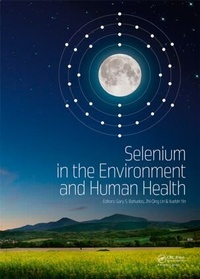
Selenium in the Environment and Human Health
1st Edition
Published on 29. November 2013
Book
Hardback
248 pages
978-1-138-00017-9 (ISBN)
Description
Selenium is arguably the naturally occurring trace element of greatest concern worldwide. In excessive amounts it can lead to toxicosis and teratogenesis in animals, while the impact of selenium deficiency can be even more significant. Contributors from 22 countries explored the connections and inter-relationships between selenium in the environment, agriculture, human and animal health, and molecular and biochemistry processes to complete this book containing 90 peer-reviewed extended abstracts. The text represents glimpses of the presentations that were delivered at the 3rd International Conference on Selenium in the Environment and Human Health in 2013 in Hefei, China. We are indebted to the international authors representing a multitude of disciplines from academic, industry, and governments for sharing their extraordinary new knowledge on selenium research.
More details
Language
English
Place of publication
London
United Kingdom
Publishing group
Taylor & Francis Ltd
Target group
Professional and scholarly
Professional
Dimensions
Height: 246 mm
Width: 174 mm
Weight
620 gr
ISBN-13
978-1-138-00017-9 (9781138000179)
Copyright in bibliographic data and cover images is held by Nielsen Book Services Limited or by the publishers or by their respective licensors: all rights reserved.
Schweitzer Classification
Other editions
Additional editions
Gary S. Banuelos | Zhi-Qing Lin | Xuebin Yin
Selenium in the Environment and Human Health
E-Book
11/2013
1st Edition
CRC Press
€211.99
Available for download
Gary S. Banuelos | Zhi-Qing Lin | Xuebin Yin
Selenium in the Environment and Human Health
E-Book
11/2013
1st Edition
CRC Press
€211.99
Available for download
Persons
Dr. Gary Banuelos is a Plant/Soil scientist at the U.S. Department of Agriculture-Agricultural Research Service, Water Management Research Unit, Parlier, California, and adjunct professor at the University of California and California State University-Fresno. Dr. Banuelos began work with "green technology" with Professor H. Marschner in Germany and focuses his research on the phytoremediation of soils and waters laden with selenium, boron, and salinity in California, and on integrated production of innovative biofortified and bio-based products (e.g., biofuel, Se-enriched feeds, and organic fertilizer/herbicides). He strives for creating a sustainable green strategy for managing trace elements in the United States and in other parts of the world. Dr. Banuelos is the principle author of over 140 refereed technical journals on the topic of phytoremediation and has co-edited four books. He received his Bachelor of Arts degree in German from California State University, Bachelor of Science in Crop Science, and Master of Science degree in International Agriculture from California Poly-Technical University, while his diploma in Plant Biology was earned at the University of Tubingen, Germany, and doctorate in Agriculture/Plant Nutrition at Hohenheim University, Germany, as a U.S. National Science Foundation Fellow.
Dr. Z.-Q. Lin is a Professor in the Department of Biological Sciences and the Director of the Environmental Sciences Program at Southern Illinois University - Edwardsville in Illinois. Dr. Lin received his BS degree in Environmental Biology from Liaoning University in China, MS degree in Pollution Ecology from Chinese Academy of Sciences, and Ph.D. degree in Renewable Resources from McGill University in Canada. He was a post-graduate researcher on biogeochemistry of selenium at University of California - Berkeley. His research is related to the biogeochemistry of environmentally important trace elements, with a special focus on biological accumulation, transformation, and volatilization processes of selenium in the air-water-soil-plant system. He is the author or coauthor of over 65 peer-reviewed articles published in scientific journals, proceedings and monographs.
Dr. Xuebin Yin is an Associate Professor in the Department of Environmental Sciences and the Director of Advanced Lab for Selenium and Human Health, at University of Science and Technology of China (USTC). Dr. Yin started his research on selenium biogeochemistry, phytoremediation and biofortification with Professor Liguang Sun at USTC in 1998, and continued with Professor Yongming Luo at the Chinese Academy of Sciences in 2005. His research is related to the biogeochemistry of trace/macro elements (such as, selenium, zinc, calcium, iron, iodine and fluorine), with a special emphasis on their biological transformation process, health issue and utilization in the agriculture and foods. He is the author or coauthor of over 40 refereed journal and review articles, proceedings, and book chapters. He has worked twice as chair of the organizing committee for the Selenium conference. Dr. Yin received his Bachelor of Science degree (2000) in Geochemistry, Ph. D. degree of Environmental Science (2005) from USTC.
Dr. Z.-Q. Lin is a Professor in the Department of Biological Sciences and the Director of the Environmental Sciences Program at Southern Illinois University - Edwardsville in Illinois. Dr. Lin received his BS degree in Environmental Biology from Liaoning University in China, MS degree in Pollution Ecology from Chinese Academy of Sciences, and Ph.D. degree in Renewable Resources from McGill University in Canada. He was a post-graduate researcher on biogeochemistry of selenium at University of California - Berkeley. His research is related to the biogeochemistry of environmentally important trace elements, with a special focus on biological accumulation, transformation, and volatilization processes of selenium in the air-water-soil-plant system. He is the author or coauthor of over 65 peer-reviewed articles published in scientific journals, proceedings and monographs.
Dr. Xuebin Yin is an Associate Professor in the Department of Environmental Sciences and the Director of Advanced Lab for Selenium and Human Health, at University of Science and Technology of China (USTC). Dr. Yin started his research on selenium biogeochemistry, phytoremediation and biofortification with Professor Liguang Sun at USTC in 1998, and continued with Professor Yongming Luo at the Chinese Academy of Sciences in 2005. His research is related to the biogeochemistry of trace/macro elements (such as, selenium, zinc, calcium, iron, iodine and fluorine), with a special emphasis on their biological transformation process, health issue and utilization in the agriculture and foods. He is the author or coauthor of over 40 refereed journal and review articles, proceedings, and book chapters. He has worked twice as chair of the organizing committee for the Selenium conference. Dr. Yin received his Bachelor of Science degree (2000) in Geochemistry, Ph. D. degree of Environmental Science (2005) from USTC.
Content
Preface Acknowledgements List of contributors 1 Biogeochemistry of selenium Role of climatic factors on the terrestrial distribution of selenium; Assessing global cycling of selenium: Analytical tools to quantify volatile species and their fluxes; Selenium in soil profiles and the rhizosphere soils of typical Kaschin-Beck disease areas; Selenium distribution linked to monsoon climate in the Chinese Loess Plateau; Fractionation and speciation of selenium in surface soil with deficient and adequate selenium; speciation in rock from a high selenium region in Ziyang, China; Selenium speciation in soils from selenosis area: Comparison between a Sequential Extraction Procedure and XAFS H.-B. Behaviour of native and applied selenium in Malawi soils; Use of stable enriched selenite tracer in field experiments to investigate short- and long-term fate in soil of selenium; Use of stable isotope signatures in plants as a tool to explore the selenium cycle in the critical zone; The source-partitioning of selenium volatilization in soil-Stanleya pinnata and Brassica juncea systems.../Part Contents