

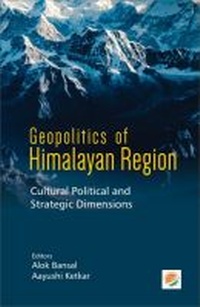
Geopolitics of Himalayan Region
Cultural Political and Strategic Dimensions
Published on 30. December 2019
Book
Hardback
255 pages
978-93-86618-68-9 (ISBN)
Description
The world's youngest mountain range, the Himalayas, is home to two of the world's oldest civilizations that are contemporary Great Power aspirers - India and China. These two Asian giants are the world's fastest growing economies and hold over one third of global population, giving them the necessary clout to impact global politics. In the last few years, Himalayan Region, which influences and dominates a large part of Eurasian land mass has seen jostling for space between these two emerging powers as well as various extra-regional powers.
For India, the Himalayas symbolise physical strength, spiritual elevation, cultural diversity and strategic advantage and forms the basis of India's national consciousness. They act as a natural divide between the Indian subcontinent on the one hand and Central Asia and China on the other. In fact, the boundaries of South and Central Asia converge along the Himalayas, lending unique geo-political and geo-strategic significance to this region that represents diverse identities, ecology and, yet finds a common civilizational and cultural tradition that binds it seamlessly.
This book is truly ambitious, as it attempts to take a holistic look on all the three key dimensions impacting the region - cultural, political, and strategic - making it a pioneering effort in studying the region beyond the myopic prism of bilateral relations. Elucidating contributions on various critical issues from practitioners and experts par excellence lends greater credibility and efficacy in understanding the immense possibilities that the region offers - from being the hotbed of intense competition to an exemplar of political and economic cooperation, supported by a complex web of religio-cultural and civilisational linkages.
For India, the Himalayas symbolise physical strength, spiritual elevation, cultural diversity and strategic advantage and forms the basis of India's national consciousness. They act as a natural divide between the Indian subcontinent on the one hand and Central Asia and China on the other. In fact, the boundaries of South and Central Asia converge along the Himalayas, lending unique geo-political and geo-strategic significance to this region that represents diverse identities, ecology and, yet finds a common civilizational and cultural tradition that binds it seamlessly.
This book is truly ambitious, as it attempts to take a holistic look on all the three key dimensions impacting the region - cultural, political, and strategic - making it a pioneering effort in studying the region beyond the myopic prism of bilateral relations. Elucidating contributions on various critical issues from practitioners and experts par excellence lends greater credibility and efficacy in understanding the immense possibilities that the region offers - from being the hotbed of intense competition to an exemplar of political and economic cooperation, supported by a complex web of religio-cultural and civilisational linkages.
More details
Language
English
Place of publication
New Delhi
India
Target group
Professional and scholarly
Dimensions
Height: 250 mm
Width: 160 mm
Weight
750 gr
ISBN-13
978-93-86618-68-9 (9789386618689)
Copyright in bibliographic data and cover images is held by Nielsen Book Services Limited or by the publishers or by their respective licensors: all rights reserved.
Schweitzer Classification