

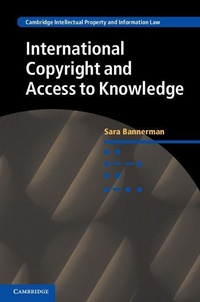
International Copyright and Access to Knowledge
Published on 19. February 2016
Book
Hardback
278 pages
978-1-107-02306-2 (ISBN)
Description
The principle of Access to Knowledge (A2K) has become a common reference point for a diverse set of agendas that all hope to realize technological and human potential by making knowledge more accessible. This book is a history of international copyright focused on principles of A2K and their proponents. Whilst debate and discussion so far has covered the perspectives of major western countries, the author's fresh approach to the topic considers emerging countries and NGOs, who have fought for the principles of A2K that are now fundamental to the system. Written in a clear and accessible style, the book connects copyright history to current problems, issues and events.
Reviews / Votes
'Sara Bannerman's thoughtful and compelling book is a must-read for all of those interested in the challenges of increasing access to knowledge. She offers historical perspective on the narrowing of the knowledge commons and identifies opportunities for positive change going forward.' Susan K. Sell, George Washington University 'Sara Bannerman sheds new light on copyright history, from the perspective of its relationship to Access to Knowledge (A2K). Her ground-breaking research provides new insights into the problems of access to scientific knowledge and news, the importance of translations and the copyright challenges of the developing world, access to the collections of cultural institutions, and the histories of institutions and interest groups influencing copyright.' Graham Greenleaf, University of New South Wales, Australia 'This timely and important book carefully documents the growing erosion of the principles of access in the international copyright system. It provocatively reframes the development debate as one seeking to reclaim alternative visions and models. The book further underscores the potentially important roles of developing countries, indigenous communities, nongovernmental organizations and other nondominant players. A must-read for anybody who cares about development in the international intellectual property regime!' Peter K. Yu, Director, Center for Law and Intellectual Property, Texas A&M University 'This book provides a wealth of historical and current details about the major legal frameworks for international copyright and access to knowledge. Divided into three sections (Ideas, Interests, and Institutions), it is a well-organized and lively account that is indispensable reading for those who desire a concise yet thorough grounding in this subject.' Margaret Chon, Seattle UniversityMore details
Series
Language
English
Place of publication
Cambridge
United Kingdom
Target group
Professional and scholarly
Dimensions
Height: 235 mm
Width: 157 mm
Thickness: 20 mm
Weight
557 gr
ISBN-13
978-1-107-02306-2 (9781107023062)
Copyright in bibliographic data and cover images is held by Nielsen Book Services Limited or by the publishers or by their respective licensors: all rights reserved.
Schweitzer Classification
Other editions
Additional editions
Sara Bannerman
International Copyright and Access to Knowledge
E-Book
04/2016
Cambridge University Press
€91.99
Available for download
Sara Bannerman
International Copyright and Access to Knowledge
E-Book
02/2016
Cambridge University Press
€76.49
Available for download
Person
Sara Bannerman is an Associate Professor at McMaster University, Ontario. She has published numerous articles and book chapters on international copyright and international copyright history, as well as on other topics in new media, traditional media, and communications theory.
Content
1. Introduction; Part I. Ideas: Principles of Access: 2. Access and development; 3. Access to scientific knowledge; 4. Access to education, libraries, and traditional knowledge; 5. Access to news; 6. Access to translations; Part II. Interests: 7. The role and inclusion of developing countries in international copyright; 8. The role and inclusion of NGOs in international copyright; 9. The role and inclusion of indigenous peoples in international copyright; Part III. Institutions: 10. Institutional aspects of international copyright at WIPO.