

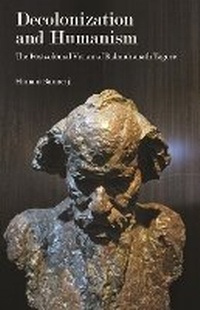
Decolonization and Humanism
The Postcolonial Vision of Rabindranath Tagore
Will be published approx. on 30. April 2024
Book
Hardback
244 pages
978-81-958394-4-5 (ISBN)
Description
The essays in this collection examine the social and political thought of acclaimed poet and writer Rabindranath Tagore (1861-1941). His prose writings, including correspondence, are explored here through a Marxist perspective in order to assess their relevance for current critical and political needs. The collection explores Tagore's understanding of ideas of freedom and decolonization, which have gained urgency in our time. For accomplishing this task, the author examines Tagore's views on nationalism, imperialism, universalist humanism and modernism, suggesting that his version of modernism has great potential for transforming fundamental social relations and forms of consciousness of colonized spaces. Tagore's critical deployment of universalist humanism and modernism are studied in comparison with those of others engaged in postcolonial studies. The essays point out the reasons for Rabindranath's rejection of nationalism and imperialism, and show how he reframes the conventional problematic of decolonization in a dialectic of freedom and subjection.
This collection challenges the postmodernist absorption of the field of postcolonial studies, deeply inflected by Michel Foucault's anti-humanism and deconstructionist discourse analysis. It introduces a clarity in the epistemological confusion present in much of the writings on decolonization, which uneasily combine the general goal of decolonization with a particularism of an anti-modernist view that presents a segmenting culturalist/identitarian approach. It is claimed here that Rabindranath makes a vital contribution to the study of postcolonialism by rescuing the critique of colonization from the telos of postmodernism. He provides us with an understanding of the critical potential of a modernist idealism, generally dismissed as vacuous, rescuing humanism from the connotation of colonial discourse. The essays here affirm the adequacy of Tagore's universalist lens for imagining a utopian horizon which opens up a path towards an unfolding decolonization.
This volume accomplishes its task by critically reflecting on Tagore's writings on the self, pedagogy, patriarchy, human development and alienation. It provides evidence of Tagore's place as a classic, and perhaps the earliest, example of anti-colonial critique globally from within the heart of colonized India.
This collection challenges the postmodernist absorption of the field of postcolonial studies, deeply inflected by Michel Foucault's anti-humanism and deconstructionist discourse analysis. It introduces a clarity in the epistemological confusion present in much of the writings on decolonization, which uneasily combine the general goal of decolonization with a particularism of an anti-modernist view that presents a segmenting culturalist/identitarian approach. It is claimed here that Rabindranath makes a vital contribution to the study of postcolonialism by rescuing the critique of colonization from the telos of postmodernism. He provides us with an understanding of the critical potential of a modernist idealism, generally dismissed as vacuous, rescuing humanism from the connotation of colonial discourse. The essays here affirm the adequacy of Tagore's universalist lens for imagining a utopian horizon which opens up a path towards an unfolding decolonization.
This volume accomplishes its task by critically reflecting on Tagore's writings on the self, pedagogy, patriarchy, human development and alienation. It provides evidence of Tagore's place as a classic, and perhaps the earliest, example of anti-colonial critique globally from within the heart of colonized India.
More details
Language
English
Place of publication
India
Target group
Professional and scholarly
Product notice
Trade binding
Dimensions
Height: 234 mm
Width: 156 mm
ISBN-13
978-81-958394-4-5 (9788195839445)
Copyright in bibliographic data and cover images is held by Nielsen Book Services Limited or by the publishers or by their respective licensors: all rights reserved.
Schweitzer Classification
Person
Himani Bannerji is Professor Emerita, York University, Canada. A Marxist anti-racist feminist, she specializes in ideology critique and historical sociology. Her publications include The Ideological Condition: Selected Essays on History, Race and Gender (nominated for the 2021 Deutscher Memorial Prize), Demography and Democracy: Essays on Nationalism, Gender, and Ideology, and Inventing Subjects: Studies in Hegemony, Patriarchy and Colonialism (recipient of the 2005 Rabindranath Memorial Prize, West Bengal Literary Academy).