

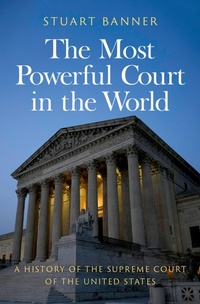
The Most Powerful Court in the World
A History of the Supreme Court of the United States
Published on 27. February 2025
Book
Hardback
672 pages
978-0-19-778035-0 (ISBN)
Description
An authoritative, even-handed, and accessible history of the Supreme Court of the United States, the most powerful court in the world and the final arbiter of the world's oldest constitution.
Will abortion be legal? Should people of the same sex be allowed to marry? May colleges prefer black applicants over white ones? These are among the most bitterly contested issues in the United States today. We answer these questions, and many more, by presenting them to nine lawyers--the justices of the Supreme Court of the United States. No other nation commits so many important questions to its highest court.
Stuart Banner's The Most Powerful Court in the World is an authoritative history of the United States Supreme Court from the Founding era to the present. Not merely a history of the Court's opinions and jurisprudence, it is also a rich account of the Court in the broadest sense--of the sorts of people who become justices and the methods by which they are chosen, of how the Court does its work, and of its relationship with other branches of government. It is about how the Court acquired so much power, how it has retained its power in the face of repeated challenges and criticisms, and what it has done with its power over the years. Rather than praising or criticizing the Court's decisions, Banner makes the case that one cannot fully understand the decisions without knowing about the institution that produced them.
Offering a fresh analytical window into today's contentious debates about the Court--debates that often rest on dubious ideas about the Court's history--The Most Powerful Court in the World helps readers see cases through the justices' eyes.
Will abortion be legal? Should people of the same sex be allowed to marry? May colleges prefer black applicants over white ones? These are among the most bitterly contested issues in the United States today. We answer these questions, and many more, by presenting them to nine lawyers--the justices of the Supreme Court of the United States. No other nation commits so many important questions to its highest court.
Stuart Banner's The Most Powerful Court in the World is an authoritative history of the United States Supreme Court from the Founding era to the present. Not merely a history of the Court's opinions and jurisprudence, it is also a rich account of the Court in the broadest sense--of the sorts of people who become justices and the methods by which they are chosen, of how the Court does its work, and of its relationship with other branches of government. It is about how the Court acquired so much power, how it has retained its power in the face of repeated challenges and criticisms, and what it has done with its power over the years. Rather than praising or criticizing the Court's decisions, Banner makes the case that one cannot fully understand the decisions without knowing about the institution that produced them.
Offering a fresh analytical window into today's contentious debates about the Court--debates that often rest on dubious ideas about the Court's history--The Most Powerful Court in the World helps readers see cases through the justices' eyes.
Reviews / Votes
Stuart Banner, a UCLA law professor, now aims to join accessibility with comprehensiveness - and succeeds admirably. The Most Powerful Court in the World is thorough, nuanced, evenhanded and, above all, eminently readable. * Adam J. White, Wall Street Journal * Stuart Banner's book is a study of the court that situates this institution firmly in both its social and human context. It is also, in my opinion, the most interesting, the most readable, and the most insightful history of the court yet produced. Congratulations goes to Stuart Banner for this tremendous achievement. * Lawrence Friedman, Marion Rice Kirkwood Professor of Law, Emeritus, Stanford Law School * This masterful synthesis manages to be at once erudite, engrossing, enlightening, and entertaining. It is a must-read for anyone interested in the history of the Court and its relationship to American society and politics. * Laura Kalman, Distinguished Research Professor of History, University of California, Santa Barbara * Banner's The Most Powerful Court in the World is a fabulous read for anyone interested in the Supreme Court, whether a nonlawyer, U.S. history buff, law student, or seasoned Supreme Court advocate. Strikingly lucid, always engaging, and remarkably balanced, Banner's account demolishes long-held misconceptions about the Court, reveals the deep historical roots of present-day accusations of the Court's politicization, and enriches the reader with a cornucopia of long forgotten and newly unearthed, eye-popping facts * Richard Lazarus, Charles Stebbins Fairchild Professor of Law, Harvard Law School * Stuart Banner has written the best one-volume history of the Supreme Court now available. One reason is its inclusion of recent decisions of the Supreme Court among the rich array of cases that he incisively assesses. But at least as important is his rich historical analysis of the Court as an institution within the complex matrix of the American political system. I have been teaching about the Supreme Court for half a century, and I am embarrassed to admit how much I learned while reading Banner. Scholars and general readers alike should both enjoy and learn from this rich and well-written book. * Sanford Levinson, W. St. John Garwood and W. St. John Garwood, Jr. Centennial Chair in Law, University of Texas Law School * STARRED REVIEW: Accessible, intelligent, and colorful ... With clear-minded authority, Banner tells the story of a crucial, but misunderstood, part of the constitutional structure. * Kirkus Reviews * This fascinating book by Professor Stuart Banner is about how the court acquired so much power, how it has retained its power in the face of repeated challenges, whether it has been as powerful in practice as in theory, and what it has done with its power over the years. * Kevin McVeigh, Law Society Gazette * UCLA law professor Stuart Banner's new book is simply the finest and most valuable book ever written about the U.S. Supreme Court. * David J. Garrow, Free Beacon * Banner (law, Univ. of California) has written an excellent historical study of the US Supreme Court and its role in American politics. Banner should be commended because this is truly one of the best books available on the highest court in the land. The study is extremely comprehensive, covering all the important justices, case law, appointments or confirmation processes, and how each has evolved throughout American history. The book is remarkably well balanced from an ideological standpoint and is not overburdened by either unnecessary legal jargon or editorial commentary. It is rare to find a book with no real drawbacks and would make a great addition to any library. * B. W. Monroe, CHOICE *More details
Language
English
Place of publication
New York
United States
Target group
Professional and scholarly
Dimensions
Height: 240 mm
Width: 163 mm
Thickness: 47 mm
Weight
1132 gr
ISBN-13
978-0-19-778035-0 (9780197780350)
Copyright in bibliographic data and cover images is held by Nielsen Book Services Limited or by the publishers or by their respective licensors: all rights reserved.
Schweitzer Classification
Other editions
Additional editions
Stuart Banner
The Most Powerful Court in the World
A History of the Supreme Court of the United States
E-Book
10/2024
OUP eBook
€33.99
Available for download
Stuart Banner
The Most Powerful Court in the World
A History of the Supreme Court of the United States
E-Book
10/2024
OUP eBook
€33.99
Available for download
Person
Stuart Banner is the Norman Abrams Distinguished Professor of Law at the University of California, Los Angeles. He is the author of several books about the history of the American legal system, including How the Indians Lost Their Land; The Death Penalty; The Decline of Natural Law; Speculation; The Baseball Trust; and American Property.
Content
Acknowledgments
Introduction
1. Establishing the Court
2. Itinerant Judges on a Part-time Court
3. Federal and State Power
4. Slaves and Indians
5. The Court and the Civil War
6. Life at the Court, 1870-1930
7. The Jim Crow Court
8. The Lochner Era
9. The Birth of the Modern Court
10. Court-Packing and Constitutional Change
11. The Justices at War
12. Desegregation
13. The Liberal Court
14. A Partial Counterrevolution
15. New Paths to the Court
16. Back to the Right
Epilogue
Abbreviations
Notes
Index
Introduction
1. Establishing the Court
2. Itinerant Judges on a Part-time Court
3. Federal and State Power
4. Slaves and Indians
5. The Court and the Civil War
6. Life at the Court, 1870-1930
7. The Jim Crow Court
8. The Lochner Era
9. The Birth of the Modern Court
10. Court-Packing and Constitutional Change
11. The Justices at War
12. Desegregation
13. The Liberal Court
14. A Partial Counterrevolution
15. New Paths to the Court
16. Back to the Right
Epilogue
Abbreviations
Notes
Index