

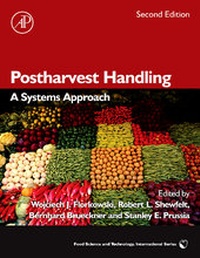
Postharvest Handling
A Systems Approach
2nd Edition
Published on 21. February 2009
Book
Hardback
640 pages
978-0-12-374112-7 (ISBN)
Description
Consideration of the interactions between decisions made at one point in the supply chain and its effects on the subsequent stages is the core concept of a systems approach. Postharvest Handling is unique in its application of this systems approach to the handling of fruits and vegetables, exploring multiple aspects of this important process through chapters written by experts from a variety of backgrounds.Newly updated and revised, this second edition includes coverage of the logistics of fresh produce from multiple perspectives, postharvest handing under varying weather conditions, quality control, changes in consumer eating habits and other factors key to successful postharvest handling.The ideal book for understanding the economic as well as physical impacts of postharvest handling decisions.
More details
Edition
2nd edition
Language
English
Place of publication
San Diego
United States
Publishing group
Elsevier Science Publishing Co Inc
Target group
Professional and scholarly
Postharvest physiologists or technologists across the disciplines of agricultural economics, agricultural engineering, food sciences, and horticulture along with handlers of fresh or minimally processed products within the fresh produce processing industries will find this to be an invaluable resource.
Dimensions
Height: 246 mm
Width: 189 mm
Weight
1500 gr
ISBN-13
978-0-12-374112-7 (9780123741127)
Copyright in bibliographic data and cover images is held by Nielsen Book Services Limited or by the publishers or by their respective licensors: all rights reserved.
Schweitzer Classification
Other editions
New editions
Book
10/2018
3rd Edition
Academic Press
€112.84
The article will not be published
Book
04/2014
3rd Edition
Academic Press
€139.50
Shipment within 15-20 days
Additional editions
E-Book
02/2009
2nd Edition
Academic Press
€108.00
Available for download
Persons
Nigel Banks worked as a Professor of Postharvest Technology at Massey University and at ZESPRI as General Manager for Innovation, where he learned branding, growers, consumers, ways to connect them and the added value of an outstanding team. Through Postharvest.Co, Nigel is exploring new ways to connect postharvesters, art, online tools and learning with an eye to the increasingly pressing needs of our future world. Wojciech J. Florkowski has over 18 years of experience in research, project management, and training. His areas of specialization and expertise include agricultural economics and international business with emphasis on marketing and consumer studies, technology transfer and assessment, environmental policy analysis, and research policy. He is the author of over 200 publications on a variety of economic, marketing, consumer and policy issues, including the problems of agricultural productivity, policy, consumer willingness-to-pay and price behavior. He?co-edited?"Postharvest?Handling: A Systems Approach? (3rd edition) Robert L Shewfelt is Professor Emeritus of Food Science and Technology, University of Georgia. He advises more than 50 students and has taught 11 different courses in the past two years ranging from Freshman Seminars in Chocolate Science and Coffee Technology to graduate-level courses in Food Research & the Scientific Method. Dr. Shewfelt was also the 2006 recipient of the Cruess Award for Excellence in Teaching of IFT. He?co-edited?"Postharvest?Handling: A Systems Approach? (3rd edition)
Content
Systems Approach to Postharvest Handling; Business Models of Fresh Produce in the United States; Challenges in Handling Fresh Fruits and Vegetables; Preharvest Physiological and Cultural Effects on Postharvest Quality; Measuring Quality and Maturity; Microbial Quality; Testing and Measuring Consumer Acceptance; Modeling Quality Characteristics; Visual Inspection and Sorting: Finding Poor Quality Before the Consumer Does; Latent Damage: A Systems Perspective; Nondestructive Evaluation: Detection of External and Internal Attributes Frequently Associated with Quality or Damage; Stress Physiology: A Cellular Approach to Quality; Logistics of Fresh Produce: Implications for Quality; Postharvest Handling Under Extreme Weather Conditions; Postharvest Handling of Locally Grown Produce; Refrigeration of Fresh Produce From Field to Home: Logistics and Refrigeration and the Refrigerator; Challenges in Quality of Organic Produce; The Shrinking System: Quality Specificity of Fresh Cut Vegetables and Fruit; Tropical Fresh Fruit: Quality Challenge; Food Safety: Food Safety and Product Integrity in Critical Points Within the Production and Distribution System; Quality Management: An Industrial Approach ot Produce Handling; Produce Marketing: New Techniques At the Supermarket; Consumer Eating Habits and Fresh Produce Quality; Genetic Modification Improvements in Fresh Produce Quality: Implications for Systems Approach; Quality of Fresh Produce and Public Health; Regulation of Fresh Produce Postharvest HAndling; Interdisciplinary Solutions to Challenges in Postharvest Handling