

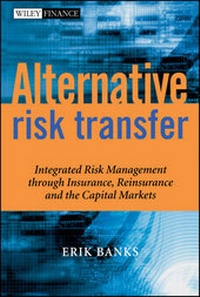
Alternative Risk Transfer
Integrated Risk Management through Insurance, Reinsurance, and the Capital Markets
Published on 27. January 2004
Book
Hardback
238 pages
978-0-470-85745-8 (ISBN)
Description
A practical approach to ART-an alternative method by which companies take on various types of risk
This comprehensive book shows readers what ART is, how it can be used to mitigate risk, and how certain instruments/structures associated with ART should be implemented. Through numerous examples and case studies, readers will learn what actually works and what doesn't when using this technique.
Erik Banks (CT) joined XL Capital's weather/energy risk management subsidiary, Element Re, as a Partner and Chief Risk Officer in 2001.
More details
Other editions
Additional editions
Erik Banks
Alternative Risk Transfer
Integrated Risk Management through Insurance, Reinsurance, and the Capital Markets
E-Book
06/2004
Wiley
€90.99
Available for download
Person
ERIK BANKS has held senior risk management positions at several global financial institutions, including XL Capital, where he was Partner and Chief Risk Officer of the Bermuda reinsurer's derivative subsidiary, and Merrill Lynch, where he spent 13 years managing credit and market risk teams in Tokyo, Hong Kong, London and New York. Mr. Banks has written various books on risk management, emerging markets, derivatives, merchant banking, and electronic finance.
Content
Acknowledgements.
Biography.
PART I: RISK AND THE ART MARKET.
1 Overview of Risk Management.
1.1 Risk and return.
1.2 Active risk management.
1.3 Risk concepts.
1.4 Outline of the book.
2 Risk Management Drivers: Theoretical Motivations, Benefits, and Costs.
2.1 Maximizing enterprise value.
2.2 The decision framework.
2.3 Coping with market cycles.
2.4 Accessing new risk capacity.
2.5 Diversifying the credit risk of intermediaries.
2.6 Managing enterprise risks intelligently.
2.7 Reducing taxes.
2.8 Overcoming regulatory barriers.
2.9 Capitalizing on deregulation.
3 The ART Market and its Participants.
3.1 A definition of ART.
3.2 Origins and background of ART.
3.3 Market participants.
3.4 Product and market convergence.
PART II: INSURANCE AND REINSURANCE.
4 Primary Insurance/Reinsurance Contracts.
4.1 Insurance concepts.
4.2 Insurance and loss financing.
4.3 Primary insurance contracts.
4.4 Reinsurance and retrocession contracts.
5 Captives.
5.1 Using captives to retain risks.
5.2 Forms of captives.
5.3 Tax consequences.
6 Multi-risk Products.
6.1 Multiple peril products.
6.2 Multiple trigger products.
PART III: CAPITAL MARKETS.
7 Capital Markets Issues and Securitization.
7.1 Overview of securitization.
7.2 Insurance-linked securities.
7.3 Structural features.
7.4 Catastrophe bonds.
7.5 Other insurance-linked securities.
8 Contingent Capital Structures.
8.1 Creating post-loss financing products.
8.2 Contingent debt.
8.3 Contingent equity.
9 Insurance Derivatives.
9.1 Derivatives and ART.
9.2 General characteristics of derivatives.
9.3 Exchange-traded insurance derivatives.
9.4 OTC insurance derivatives.
9.5 Bermuda transformers and capital markets subsidiaries.
PART IV: ART OF THE FUTURE.
10 Enterprise Risk Management.
10.1 Combining risks.
10.2 Developing an enterprise risk management program.
10.3 End-user demand.
11 Prospects for Growth.
11.1 Drivers of growth.
11.2 Barriers to growth.
11.3 Market segments.
11.4 End-user profiles.
11.5 Future convergence.
Glossary.
Selected References.
Index.