

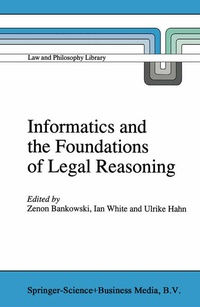
Informatics and the Foundations of Legal Reasoning
Published on 30. April 1995
Book
Hardback
XIV, 376 pages
978-0-7923-3455-2 (ISBN)
Description
Informatics and the Foundations of Legal Reasoning
represents a close collaboration between a wide range of disciplines and countries. Fourteen papers, together with a long analytical introduction by the editors, were selected from the contributions of legal theorists, computer scientists, philosophers and logicians who were members of an International Working Group supported by the European Commission. The Group was mandated to work towards determining how far the law is amenable to formal modeling, and in what ways computers might assist legal thinking and practice. The book is the result of discussions held by the Group over two and half years. It will help students and researchers from different backgrounds to focus on a common set of topics of increasing general interest. It embodies the results of work in progress and suggests many issues for further discussion.
A stimulating text for undergraduate and graduate courses in law, philosophy and computer science departments, as well as for those interested in the place of computers in legal practice, especially at the international level.
A stimulating text for undergraduate and graduate courses in law, philosophy and computer science departments, as well as for those interested in the place of computers in legal practice, especially at the international level.
More details
Series
Edition
1995 ed.
Language
English
Place of publication
Dordrecht
Netherlands
Target group
Professional and scholarly
Research
Illustrations
XIV, 376 p.
Dimensions
Height: 241 mm
Width: 160 mm
Thickness: 26 mm
Weight
758 gr
ISBN-13
978-0-7923-3455-2 (9780792334552)
DOI
10.1007/978-94-015-8531-6
Schweitzer Classification
Other editions
Additional editions
Z. Bankowski | I. White | Ulrike Hahn
Informatics and the Foundations of Legal Reasoning
Book
10/2010
Springer
€213.99
Shipment within 15-20 days
Content
Policy Arguments and Legal Reasoning.- Defeasibility in Law and Logic.- Defeasibility in Legal Reasoning.- On Some Problems of the Theory of Legal Argumentation.- Analogical Reasoning and Legal Institutions.- The Redundancy of Reasoning.- Ontology and Dimension in Legal Reasoning.- Common Law Concepts: The Problem of Indefinability.- Formalization, Invention, Justification.- On the Rôle of Deontic Logic in the Characterization of Normative Systems.- AI, Legal Theory and EC Law: A Mapping of the Main Problems.- Building an Intestate Succession Adviser: Compartmentalisation and Creativity in Decision Support Systems.- Legislation as Logic Programs.- Using Information Technology as a Determiner of Legal Facts.