

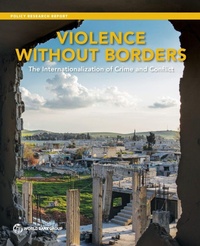
Violence Without Borders
The Internationalization of Crime and Conflict
Published on 30. June 2020
Book
Paperback/Softback
144 pages
978-1-4648-1452-5 (ISBN)
Description
Just like nearly every aspect of human experience, crime, conflict, and violence have become increasingly global. Around the world, civil wars, of which there are more today than at any time since the end of World War II, displace greater numbers of people ever farther from their countries of origin. Transnational terrorism has reached a 50-year high, in terms of both its incidence and the number of reported fatalities. Cross-border criminal markets--illicit drugs, human trafficking, wildlife trade, and so forth--take a heavy toll on the many societies they affect.This Policy Research Report, Violence without Borders: The Internationalization of Crime and Conflict, offers a unified framework to take stock of the theoretical and empirical literature on crime, conflict, and violence and to discuss how the international community organizes itself to address security as a regional and global public good. The increasingly global effects of crime and conflict require an equally global response to violence.
More details
Series
Language
English
Place of publication
Washington
United States
Target group
Professional and scholarly
Product notice
Paperback (trade)
Unsewn / adhesive bound
Dimensions
Height: 235 mm
Width: 191 mm
Thickness: 8 mm
Weight
259 gr
ISBN-13
978-1-4648-1452-5 (9781464814525)
Copyright in bibliographic data and cover images is held by Nielsen Book Services Limited or by the publishers or by their respective licensors: all rights reserved.
Schweitzer Classification
Person
The World Bank came into formal existence in 1945 following the international ratification of the Bretton Woods agreements. It is a vital source of financial and technical assistance to developing countries around the world. The organization's activities are focused on education, health, agriculture and rural development, environmental protection, establishing and enforcing regulations, infrastructure development, governance and legal institutions development. The World Bank is made up of two unique development institutions owned by its 185 Member Countries. The International Bank for Reconstruction and Development (IBRD) focuses on middle income and creditworthy poor countries and the International Development Association (IDA), which focuses on the poorest countries in the world.