

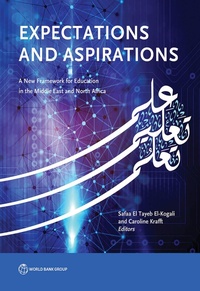
Expectations and Aspirations
A New Framework for Education in the Middle East and North Africa
Published on 21. October 2019
Book
Paperback/Softback
200 pages
978-1-4648-1234-7 (ISBN)
Description
Over centuries, the Middle East and North Africa (MENA) region has been the birthplace of some of the world's greatest civilizations. Despite recent setbacks, the region once again can become an engine of intellectual, economic, and social progress for individuals as well as societies. To succeed, education must regain its role as the main driver of knowledge, skills, and innovation.
Unleashing the Potential of Education in the Middle East and North Africa highlights two missing factors that have held back the region's educational potential. First is the lack of a "push" at the outset of educational systems to build solid foundations for children's learning. Continued underinvestment in early schooling has resulted in weak and delayed acquisition of literacy, numeracy, and socioemotional skills from which it is difficult to catch up. The second factor is the lack of a "pull" on education systems from the labour market and society to demand the skills that would enable children to succeed later in life. This missing pull factor creates a cycle in which labour markets, society, and educational systems focus on credentials rather than on skills.
Overcoming these obstacles of the missing push and pull is well within the control of countries' policy makers, stakeholders, and individuals. The report lays out a road map to modernise education in MENA to meet the hopes and aspirations of the region's people and governments. To address these push and pull factors, countries will need to strengthen their focus on learning rather than on memorising and develop all students' foundational skills for continued learning. Countries urgently need to develop skills required by labour markets. Societies need to shift to valuing skills over credentials. Making these changes will help to unleash the potential of education to lead to peace and shard prosperity in the twenty-first century.
Unleashing the Potential of Education in the Middle East and North Africa highlights two missing factors that have held back the region's educational potential. First is the lack of a "push" at the outset of educational systems to build solid foundations for children's learning. Continued underinvestment in early schooling has resulted in weak and delayed acquisition of literacy, numeracy, and socioemotional skills from which it is difficult to catch up. The second factor is the lack of a "pull" on education systems from the labour market and society to demand the skills that would enable children to succeed later in life. This missing pull factor creates a cycle in which labour markets, society, and educational systems focus on credentials rather than on skills.
Overcoming these obstacles of the missing push and pull is well within the control of countries' policy makers, stakeholders, and individuals. The report lays out a road map to modernise education in MENA to meet the hopes and aspirations of the region's people and governments. To address these push and pull factors, countries will need to strengthen their focus on learning rather than on memorising and develop all students' foundational skills for continued learning. Countries urgently need to develop skills required by labour markets. Societies need to shift to valuing skills over credentials. Making these changes will help to unleash the potential of education to lead to peace and shard prosperity in the twenty-first century.
More details
Language
English
Place of publication
Washington
United States
Target group
Professional and scholarly
Product notice
Paperback (trade)
Unsewn / adhesive bound
Dimensions
Height: 264 mm
Width: 203 mm
Thickness: 20 mm
Weight
839 gr
ISBN-13
978-1-4648-1234-7 (9781464812347)
Copyright in bibliographic data and cover images is held by Nielsen Book Services Limited or by the publishers or by their respective licensors: all rights reserved.
Schweitzer Classification
Persons
The World Bank came into formal existence in 1945 following the international ratification of the Bretton Woods agreements. It is a vital source of financial and technical assistance to developing countries around the world. The organization's activities are focused on education, health, agriculture and rural development, environmental protection, establishing and enforcing regulations, infrastructure development, governance and legal institutions development. The World Bank is made up of two unique development institutions owned by its 185 Member Countries. The International Bank for Reconstruction and Development (IBRD) focuses on middle income and creditworthy poor countries and the International Development Association (IDA), which focuses on the poorest countries in the world.