

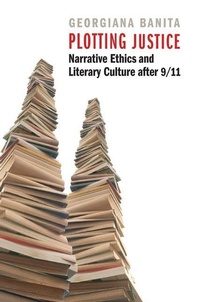
Plotting Justice
Narrative Ethics and Literary Culture After 9/11
Published on 1. October 2012
Book
Hardback
376 pages
978-0-8032-4038-4 (ISBN)
Description
Have the terrorist attacks of September 11 shifted the moral coordinates of contemporary fiction? And how might such a shift, reflected in narrative strategies and forms, relate to other themes and trends emerging with the globalization of literature? This book pursues these questions through works written in the wake of 9/11 and examines the complex intersection of ethics and narrative that has defined a significant portion of British and American fiction over the past decade.
Don DeLillo, Pat Barker, Aleksandar Hemon, Lorraine Adams, Michael Cunningham, and Patrick McGrath are among the authors Georgiana Banita considers. Their work illustrates how post-9/11 literature expresses an ethics of equivocation-in formal elements of narrative, in a complex scrutiny of justice, and in tense dialogues linking this fiction with the larger political landscape of the era. Through a broad historical and cultural lens, Plotting Justice reveals links between the narrative ethics of post-9/11 fiction and events preceding and following the terrorist attacks-events that defined the last half of the twentieth century, from the Holocaust to the Balkan War, and those that 9/11 precipitated, from war in Afghanistan to the Abu Ghraib scandal. Challenging the rhetoric of the war on terror, the book honors the capacity of literature to articulate ambiguous forms of resistance in ways that reconfigure the imperatives and responsibilities of narrative for the twenty-first century.
Don DeLillo, Pat Barker, Aleksandar Hemon, Lorraine Adams, Michael Cunningham, and Patrick McGrath are among the authors Georgiana Banita considers. Their work illustrates how post-9/11 literature expresses an ethics of equivocation-in formal elements of narrative, in a complex scrutiny of justice, and in tense dialogues linking this fiction with the larger political landscape of the era. Through a broad historical and cultural lens, Plotting Justice reveals links between the narrative ethics of post-9/11 fiction and events preceding and following the terrorist attacks-events that defined the last half of the twentieth century, from the Holocaust to the Balkan War, and those that 9/11 precipitated, from war in Afghanistan to the Abu Ghraib scandal. Challenging the rhetoric of the war on terror, the book honors the capacity of literature to articulate ambiguous forms of resistance in ways that reconfigure the imperatives and responsibilities of narrative for the twenty-first century.
Reviews / Votes
"Part narrative theory, part ethical analysis, this book offers a well-written conceptual examination of the juncture between fiction and morality in the literature written in the wake of 9/11."-E. T. Mason, CHOICE "Banita's book makes an important contribution to scholarship on post-9/11 literature."-Clemens Spahr, NOVEL "With great breadth and power, Banita's Plotting Justice will be of interest to scholars concerned with discussion of narrative ethics, but also to scholars interested in the specific narrative strategies and themes that emerge in post-9/11 fiction."-James Gifford, The Year's Work in English StudiesMore details
Language
English
Place of publication
Lincoln
United States
Target group
Professional and scholarly
Product notice
Cloth over boards
Dimensions
Height: 236 mm
Width: 159 mm
Thickness: 32 mm
Weight
700 gr
ISBN-13
978-0-8032-4038-4 (9780803240384)
Copyright in bibliographic data and cover images is held by Nielsen Book Services Limited or by the publishers or by their respective licensors: all rights reserved.
Schweitzer Classification
Person
Georgiana Banita is an assistant professor of North American literature and media at the University of Bamberg and Honorary Research Fellow at the United States Studies Centre, University of Sydney.
Content
Acknowledgments
Introduction: New Ethics, New Literatures, New Americas
1. Falling Man Fiction: DeLillo, Spiegelman, Schulman, and the Spectatorial Condition
2. Sex and Sense: McGrath, Tristram, and Psychoanalysis from Ground Zero to Abu Ghraib
3. Moral Crusades: Race, Risk, and Walt Whitman's Afterlives
4. The Internationalization of Conscience: Hemon, Barker, Balkanism
5. Reading for the Pattern: Narrative, Data Mining, and the Transnational Ethics of Surveillance
Conclusion: Postincendiary Circumstances
Notes
Bibliography
Index
Introduction: New Ethics, New Literatures, New Americas
1. Falling Man Fiction: DeLillo, Spiegelman, Schulman, and the Spectatorial Condition
2. Sex and Sense: McGrath, Tristram, and Psychoanalysis from Ground Zero to Abu Ghraib
3. Moral Crusades: Race, Risk, and Walt Whitman's Afterlives
4. The Internationalization of Conscience: Hemon, Barker, Balkanism
5. Reading for the Pattern: Narrative, Data Mining, and the Transnational Ethics of Surveillance
Conclusion: Postincendiary Circumstances
Notes
Bibliography
Index