

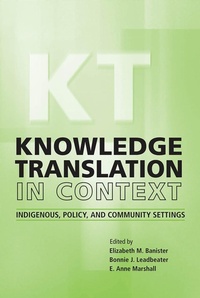
Knowledge Translation in Context
Indigenous, Policy, and Community Settings
Published on 16. May 2019
Book
Paperback/Softback
216 pages
978-1-4875-2473-9 (ISBN)
Description
The main goal of knowledge translation (KT) is to ensure that diverse communities benefit from academic research results through improved social and health outcomes. But despite growing interest in researcher-user collaborations, little is known about what makes or breaks these types of relationships. Knowledge Translation in Context is an essential tool for researchers to learn how to be effective partners in the KT process.
Drawing on expertise and studies from across the globe, Elizabeth Banister, Bonnie Leadbeater, and Anne Marshall outline a variety of perspectives on KT processes. Case studies outline the uses of KT in many contexts, including community, policy, Indigenous, and non-profit organizations. While recognizing the specificity of each situation, Knowledge Translation in Context highlights the most important elements that have led KT to succeed (or fail) as a dynamic, multidirectional process.
Drawing on expertise and studies from across the globe, Elizabeth Banister, Bonnie Leadbeater, and Anne Marshall outline a variety of perspectives on KT processes. Case studies outline the uses of KT in many contexts, including community, policy, Indigenous, and non-profit organizations. While recognizing the specificity of each situation, Knowledge Translation in Context highlights the most important elements that have led KT to succeed (or fail) as a dynamic, multidirectional process.
Reviews / Votes
'This should be on the reading list of every practitioner or academic involved in community based quality improvement initiatives that attempt to bridge the ''knowing-doing'' gap.' - Minakshi Sharma (Journal of Canadian Health Libraries Association April 2014)More details
Language
English
Place of publication
Toronto
Canada
Target group
College/higher education
Professional and scholarly
Product notice
Paperback (trade)
Dimensions
Height: 229 mm
Width: 152 mm
Thickness: 13 mm
Weight
336 gr
ISBN-13
978-1-4875-2473-9 (9781487524739)
Copyright in bibliographic data and cover images is held by Nielsen Book Services Limited or by the publishers or by their respective licensors: all rights reserved.
Schweitzer Classification
Persons
Elizabeth M. Banister is a professor in the School of Nursing at the University of Victoria.
Bonnie J. Leadbeater is a professor in the Department of Psychology at the University of Victoria.
E. Anne Marshall is a professor in the Department of Educational Psychology and Leadership Studies at the University of Victoria.
Bonnie J. Leadbeater is a professor in the Department of Psychology at the University of Victoria.
E. Anne Marshall is a professor in the Department of Educational Psychology and Leadership Studies at the University of Victoria.
Content
Foreword by Budd Dall
Acknowledgments
Introduction: How-What-We-Know-Becomes-More-Widely-Known: Is Context Dependent and Culturally Sensitive by Bonnie J. Leadbeater, Elizabeth M. Banister, and E. Anne Marshall (all University of Victoria)
PART ONE: Knowledge Translation in Community-University Contexts
Developing Knowledge Transfer with Non-profit Organizations Serving Vulnerable Populations by Cecilia Benoit (University of Victoria), Lauren Casey (Canadian National Coalition of Experiental Women), Mikael Jansson (University of Victoria), Rachel Phillips (University of Victoria), and David Burns (Child and Family Counselling Association)
Cross-Cultural Journeys: Transferring and Exchanging Knowledge among Researchers and Community Partners by E. Anne Marshall and Francis Guenette (University of Victoria)
Using Evaluative Inquiry to Generate Knowledge about the Quality and Value of Community Initiatives by Kate Mckegg (University of Auckland)
Knowledge Translation Processes in Developing a Community-Based Evaluation Toolkit by Joan Wharf Higgins (University of Victoria), Patti-Jean Naylor (University of Victoria), Heather Macleod Williams (MTM Research and Associates), and Trina Sporer (BC Recreation and Parks Association)
Contents
PART TWO: Knowledge Translation in Policy Contexts
Sharing Knowledge for Policy: The Role of Science Organizations as Knowledge Brokers by Mary Ann Mccabe (George Washington University School of Medicine)
Knowledge Translation at the Political Level: Bridging the Policy Research to Policy Practice Gap by Simon Lenton (Curtin University of Technology, Australia)
User-Led Reviews of Research Knowledge: Enhancing Relevance and Reception by David A. Gough (University of London)
PART THREE: Knowledge Translation in Indigenous Contexts
Knowledge Translation and Adolescent Girls' Sexual Health Education in Indigenous Communities by Deborah L. Begoray (University of Victoria) and Elizabeth M. Banister (University of Victoria)
Knowledge Transfer and Indigenous Research by Helen Moewaka Barnes, Wendy Henwood, Sandy Kerr, Verne, Mcmanus, and Tim Mccreanor (all Massey University , Auckland)
Knowledge Translation and Indigenous Communities: A Decolonizing Perspective by Janet K. Smylie (University of Toronto)
Concluding Thoughts by Elizabeth M. Banister, Bonnie J. Leadbeater, and E. Anne Marshall
Contributors
Acknowledgments
Introduction: How-What-We-Know-Becomes-More-Widely-Known: Is Context Dependent and Culturally Sensitive by Bonnie J. Leadbeater, Elizabeth M. Banister, and E. Anne Marshall (all University of Victoria)
PART ONE: Knowledge Translation in Community-University Contexts
Developing Knowledge Transfer with Non-profit Organizations Serving Vulnerable Populations by Cecilia Benoit (University of Victoria), Lauren Casey (Canadian National Coalition of Experiental Women), Mikael Jansson (University of Victoria), Rachel Phillips (University of Victoria), and David Burns (Child and Family Counselling Association)
Cross-Cultural Journeys: Transferring and Exchanging Knowledge among Researchers and Community Partners by E. Anne Marshall and Francis Guenette (University of Victoria)
Using Evaluative Inquiry to Generate Knowledge about the Quality and Value of Community Initiatives by Kate Mckegg (University of Auckland)
Knowledge Translation Processes in Developing a Community-Based Evaluation Toolkit by Joan Wharf Higgins (University of Victoria), Patti-Jean Naylor (University of Victoria), Heather Macleod Williams (MTM Research and Associates), and Trina Sporer (BC Recreation and Parks Association)
Contents
PART TWO: Knowledge Translation in Policy Contexts
Sharing Knowledge for Policy: The Role of Science Organizations as Knowledge Brokers by Mary Ann Mccabe (George Washington University School of Medicine)
Knowledge Translation at the Political Level: Bridging the Policy Research to Policy Practice Gap by Simon Lenton (Curtin University of Technology, Australia)
User-Led Reviews of Research Knowledge: Enhancing Relevance and Reception by David A. Gough (University of London)
PART THREE: Knowledge Translation in Indigenous Contexts
Knowledge Translation and Adolescent Girls' Sexual Health Education in Indigenous Communities by Deborah L. Begoray (University of Victoria) and Elizabeth M. Banister (University of Victoria)
Knowledge Transfer and Indigenous Research by Helen Moewaka Barnes, Wendy Henwood, Sandy Kerr, Verne, Mcmanus, and Tim Mccreanor (all Massey University , Auckland)
Knowledge Translation and Indigenous Communities: A Decolonizing Perspective by Janet K. Smylie (University of Toronto)
Concluding Thoughts by Elizabeth M. Banister, Bonnie J. Leadbeater, and E. Anne Marshall
Contributors