

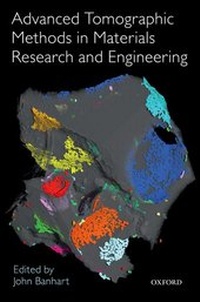
Advanced Tomographic Methods in Materials Research and Engineering
Published on 20. March 2008
Book
Hardback
490 pages
978-0-19-921324-5 (ISBN)
Description
Tomography provides three-dimensional images of heterogeneous materials or engineering components, and offers an unprecedented insight into their internal structure. By using X-rays generated by synchrotrons, neutrons from nuclear reactors, or electrons provided by transmission electron microscopes, hitherto invisible structures can be revealed which are not accessible to conventional tomography based on X-ray tubes.
This book is mainly written for applied physicists, materials scientists and engineers. It provides detailed descriptions of the recent developments in this field, especially the extension of tomography to materials research and engineering. The book is grouped into four parts: a general introduction into the principles of tomography, image analysis and the interactions between radiation and matter, and one part each for synchrotron X-ray tomography, neutron tomography, and electron tomography. Within these parts, individual chapters written by different authors describe important versions of tomography, and also provide examples of applications to demonstrate the capacity of the methods. The accompanying CD-ROM contains some typical data sets and programs to reconstruct, analyse and visualise the three-dimensional data.
This book is mainly written for applied physicists, materials scientists and engineers. It provides detailed descriptions of the recent developments in this field, especially the extension of tomography to materials research and engineering. The book is grouped into four parts: a general introduction into the principles of tomography, image analysis and the interactions between radiation and matter, and one part each for synchrotron X-ray tomography, neutron tomography, and electron tomography. Within these parts, individual chapters written by different authors describe important versions of tomography, and also provide examples of applications to demonstrate the capacity of the methods. The accompanying CD-ROM contains some typical data sets and programs to reconstruct, analyse and visualise the three-dimensional data.
More details
Series
Language
English
Place of publication
Oxford
United Kingdom
Target group
Professional and scholarly
Illustrations
233 halftones and line drawings, 4 page colour plate section
Dimensions
Height: 240 mm
Width: 162 mm
Thickness: 25 mm
Weight
955 gr
ISBN-13
978-0-19-921324-5 (9780199213245)
Copyright in bibliographic data and cover images is held by Nielsen Book Services Limited or by the publishers or by their respective licensors: all rights reserved.
Schweitzer Classification
Person
John Banhart - Editor
Professor for Materials Science at Technical University Berlin and
Head of the Department of Materials Research at Hahn-Meitner Institute Berlin
1984: Degree in Physics, University of Munich
1989: PhD in Physical Chemistry, University of Munich
1990: Postdoc at University of Vienna
1998: Habilitation (2nd PhD) in Solid State Physics, University of Bremen
1991-2001: Senior Scientist at Fraunhofer-Institute for Materials Research Bremen
2002: Current Position
Professor for Materials Science at Technical University Berlin and
Head of the Department of Materials Research at Hahn-Meitner Institute Berlin
1984: Degree in Physics, University of Munich
1989: PhD in Physical Chemistry, University of Munich
1990: Postdoc at University of Vienna
1998: Habilitation (2nd PhD) in Solid State Physics, University of Bremen
1991-2001: Senior Scientist at Fraunhofer-Institute for Materials Research Bremen
2002: Current Position
Content
1. Introduction ; 2. Some Mathematical Concepts for Tomographic Reconstruction ; 3. Visualisation, Processing and Analysis of Tomographic Data ; 4. Radiation Sources and Interaction of Radiation with Matter ; 5. Synchrotron X-ray Absorption Tomography ; 6. Phase Contrast and Holographic Tomography ; 7. Tomography using magnifying optics ; 8. Scanning Tomography ; 9. Three-dimensional X-ray Diffraction ; 10. Detectors for Synchrotron Tomography ; 11. Fundamentals of Electron Tomography ; 12. Applications of Electron Tomography ; 13. Neutron Absorption Tomography ; 14. Neutron Phase Contrast and Polarised Neutron Tomography ; 15. Neutron Refraction and Small-Angle Scattering Tomography ; Appendix A: Facilities for Tomography ; Appendix B: Examples on CDROM