

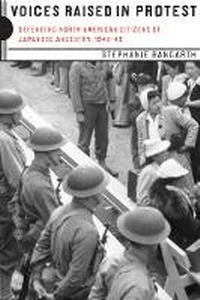
Voices Raised in Protest
Defending North American Citizens of Japanese Ancestry, 1942-49
Will be published approx. on 1. July 2008
Book
Paperback/Softback
296 pages
978-0-7748-1416-4 (ISBN)
Description
The uprooting and confinement of Japanese Americans and Japanese Canadians during the Second World War constituted the worst violations of citizenship rights in twentieth-century North America. Voices Raised in Protest examines the meaning and impact of these actions and how they diverged in Canada and the United States.
Many North Americans opposed their governments' wartime policies toward their fellow citizens of Japanese extraction. In this timely book, Stephanie Bangarth studies the efforts and discourse of anti-internment advocates, and discusses the various cases they brought before the courts. Persons of Japanese ancestry were also active in their own defence. Their critiques of the removal and deportation policies were seminal examples of a growing general interest in civil rights, and would provide a foundation for rights activism in subsequent years.
Voices Raised in Protest offers valuable perspective for today's debates over ethnic and racial profiling, treatment of "enemy combatants," and tensions between civil-liberty and security imperatives. It will be of interest to activists and general readers as well as to scholars and students in history, law, politics, and Asian Canadian/American studies.
Many North Americans opposed their governments' wartime policies toward their fellow citizens of Japanese extraction. In this timely book, Stephanie Bangarth studies the efforts and discourse of anti-internment advocates, and discusses the various cases they brought before the courts. Persons of Japanese ancestry were also active in their own defence. Their critiques of the removal and deportation policies were seminal examples of a growing general interest in civil rights, and would provide a foundation for rights activism in subsequent years.
Voices Raised in Protest offers valuable perspective for today's debates over ethnic and racial profiling, treatment of "enemy combatants," and tensions between civil-liberty and security imperatives. It will be of interest to activists and general readers as well as to scholars and students in history, law, politics, and Asian Canadian/American studies.
Reviews / Votes
The greatest significance of Bangarth's book is that is compares and contrasts the evacuation, internment, and relocation of the Nikkei in the US and Canada. [...] This thoroughly researched book draws from a wide range of sources that all illustrate the various ways in which observers and participants protested and defended the evacuation and relocation of the Nikkei. [...] Overall, a useful addition to internment historiography. - J.T. Rasel, Air Force Research Laboratory (Choice, Vol.46, No.02)More details
Language
English
Place of publication
Vancouver
Canada
Target group
Professional and scholarly
Product notice
Paperback (trade)
Illustrations
13 illustrations, 1 map
Dimensions
Height: 229 mm
Width: 152 mm
Weight
440 gr
ISBN-13
978-0-7748-1416-4 (9780774814164)
Copyright in bibliographic data and cover images is held by Nielsen Book Services Limited or by the publishers or by their respective licensors: all rights reserved.
Schweitzer Classification
Person
Stephanie Bangarth is an assistant professor of history at King's University College at The University of Western Ontario.
Content
Introduction
1 A Practicable Coincidence of Policies?
2 The CCJC and the ACLU: Engaging Debate, 1942-1946
3 "Dear Friend": Advocacy Expanded
4 Advancing Their Rights: Minorities and Advocacy
5 "The war is over. Long live the war!" Legal Battles to Obtain Justice during and after the Second World War
6 Conclusion: "They Made Democracy Work"
Afterword
Appendices
Notes
Bibliography
Index
1 A Practicable Coincidence of Policies?
2 The CCJC and the ACLU: Engaging Debate, 1942-1946
3 "Dear Friend": Advocacy Expanded
4 Advancing Their Rights: Minorities and Advocacy
5 "The war is over. Long live the war!" Legal Battles to Obtain Justice during and after the Second World War
6 Conclusion: "They Made Democracy Work"
Afterword
Appendices
Notes
Bibliography
Index