

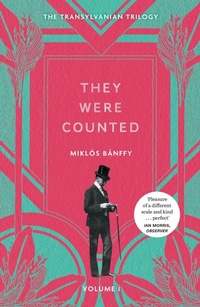
They Were Counted
The Transylvanian Trilogy, Volume I
Published on 26. September 2024
Book
Paperback/Softback
656 pages
978-1-5294-3466-8 (ISBN)
Description
"Perfect late night reading" JAN MORRIS
"Banffy is a born storyteller" PATRICK LEIGH FERMOR
"Totally absorbing" MARTHA KEARNEY
"So evocative" SIMON JENKINS
An extraordinary portrait of the vanished world of pre-1914 Hungary, They Were Counted is an epic story told through the eyes of two cousins, Count Balint Abady and Count Laszlo Gyeroffy. Shooting parties in great country houses, turbulent scenes in parliament and the luxury life in Budapest provide the backdrop for this gripping, prescient novel, forming a chilling indictment of upper-class frivolity and political folly in which good manners cloak indifference and brutality. Abady becomes aware of the plight of a group of Romanian mountain peasants and champions their cause, while Gyeroffy dissipates his resources at the gaming tables, mirroring the decline of the Austro-Hungarian empire itself.
This is the first volume Banffy's trilogy, which continues with They Were Found Wanting and They Were Divided. It was rediscovered for an international readership after the fall of communism in Hungary.
With a Foreword by Patrick Leigh-Fermor
Translated from Hungarian by Patrick Thursfield and Katalin Banffy-Jelen
WINNER OF THE WEIDENFELD TRANSLATION PRIZE
"Banffy is a born storyteller" PATRICK LEIGH FERMOR
"Totally absorbing" MARTHA KEARNEY
"So evocative" SIMON JENKINS
An extraordinary portrait of the vanished world of pre-1914 Hungary, They Were Counted is an epic story told through the eyes of two cousins, Count Balint Abady and Count Laszlo Gyeroffy. Shooting parties in great country houses, turbulent scenes in parliament and the luxury life in Budapest provide the backdrop for this gripping, prescient novel, forming a chilling indictment of upper-class frivolity and political folly in which good manners cloak indifference and brutality. Abady becomes aware of the plight of a group of Romanian mountain peasants and champions their cause, while Gyeroffy dissipates his resources at the gaming tables, mirroring the decline of the Austro-Hungarian empire itself.
This is the first volume Banffy's trilogy, which continues with They Were Found Wanting and They Were Divided. It was rediscovered for an international readership after the fall of communism in Hungary.
With a Foreword by Patrick Leigh-Fermor
Translated from Hungarian by Patrick Thursfield and Katalin Banffy-Jelen
WINNER OF THE WEIDENFELD TRANSLATION PRIZE
Reviews / Votes
Just about as good as any fiction I have ever read, like Anna Karenina and War and Peace rolled into one. Love, sex, town, country, money, power, beauty, and the pathos of a society which cannot prevent its own destruction - all are here -- Charles Moore * Daily Telegraph * Fascinating. He writes about his quirky border lairds and squires and the high misty forest ridges and valleys of Transylvania with something of the ache that Czeslaw Milosz brings to the contemplation of this lost Eden -- W. L. Webb * Guardian * Pleasure of a different scale and kind. It is a sort of Galworthian panorama of life in the dying years of the Habsburg Empire - perfect late night reading for nostalgic romantics like me -- Jan Morris * Observer "Books of the Year" * Full of arresting descriptions, beautiful evocations of scenery and wise political and moral insights -- Francis King * Spectator * So enjoyable, so irresistible, it is the author's keen political intelligence and refusal to indulge in self-deception which give it an unusual distinction. It's a novel that, read at the gallop for sheer enjoyment, is likely to carry you along. But many will want to return to it for a second, slower reading, to savour its subtleties and relish the author's intelligence -- Allan Massie * Scotsman * Like Joseph Roth and Robert Musil, Miklos Banffy is one of those novelists Austria-Hungary specialised in. Intimate and sparkling chroniclers of a wider ruin, ironic and elegiac, they understood that in the 1900s the fate of classes and nations was beginning to turn almost on a change in the weather . . . Banffy, a prime witness of his times, shows in these memoirs exactly what an extraordinary period it must have been to live through -- Julian Evans * Daily Telegraph * Although comparisons with Lampedusa's novel The Leopard are inevitable, Banffy's work is perhaps nearer in feel to that of Joseph Roth, in The Radetzky March. They were, after all, mourning the fall of the same empire -- Ruth Pavey * New Statesman *More details
Language
English
Place of publication
London
United Kingdom
Publishing group
Quercus Publishing
Product notice
Paperback (UK-B)
Dimensions
Height: 197 mm
Width: 129 mm
Thickness: 46 mm
Weight
456 gr
ISBN-13
978-1-5294-3466-8 (9781529434668)
Copyright in bibliographic data and cover images is held by Nielsen Book Services Limited or by the publishers or by their respective licensors: all rights reserved.
Schweitzer Classification
Other editions
Additional editions
E-Book
07/2009
Arcadia Books
€3.99
Available for download
Persons
Count Miklos Banffy (1873-1950) was variously a diplomat, MP and foreign minister in 1921-22 when he signed the peace treaty with the United States and obtained Hungary's admission to the League of Nations. He was responsible for organising the last Habsburg coronation, that of King Karl in 1916. His famous "The Writing on the Wall" trilogy was first published in Budapest in the 1930s, and rediscovered for the international market after the fall of communism. This epic work has now been translated into ten languages.