

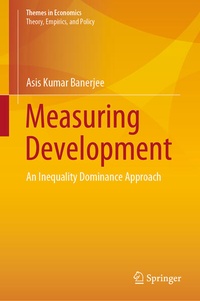
Measuring Development
Description
An excerpt from the book's Foreword:"[This book] is a comprehensive and valuable contribution to the literature on the measurement of inequality and the use of such measurement in the assessment of social welfare. I believe that it will be of much interest to researchers working on measures of inequality and social welfare as well as advanced graduate students who are looking for a solid introduction to this important area of normative economics."
- Prof. Prasanta K. Pattanaik, University of California, Riverside, California, U.S.A.
Reviews / Votes
"Asis Banerjee's book is one that anyone working in the area should, in the least, have an opinion of. The importance of taking inequality seriously in development measures is rightfully championed by the author, and the difficultly of achieving robust rankings highlights the potential for much future work." (Aaron Nicholas, Economic Record, Vol. 97 (317), June, 2021)
"The book is a notable addition to an area of normative economics that has assumed renewed prominence in the context of rising dissatisfaction with the vaunted gains of globalization." (Soumyen Sikdar, Journal of Quantitative Economics, Vol. 18, 2020)
More details
Other editions
Additional editions
Person
Asis Kumar Banerjee is a former Vice-Chancellor and a former Professor of Economics at the University of Calcutta. He holds an M.A. in Economics from the same university, and a Ph.D. in Economics from Johns Hopkins University. He has been associated with Presidency College, Calcutta; the Indian Statistical Institute, New Delhi; and the University of California, Riverside, California. His research interests include welfare economics, game theory and economic development.
Content
Chapter 1: Introduction.- Chapter 2: Towards an Inequality-Sensitive Measure of Development: The Unidimensional Case.- Chapter 3: Unidimensional Development Ranking and Fuzzy Lorenz Dominance.- Chapter 4: Illustrative Applications of Unidimensional Development Indices.- Chapter 5: Multidimensional Lorenz dominance.- Chapter 6: Multidimensional Inequality-Sensitive Development Ranking.- Chapter 7: An Illustration: Multidimensional Development and Inter-State Inequality in India in the 2000s.- Chapter 8: Overview and Concluding Remarks.