

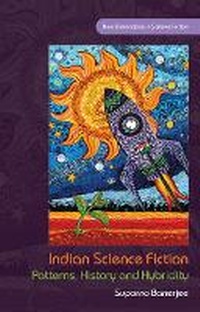
Indian Science Fiction
Patterns, History and Hybridity
Published on 15. November 2020
Book
Hardback
272 pages
978-1-78683-666-3 (ISBN)
Description
This study draws on postcolonial theory, science fiction criticism, utopian studies, genre theory, Western and Indian philosophy and history to propose that Indian science fiction functions at the intersection of Indian and Western cultures. Banerjee deploys a diachronic and comparative approach in examining the multilingual science fiction traditions of India, to trace the overarching generic evolutions, which he complements with an analysis of specific patterns of hybridity in the genre's formal and thematic elements. The book analyses Indian science fiction's use of alterity in its use of time, space and characters, and the epistemologies that ground its world building, to contend that in all of these intrinsic elements Indian science fiction shows an inherent cultural intersectionality - mostly between India and the West, but also among the diverse cultures of the nation. The work demonstrates that, despite the linguistic and cultural diversity of the Indian science fiction traditions, larger patterns and connections are visible.
More details
Series
Language
English
Place of publication
Wales
United Kingdom
Target group
Professional and scholarly
Illustrations
No
Dimensions
Height: 216 mm
Width: 138 mm
ISBN-13
978-1-78683-666-3 (9781786836663)
Copyright in bibliographic data and cover images is held by Nielsen Book Services Limited or by the publishers or by their respective licensors: all rights reserved.
Schweitzer Classification
Other editions
Additional editions
E-Book
11/2020
1st Edition
University of Wales Press
€73.49
Available for download
E-Book
11/2020
1st Edition
University of Wales Press
€78.49
Available for download
Person
Suparno Banerjee is an Associate Professor of English at Texas State University.
Content
Acknowledgements
Chronology
Introduction: To Mark or Not to Mark Territories
1. Genealogies: A Brief History of Indian SF
2. Cognitions and Estrangements: Epistemes and the World-Building in Indian Sf
3. Other Times: Alternative Histories, Imagining the Future and Non-Linear Temporalities
4. Other Spaces: Utopian Discourses and Non-Expansionist Journeys
5. The Others: Aliens, Robots, Cyborgs and Other Others
Conclusion: Close Encounters
Notes
Bibliography: Primary Texts
Bibliography: Secondary Texts
Chronology
Introduction: To Mark or Not to Mark Territories
1. Genealogies: A Brief History of Indian SF
2. Cognitions and Estrangements: Epistemes and the World-Building in Indian Sf
3. Other Times: Alternative Histories, Imagining the Future and Non-Linear Temporalities
4. Other Spaces: Utopian Discourses and Non-Expansionist Journeys
5. The Others: Aliens, Robots, Cyborgs and Other Others
Conclusion: Close Encounters
Notes
Bibliography: Primary Texts
Bibliography: Secondary Texts