

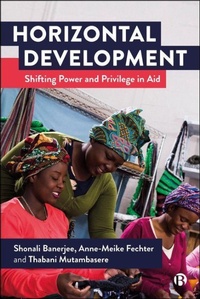
Horizontal Development
Shifting Power and Privilege in Aid
1st Edition
Published on 26. June 2025
Book
Hardback
166 pages
978-1-5292-2458-0 (ISBN)
Description
Accessible and comprehensive, this book puts forth an innovative perspective on international aid, going beyond top-down attempts to centre local voices and practices.
By providing an overview of newer iterations and overlooked practices in development, including citizen aid, technologies for development, and faith-based humanitarianism, the book explores the extent to which they disrupt existing models and potentially lead to more equitable grassroots-led approaches. The authors develop the concept of 'horizontal development' to examine how power and privilege operate in international and local horizontal development spaces. Examining challenges, they also highlight opportunities for doing things differently in light of prominent calls for decolonising aid and development.
By providing an overview of newer iterations and overlooked practices in development, including citizen aid, technologies for development, and faith-based humanitarianism, the book explores the extent to which they disrupt existing models and potentially lead to more equitable grassroots-led approaches. The authors develop the concept of 'horizontal development' to examine how power and privilege operate in international and local horizontal development spaces. Examining challenges, they also highlight opportunities for doing things differently in light of prominent calls for decolonising aid and development.
More details
Edition
First Edition
Language
English
Place of publication
Bristol
United Kingdom
Target group
College/higher education
Product notice
Unsewn / adhesive bound
Cloth over boards
Illustrations
Not illustrated
Dimensions
Height: 234 mm
Width: 156 mm
Thickness: 11 mm
Weight
413 gr
ISBN-13
978-1-5292-2458-0 (9781529224580)
Copyright in bibliographic data and cover images is held by Nielsen Book Services Limited or by the publishers or by their respective licensors: all rights reserved.
Schweitzer Classification
Other editions
Additional editions
Shonali Banerjee | Anne-Meike Fechter | Thabani Mutambasere
Horizontal Development
Shifting Power and Privilege in Aid
Book
06/2025
1st Edition
Bristol University Press
€33.00
Shipment within 3-4 weeks
Shonali Banerjee | Anne-Meike Fechter | Thabani Mutambasere
Horizontal Development
Shifting Power and Privilege in Aid
E-Book
06/2025
1st Edition
Bristol University Press
€34.49
Available for download
Persons
Shonali Banerjee is an Assistant Professor of International Development in the Department of Politics and International Studies, University of Warwick. She was formerly the Senior Research Associate at the University of Cambridge Centre for Strategic Philanthropy. Dr Banerjee holds a PhD in International Development from the University of Sussex, an has spent nearly fifteen years studying and working within the development sector, focusing on NGOs, philanthropy, and financialisation in Asia, the Middle East and Africa.
Anne-Meike Fechter is Professor of Anthropology and International Development in the School of Global Studies, University of Sussex, UK. She is fascinated by the myriad way in which people support others, on the margins and outside of the formal aid and development system, and how that shapes our ideas not just of aid, but what it tells us about societies hang together. She currently works with colleagues on informal and mutual aid among displaced people in Myanmar.
Thabani Mutambasere is Lecturer in African Studies and International Development in the School of Social and Political Science, University of Edinburgh. His research explores how African diasporas impact their home countries through political engagement, development work, and humanitarian efforts, beyond just financial remittances. Before joining academia, Thabani worked in the development sector tackling issues related to governance and civic education.
Anne-Meike Fechter is Professor of Anthropology and International Development in the School of Global Studies, University of Sussex, UK. She is fascinated by the myriad way in which people support others, on the margins and outside of the formal aid and development system, and how that shapes our ideas not just of aid, but what it tells us about societies hang together. She currently works with colleagues on informal and mutual aid among displaced people in Myanmar.
Thabani Mutambasere is Lecturer in African Studies and International Development in the School of Social and Political Science, University of Edinburgh. His research explores how African diasporas impact their home countries through political engagement, development work, and humanitarian efforts, beyond just financial remittances. Before joining academia, Thabani worked in the development sector tackling issues related to governance and civic education.
Content
Introduction
1. South-South Cooperation and Development
2. Professional Volunteering and Voluntourism
3. Localization and 'Local' Aid
4. Faith-Based Approaches
5. Diaspora-Led Development
6. Transnational Citizen Aid
7. Digital Humanitarianism
8. Mutual Aid and Solidarity
Conclusion
1. South-South Cooperation and Development
2. Professional Volunteering and Voluntourism
3. Localization and 'Local' Aid
4. Faith-Based Approaches
5. Diaspora-Led Development
6. Transnational Citizen Aid
7. Digital Humanitarianism
8. Mutual Aid and Solidarity
Conclusion