

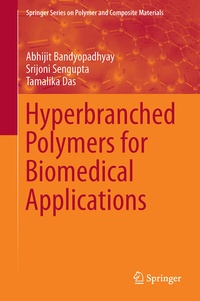
Hyperbranched Polymers for Biomedical Applications
Published on 27. September 2017
Book
Hardback
XI, 178 pages
978-981-10-6513-2 (ISBN)
Description
This book presents a comprehensive study on a new class of branched polymers, known as hyperbranched polymers (HBPs). It discusses in detail the synthesis strategies for these particular classes of polymers as well as biocompatible and biodegradable HBPs, which are of increasing interest to polymer technologists due to their immense potential in biomedical applications. The book also describes the one-pot synthesis technique for HBPs, which is feasible for large-scale production, as well as HBPs' structure-property relationship, which makes them superior to their linear counterparts. The alterable functional groups present at the terminal ends of the branches make HBPs promising candidates in the biomedical domain, and the book specifically elaborates on the suitable characteristic properties of each of the potential biological HBPs' applications. As such, the book offers a valuable reference guide for all scientists and technologists who are interestedin using these newly developed techniques to achieve faster and better treatments.
More details
Series
Edition
1st ed. 2018
Language
English
Place of publication
Singapore
Singapore
Target group
Professional and scholarly
Illustrations
109 s/w Abbildungen
XI, 178 p. 109 illus.
Dimensions
Height: 241 mm
Width: 160 mm
Thickness: 17 mm
Weight
459 gr
ISBN-13
978-981-10-6513-2 (9789811065132)
DOI
10.1007/978-981-10-6514-9
Schweitzer Classification
Other editions
Additional editions
Abhijit Bandyopadhyay | Srijoni Sengupta | Tamalika Das
Hyperbranched Polymers for Biomedical Applications
Book
12/2018
Springer
€53.49
Shipment within 15-20 days
Abhijit Bandyopadhyay | Srijoni Sengupta | Tamalika Das
Hyperbranched Polymers for Biomedical Applications
E-Book
09/2017
Springer
€53.49
Available for download
Persons
Dr. Abhijit Bandyopadhyay holds an M.Tech and Ph.D. in Polymer Science and Technology and is currently Head of the Department of Polymer Science and Technology, University of Calcutta. He is also a Technical Director at the South Asian Rubber & Polymers Park (SARPOL) in West Bengal, India. He is a former Assistant Professor of the Rubber Technology Centre at the Indian Institute of Technology Kharagpur (IIT Kharagpur), India. He has more than 10 years of teaching and research experience and has published more than 75 research papers in high-impact international journals, four book chapters, one book and holds one Indian patent. He has received numerous awards, including the Young Scientist Award from the Materials Research Society of India, Calcutta Chapter; the Young Scientist Award from the Department of Science & Technology, Government of India; and the Career Award for Young Teachers from the All India Council for Technical Education, Government of India. He is a life member of the Society for Polymer Science, India, Associate Life Member of the Indian Institute of Chemical Engineers and a Fellow of the International Congress of Environmental Research. He also serves on the Editorial Boards of various international journals. Ms. Srijoni Sengupta is a research scholar at the Department of Polymer Science and Technology, University of Calcutta, India. She received her initial degree in Chemistry (Hons) from Lady Brabourne College (Kolkata) in 2010 before completing her B.Tech (2013) and M.Tech (2015) in Polymer Science and Technology at the University of Calcutta. She is currently pursuing her Ph.D. on the "Synthesis, Study of Structure-Property Relationships and Potential Applications of Hyperbranched Polymers via Polycondensation Technique". She has published a number of papers in research journals and is presently engaged in an INSPIRE Fellowship from the Department of Science and Technology, Government of India. Ms. Tamalika Dasgraduated in Chemistry (Hons) from Scottish Church College (Kolkata) in 2008. She subsequently completed her B.Tech (2011) and M.Tech (2013) degrees at the Department of Polymer Science and Technology at the University of Calcutta. She was awarded the gold medal from the University of Calcutta twice (during both her B.Tech and M.Tech). She did her M.Tech project at the Indian Association for the Cultivation of Science (Kolkata). Currently, she is pursuing her doctoral research at the Department of Polymer Science and Technology at the University of Calcutta. Her main area of interest is hyperbranched polymers. She has published one paper in a high-impact international journal and is currently engaged in an INSPIRE Fellowship from the Department of Science and Technology, Government of India.
Content
Introduction.- Synthesis of hyperbranched polymers: Step growth method.- Synthesis of hyperbranched polymers: Mixed methods.- Structure-Property relationship of Hyperbranched polymers.- Latest biomedical applications of hyperbranched polymers: Part 1: As delivery vehicle.- Part II: In bioimaging.- Part III: For tissue engineering.