

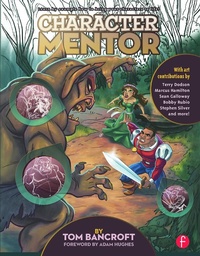
Character Mentor
Learn by Example to Use Expressions, Poses, and Staging to Bring Your Characters to Life
1st Edition
Published on 24. April 2012
Book
Paperback/Softback
178 pages
978-0-240-82071-2 (ISBN)
Description
You've researched your character extensively, tailored her to your audience, sketched hundreds of versions, and now you lean back content as you gaze at your final character model sheet. But now what? Whether you want to use her in an animated film, television show, video game, web comic, or children's book, you're going to have to make her perform. How a character looks and is costumed starts to tell her story, but her body language reveals even more. Character Mentor shows you how to pose your character, create emotion through facial expressions, and stage your character to create drama. Author Tom Bancroft addresses each topic with clear, concise prose, and then shows you what he really means through commenting on and redrawing artwork from a variety of student "apprentices." His assignments allow you to join in and bring your drawing to the next level with concrete techniques, as well as more theoretical analysis. Character Mentor is an apprenticeship in a book.
Professional artists from a variety of media offer their experience through additional commentary. These include Marcus Hamilton (Dennis the Menace), Terry Dodson (X-Men), Bobby Rubio (Pixar), Sean "Cheeks" Galloway (Spiderman animated), and more. With a foreword by comicbook artist Adam Hughes, who has produced work for DC, Marvel Comics, Lucasfilm, Warner Bros. Pictures, and other companies.
Professional artists from a variety of media offer their experience through additional commentary. These include Marcus Hamilton (Dennis the Menace), Terry Dodson (X-Men), Bobby Rubio (Pixar), Sean "Cheeks" Galloway (Spiderman animated), and more. With a foreword by comicbook artist Adam Hughes, who has produced work for DC, Marvel Comics, Lucasfilm, Warner Bros. Pictures, and other companies.
Reviews / Votes
"You've researched your character extensively, tailored her to your audience, sketched hundreds of versions, and now you lean back content as you gaze at your final character model sheet. But now what? Whether you want to use her in an animated film, television show, video game, web comic, or children's book, you're going to have to make her perform. How a character looks and is costumed starts to tell her story, but her body language reveals even more. Character Mentor shows you how to pose your character, create emotion through facial expressions, and stage your character to create drama. Author Tom Bancroft addresses each topic with clear, concise prose, and then shows you what he really means through commenting on and redrawing artwork from a variety of student 'apprentices.' His assignments allow you to join in and bring your drawing to the next level with concrete techniques, as well as more theoretical analysis. Character Mentor is an apprenticeship in a book."--CartoonBrew.com"If, like me, you are always looking to push yourself as a character artist I cannot recommend this book enough... Each chapter is a lesson on a specific topic, ranging from Posing to Shape-based composition. At the end of a chapter [Tom] sets you homework followed by examples of completed tasks by fellow students. Tom himself has gone over each example, annotating and thoroughly explaining each one in order for you to see how to bring your own work up to scratch...The best thing about this book for me, however, is that it doesn't end. You can never be truly finished with it as the teachings within are always relevant...it's like having a teacher on your shelf that will never be too busy to help you out and will always give you good advice."--Robin Liebschner, Skwigly.com
More details
Language
English
Place of publication
Oxford
United Kingdom
Publishing group
Taylor & Francis Ltd
Target group
Professional and scholarly
Professional Practice & Development
Product notice
Paperback (trade)
Unsewn / adhesive bound
Illustrations
160 farbige Abbildungen
160 Illustrations, color
Dimensions
Height: 274 mm
Width: 217 mm
Thickness: 17 mm
Weight
533 gr
ISBN-13
978-0-240-82071-2 (9780240820712)
Copyright in bibliographic data and cover images is held by Nielsen Book Services Limited or by the publishers or by their respective licensors: all rights reserved.
Schweitzer Classification
Other editions
Additional editions
Tom Bancroft
Character Mentor
Learn by Example to Use Expressions, Poses, and Staging to Bring Your Characters to Life
Book
07/2017
1st Edition
Routledge
€244.50
Shipment within 10-20 days
Tom Bancroft
Character Mentor
Learn by Example to Use Expressions, Poses, and Staging to Bring Your Characters to Life
E-Book
11/2012
1st Edition
Routledge
€65.99
Available for download
Tom Bancroft
Character Mentor
Learn by Example to Use Expressions, Poses, and Staging to Bring Your Characters to Life
E-Book
11/2012
1st Edition
Routledge
€65.99
Available for download
Person
Tom Bancroft is a 30 year veteran of the animation industry. In his artistic career he has specialized in children's character designs, animation, video game development, and comic books. Formerly, he worked at Walt Disney Feature Animation for twelve years, animating on new Disney classics, including Beauty and the Beast, The Lion King, Aladdin, Pocahontas, Mulan, Brother Bear, and more. He is the author of the popular character design book Creating Characters with Personality: For Film, TV, Animation, Video Games, and Graphic Novels.
Content
Chapter 1: Now What: Drawing basics for Posing and Expressions (Assignment #1: Character design: Elroy and Kirby); Chapter 2: The Face: Breaking down the elements of expression (Assignment #2: Drawing "Emma" with different expressions ); Chapter 3: Posing your character: what are you trying to communicate? (Assignment #3: Drawing "Tommy" in three, distinct poses); Chapter 4: Acting: Characters acting and reacting the way you want them to (Assignment #4: Thumbnail sketch a series of poses of "Tommy" to best describe a specific action); Chapter 5: Staging your scene: Using the elements of your scene to create a composition (Assignment #5: Illustrate the same scene from two different points-of-view); Chapter 6: Leading the eye: Prioritizing by design (Assignment #6: Illustrating a specific scene, using the designs provided); Chapter 7: Putting it in action: creating an illustration from start to finish