

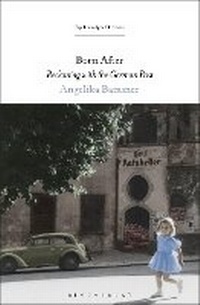
Born After
Reckoning with the German Past
Published on 20. August 2020
Book
Paperback/Softback
304 pages
978-1-5013-6771-7 (ISBN)
Description
A 2020 Prose Award Finalist
What do we do with pasts we inherit that carry shame? A major and original contribution to thinking about and grappling with the legacies of German and Nazi history, this book reflects on the relationship between history and memory through the personal narrative of a postwar German intellectual. Arguing that the pasts that haunt usare shaped both by the things people did and suffered and the affective traces the past leaves in memory, Born After is a powerful meditation on questions of guilt, complicity, loss, and longing. With bracing honesty and without sentimentality, Bammer draws on her own family story to think anew about a history that we have come to accept as familiar. Inflecting questions about history with questions about ethics, her book speaks to all those concerned with historical pasts that remain unreconciled.
What do we do with pasts we inherit that carry shame? A major and original contribution to thinking about and grappling with the legacies of German and Nazi history, this book reflects on the relationship between history and memory through the personal narrative of a postwar German intellectual. Arguing that the pasts that haunt usare shaped both by the things people did and suffered and the affective traces the past leaves in memory, Born After is a powerful meditation on questions of guilt, complicity, loss, and longing. With bracing honesty and without sentimentality, Bammer draws on her own family story to think anew about a history that we have come to accept as familiar. Inflecting questions about history with questions about ethics, her book speaks to all those concerned with historical pasts that remain unreconciled.
Reviews / Votes
A courageous, self-reflexive and conscientious book. It is an intimate account of her personal life story but at the same time it is a story of a generation of Germans born into the shattered and perplexed reality of 'aftermath' Germany who were forced to struggle with the haunting shadows of the past ... Bammer is a gifted narrator and her personal story is both intimately touching and intellectually evoking ... Bammer compels us to rethink the very foundations of identity: memory, personal history, attachment to place, culture and, above all - language. It brings together historical research (letters, family documents, interviews, etc.) with contemplative and reflective observations, reminding us of the blurred distinction between facts and representation, historiography and literature, memory and imagination ... Its embedded psychological and historical insights which are marked by a rare clarity and sensitivity ... stem from a genuine understanding of the human psyche that goes beyond the somewhat schematic and abstractive nature of theories ... Nonetheless, the most significant contribution of the book lies in its ability to raise questions without aspiring to answer them, and in its achievement in sharpening the paradoxes and dilemmas embedded not only in relation to the history of Nazi and post-war Germany but in relation to history and memory as such. * Psychoanalysis and History * Important and in many ways original contribution to this vast body of work concerned with Holocaust memory from the perspective of a perpetrator culture...What makes Bammer's accounting remarkable among other things is the huge time span of her engagement with her family history. Her personal narrative begins well before she was born in 1945 and stretches beyond the death of her father in 2009. Instead of narrating one single revelation concerning her family's implication with Nazi violence, as has been done in so many popular novels and films, Bammer tells about her recurrent, labored, and often frustrating efforts of trying to understand not only the actions of her parents and grandparents but maybe even more important their changing emotions and silences vis-a-vis their country's horrific past. * H-Judaic * Engaged in what was clearly a difficult - sometimes agonising - task, Bammer has produced a beautiful and important book ... 5 stars. * Jewish Renaissance * [Born After] is a powerful meditation on love and death, guilt and atonement, and memory and imagination, as well as a recognition of reason and its limitations when confronting history's brutal realities. Summing Up: Recommended. General readers through faculty. * CHOICE * Born After is a painfully honest and mesmerizing reflection on what it means to have been born a German in the wake of the Holocaust. An elegant writer, Angelika Bammer is unafraid to probe deeply into areas where others--including many Germans--have refused to go. She weaves together history and family, the past and the present, and literature and psychoanalytic analysis in a seamless and eminently readable fashion. I have waited for this book for a long time and when I received it I read it in one sitting because I could not put it down. And I shall return to it often. * Deborah E. Lipstadt, Professor of Holocaust Studies, Emory University, USA, and author of Antisemitism: Here and Now (2019) * In this brave and acutely perceptive book, Angelika Bammer confronts the legacy of a dark past without shirking the difficult ambiguities of denial, guilt, anger, or attachment carried by its inheritors. Moving between personal story and larger history, Born After gives us felt insight into the paradoxes of transmitted memory and the dilemmas faced by the second generation on both sides of atrocity. * Eva Hoffman, author of After Such Knowledge: Memory, History, and the Legacy of the Holocaust (2014) and Exit into History: A Journey through the New Eastern Europe (1993) * Readers of Born After will be grateful to Angelika Bammer for the invitation to join in the intimacy of her life-long memory work. This is a courageous, wise, and quietly devastating book in which the past can shift at a moment's notice, while the future remains open to surprises large and small. * Marianne Hirsch, William Peterfield Trent Professor of English and Comparative Literature, Columbia University, USA, and author of The Generation of Postmemory: Writing and Visual Culture After the Holocaust (2012). *More details
Series
Language
English
Place of publication
New York
United States
Publishing group
Bloomsbury Publishing Plc
Target group
Professional and scholarly
College/higher education
Dimensions
Height: 216 mm
Width: 140 mm
Weight
349 gr
ISBN-13
978-1-5013-6771-7 (9781501367717)
Copyright in bibliographic data and cover images is held by Nielsen Book Services Limited or by the publishers or by their respective licensors: all rights reserved.
Schweitzer Classification
Other editions
Additional editions
E-Book
06/2019
1st Edition
Bloomsbury Academic USA
€38.49
Available for download
E-Book
06/2019
1st Edition
Bloomsbury Academic USA
€38.49
Available for download
Person
Angelika Bammer is Associate Professor of Comparative Literature at Emory University, USA. She is the author of Partial Visions: Feminism and Utopianism in the 1970s (revised edition, 2015; 1st edition, 1991), and the editor of The Future of Scholarly Writing: Critical Interventions (2015) and Displacements: Cultural Identities in Question (1994).
Content
Prologue: Swastika Raincoat
Part One: The Trouble with German
In the Aftermath
Lost in the Past
Following the Clues
Family Ties
Between the Word-Gaps
Ambushed by History
Passing through Bitburg
Resident Alien
Proof of Ancestry
Part Two: Walking to Buchenwald
Into the Past
Walking to Buchenwald
The Quiet Dignity of Being True
Once Upon a Wartime
A World in Letters
Part Three: There Was a Butcher Here, Once
A Longing Called Home
Memories of War
Memories of Betrayal
There Was a Butcher Here, Once
My Nazi Family
Sources and Acknowledgments
Notes
Index
Part One: The Trouble with German
In the Aftermath
Lost in the Past
Following the Clues
Family Ties
Between the Word-Gaps
Ambushed by History
Passing through Bitburg
Resident Alien
Proof of Ancestry
Part Two: Walking to Buchenwald
Into the Past
Walking to Buchenwald
The Quiet Dignity of Being True
Once Upon a Wartime
A World in Letters
Part Three: There Was a Butcher Here, Once
A Longing Called Home
Memories of War
Memories of Betrayal
There Was a Butcher Here, Once
My Nazi Family
Sources and Acknowledgments
Notes
Index