

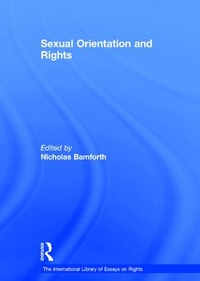
Sexual Orientation and Rights
1st Edition
Published on 3. December 2014
Book
Hardback
562 pages
978-1-4094-3040-7 (ISBN)
Description
Debate about the rights of sexual minorities, whether individuals or members of same-sex couples, has become an important issue for legislatures and courts in many constitutional democracies. This volume collects together some of the more significant writings in the debate, and reflects a variety of perspectives: liberal, conservative, and radical. The topics covered include the meaning and importance of sexual freedom, gender roles, marriage and other significant partnerships, child care and adoption, the criminal law, employment, and expression and pornography. The volume also seeks to relate arguments about sexual orientation and rights to broader debates within feminist theory.
More details
Series
Language
English
Place of publication
London
United Kingdom
Publishing group
Taylor & Francis Ltd
Target group
College/higher education
Dimensions
Height: 246 mm
Width: 174 mm
Weight
1315 gr
ISBN-13
978-1-4094-3040-7 (9781409430407)
Copyright in bibliographic data and cover images is held by Nielsen Book Services Limited or by the publishers or by their respective licensors: all rights reserved.
Schweitzer Classification
Other editions
Additional editions
Nicholas Bamforth
Sexual Orientation and Rights
E-Book
05/2017
Routledge
€416.99
Available for download
Nicholas Bamforth
Sexual Orientation and Rights
E-Book
05/2017
Routledge
€416.99
Available for download
Person
Nicholas Bamforth is Fellow in Law at The Queen's College, Oxford, and a university lecturer in Law at Oxford University. He is co-editor of Accountability in the Contemporary Constitution (2013) and co-author of Patriarchal Religion, Sexuality and Gender: A Critique of New Natural Law (2008) and Discrimination Law: Theory and Context (2008).
Content
Contents: Introduction. Part I Organizing the Arguments: Sexual orientation and the politics of biology: a critique of the argument from immutability, Janet E. Halley. Part II Substantive Progressive Arguments: Sexual autonomy and the constitutional right to privacy: a case study in human rights and the unwritten constitution, David A.J. Richards; Liberal community, Ronald Dworkin; Sexual orientation and the constitution: a test case for human rights, Edwin Cameron; Hardwick and historiography, William N. Eskridge, Jr; Editorial note: The constitutional status of sexual orientation: homosexuality as a suspect classification, Harvard Law Review; Recognising new kinds of direct sex discrimination: transsexualism, sexual orientation and dress codes, Robert Wintemute; Pornographies, Leslie Green; Pornography/death: the problem of gay pornography in a straight supremacist system, Shannon Gilreath. Part III Conservative Arguments and Responses to Them: Law, morality and 'sexual orientation', John M. Finnis; Is marriage inherently heterosexual?, Andrew Koppelman. Part IV Radical Arguments: Developing lesbian legal theory/Sexual privacy/Discourses of discrimination, Ruthann Robson; Essential rights and contested identities: sexual orientation and equality rights jurisprudence in Canada, Carl F. Stychin; On being beside oneself: on the limits of sexual automony, Judith Butler. Name index.