

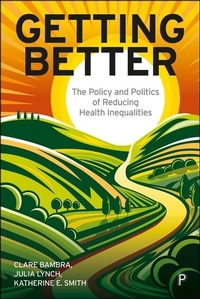
Getting Better
The Policy and Politics of Reducing Health Inequalities
1st Edition
Published on 27. May 2025
Book
Paperback/Softback
184 pages
978-1-4473-7286-8 (ISBN)
Description
Available open access digitally under CC-BY-NC-ND licence.
Health inequality has reached a crisis point. Your income or hometown can have a devastating impact on how well and how long you live. This injustice, exacerbated during the COVID-19 pandemic, continues as the cost of living rises and other sources of inequity grow. What can be done to make things better?
This book, written by the authors behind the award-winning The Unequal Pandemic, explores successful international case studies of governments reducing health inequalities - from the USA and Brazil to Germany and England - stretching over fifty years from the 1960s to the 2000s.
Essential reading for students and scholars of public health and the social sciences, and for health and social care professionals and policy makers, this book demonstrates that reducing health inequalities is possible and provides a roadmap for today's governments to follow.
Health inequality has reached a crisis point. Your income or hometown can have a devastating impact on how well and how long you live. This injustice, exacerbated during the COVID-19 pandemic, continues as the cost of living rises and other sources of inequity grow. What can be done to make things better?
This book, written by the authors behind the award-winning The Unequal Pandemic, explores successful international case studies of governments reducing health inequalities - from the USA and Brazil to Germany and England - stretching over fifty years from the 1960s to the 2000s.
Essential reading for students and scholars of public health and the social sciences, and for health and social care professionals and policy makers, this book demonstrates that reducing health inequalities is possible and provides a roadmap for today's governments to follow.
Reviews / Votes
"Recognition that the key determinants of health inequalities lie in the realm of politics and macroeconomics can foster world-weariness, even despair - what to do? This book is an evidence-based counter to despair. It shows, using four case studies, that health inequalities have been reduced by political and social policies. The key message is to continue these life-enhancing policies." Sir Michael Marmot, UCL Institute of Health Equity "As surely as movements and governments that foster economic, social and participatory democracy reduce health inequities, neoliberal and reactionary regimes increase them. This timely must-read book, examining the US, Brazil, Germany and England, explains why." Nancy Krieger, Harvard T.H. Chan School of Public Health "Economic disadvantage is the cause of countless deaths worldwide. Getting Better reminds us that it is political decisions that allow this to happen. But this also means that change is possible if the political will is there." Nico Dragano, Heinrich Heine University DuesseldorfMore details
Edition
First Edition
Language
English
Place of publication
Bristol
United Kingdom
Publishing group
Bristol University Press
Illustrations
15 s/w Abbildungen, 4 s/w Tabellen
4 Tables, black and white; 15 Illustrations, black and white
Dimensions
Height: 233 mm
Width: 157 mm
Thickness: 14 mm
Weight
282 gr
ISBN-13
978-1-4473-7286-8 (9781447372868)
Copyright in bibliographic data and cover images is held by Nielsen Book Services Limited or by the publishers or by their respective licensors: all rights reserved.
Schweitzer Classification
Other editions
Additional editions
Clare Bambra | Julia Lynch | Katherine E. Smith
Getting Better
The Policy and Politics of Reducing Health Inequalities
E-Book
05/2025
1st Edition
Policy Press
€0.00
Available for download
Persons
Clare Bambra is Professor of Public Health at the Population Health Sciences Institute, Newcastle University.
Julia Lynch is Professor of Political Science at the University of Pennsylvania.
Katherine Smith is Professor of Public Health Policy at the University of Strathclyde.
Julia Lynch is Professor of Political Science at the University of Pennsylvania.
Katherine Smith is Professor of Public Health Policy at the University of Strathclyde.
Content
1. Introduction: The holy grail of reducing health inequalities
2. The Great Society: social reform and health inequalities in the United States
3. Vote early, vote often: democratisation in Brazil and health inequalities
4. What belongs together will grow together: German reunification and health inequalities
5. Things can only get better: England's Health Inequalities Strategy
6. Waxing and waning: the four levellers of health inequalities
7. Conclusion: The politics of health inequalities
2. The Great Society: social reform and health inequalities in the United States
3. Vote early, vote often: democratisation in Brazil and health inequalities
4. What belongs together will grow together: German reunification and health inequalities
5. Things can only get better: England's Health Inequalities Strategy
6. Waxing and waning: the four levellers of health inequalities
7. Conclusion: The politics of health inequalities