

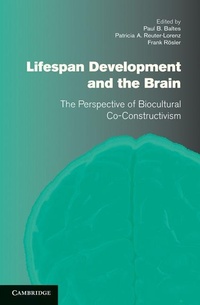
Lifespan Development and the Brain
The Perspective of Biocultural Co-Constructivism
Published on 16. August 2010
Book
Paperback/Softback
446 pages
978-0-521-17555-5 (ISBN)
Description
The book focuses on the developmental analysis of the brain-culture-environment dynamic and argues that this dynamic is interactive and reciprocal. Brain and culture co-determine each other. As a whole, this book refutes any unidirectional conception of the brain-culture dynamic. Each is influenced by and modifies the other. To capture the ubiquitous reach and significance of the mutually dependent brain-culture system, the metaphor of biocultural co-constructivism is invoked. Distinguished researchers from cognitive neuroscience, cognitive psychology and developmental psychology review the evidence in their respective fields. A special focus of the book is its coverage of the entire human lifespan from infancy to old age.
Reviews / Votes
'The book provides excellent summaries of specific areas of research contributing to the overall thesis of lifespan biocultural co-constructivism. Lifespan Development and the Brain should be required reading ...' PsycCritiquesMore details
Language
English
Place of publication
Cambridge
United Kingdom
Target group
Professional and scholarly
College/higher education
Product notice
Paperback (trade)
Illustrations
Worked examples or Exercises
Dimensions
Height: 229 mm
Width: 152 mm
Thickness: 24 mm
Weight
642 gr
ISBN-13
978-0-521-17555-5 (9780521175555)
Copyright in bibliographic data and cover images is held by Nielsen Book Services Limited or by the publishers or by their respective licensors: all rights reserved.
Schweitzer Classification
Other editions
Additional editions
Paul B. Baltes | Patricia A. Reuter-Lorenz | Frank Roesler
Lifespan Development and the Brain
The Perspective of Biocultural Co-Constructivism
E-Book
06/2006
1st Edition
Cambridge University Press
€44.49
Available for download
Paul B. Baltes | Patricia A. Reuter-Lorenz | Frank Roesler
Lifespan Development and the Brain
The Perspective of Biocultural Co-Constructivism
Book
06/2006
Cambridge University Press
€136.50
No shipping information available
Persons
Paul B. Baltes is noted for his theoretical and empirical work in developmental psychology and the interdisciplinary study of human aging. Aside from multiple honorary doctorates and election to academies, he has received numerous awards, including the International Psychology Award of the American Psychological Association, the Lifetime Achievement Award of the German Psychological Society, and the Aristotle Prize of the European Federation of Psychological Associations. Patricia A. Reuter-Lorenz is known for her research on the neuropsychological mechanisms of attention and working memory, in particular through her work with special patient populations, functional brain imaging and normal human aging. She is co-founder of the Cognitive Neuroscience Society, has served on its governing board since its inception and serves on the editorial boards of leading journals in the field. Frank Roesler is recognized for his research on biological correlates of cognitive processes, in particular memory, learning, imagery, language, and neural plasticity. He has received several awards, including the Max-Planck/Humboldt prize for international cooperation, and he has been elected as full member in two academies of sciences in Germany.
Content
Preface Paul B. Baltes, Patricia A. Reuter-Lorenz and Frank Roesler; Part I. Setting the Stage across the Ages of the Lifespan: 1. Prologue: biocultural co-constructivism as a theoretical metascript Paul B. Baltes, Frank Roesler and Patricia A. Reuter-Lorenz; 2. Biocultural co-construction of lifespan development Shu-Chen Li; Part II. Neuronal Plasticity and Biocultural Co-Construction: Microstructure Meets the Experiential Environment: 3. Neurobehavioral development in the context of biocultural co-constructivism Charles A. Nelson; 4. Adult neurogenesis Gerd Kempermann; Part III. Neuronal Plasticity and Biocultural Co-Construction: Atypical Brain Architectures: 5. Sensory input-based adaptation and brain architecture Maurice Ptito and Sebastien Desgent; 6. Blindness: a source and case of neuronal plasticity Brigitte Roeder; Part IV. Biocultural Co-Construction: Specific Functions and Domains: 7. Language acquisition: biological versus cultural implications for brain structure Angela D. Friederici and Shirley-Ann Rueschemeyer; 8. Reading, writing, and arithmetic in the brain: neural specialization for acquired functions Thad A. Polk and J. Paul Hamilton; 9. Emotion, learning, and the brain: from classical conditioning to cultural bias Elizabeth A. Phelps; 10. The musical mind: neural tuning and the aesthetic experience Oliver Vitouch; Part V. Plasticity and Biocultural Co-Construction in Later Life: 11. Influences of biological and self-initiated factors on brain and cognition in adulthood and aging Lars Nyberg and Lars Baeckman; 12. The aging mind and brain: implications of enduring plasticity for behavioral and cultural change Patricia A. Reuter-Lorenz and Joseph A. Mikels; Part VI. Biocultural Co-Construction: From Micro- to Macroenvironments in Larger Cultural Contexts: 13. Characteristics of illiterate and literate cognitive processing: implications of brain-behavior co-constructivism Karl Magnus Petersson and Alexandra Reis; 14. The influence of work and occupation on brain development Neil Charness; 15. The influence of organized violence and terror on brain and mind: a co-constructive perspective Thomas Elbert, Brigitte Rockstroh, Iris-Tatjana Kolassa, Maggie Schauer and Frank Neuner; 16. Co-constructing human engineering technologies in old age: lifespan psychology as a conceptual foundation Ulman Lindenberger and Martin Loevden; Part VII. Epilogue: 17. Letters on nature and nurture Onur Guentuerkuen.