

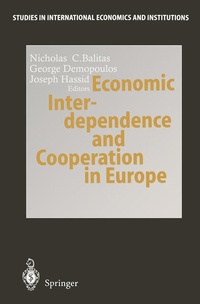
Economic Interdependence and Cooperation in Europe
Published on 23. December 2011
Book
Paperback/Softback
VI, 200 pages
978-3-642-72113-7 (ISBN)
Description
Economic integration is the most noteworthy development in international economic policy at the end of this century. Enthusiasm for the European Union has been infectuous. Yet, there are many aspects for the EU that still remain obscure and which warrant further careful scrutiny. The subject of this book is the examination of the inherent economic and political inefficiencies in the transition process of Central and East European countries which are apt to slow down its pace, divert it from its proper course and, in some cases, even endanger its sustainability. The authors of the contributions in this book, economists and political scientists, investigate the applicability of the hyperthesis of mutual benefits resulting from countries in transition becoming open to international trade and investment.
More details
Series
Edition
Softcover reprint of the original 1st ed. 1998
Language
English
Place of publication
Berlin
Germany
Publishing group
Springer Berlin
Target group
Professional and scholarly
Research
Illustrations
VI, 200 p.
Dimensions
Height: 235 mm
Width: 155 mm
Thickness: 12 mm
Weight
330 gr
ISBN-13
978-3-642-72113-7 (9783642721137)
DOI
10.1007/978-3-642-72111-3
Schweitzer Classification
Other editions
Additional editions
Nicholas C. Baltas | George Demopoulos | Joseph Hassid
Economic Interdependence and Cooperation in Europe
E-Book
12/2012
Springer
€96.29
Available for download
Nicholas C. Baltas | George Demopoulos | Joseph Hassid
Economic Interdependence and Cooperation in Europe
Book
03/1998
Springer
€85.55
Article exhausted; check different version
Content
I: Historical Background of a Monetary Union.- 1. The Financial History of the Ionian Islands in the 19th Century: Lessons from the Past?.- II: Transitional Economics: Theoretical and Institutional Issues.- 2. Rents as Distractions: Why the Exit from Transition is Prolonged.- 3. Transformation Process Five Years On: Behavioural Adaptation and Institutional Change in Poland.- III: Transitional Economics: Macroeconomic and Monetary Policy.- 4. Macroeconomic Stability and the Transition Process.- 5. Macroeconomic Stability and How to Avoid the Frequent Use of Stabilization Therapies.- 6. Problems of Transition in the Monetary Sector: The Bulgarian Experience.- IV: Competition Policy, Internal Market and Trade Policies in the CEECs.- 7. Competition Policy and Integration: Levelling or Tilling the Playing Field?.- 8. The Operation of the Internal Market and Approximation to Internal Market Legislation by CEECs.- 9. Integration, Trade Policies, Factor Movements and the European Competitive Order: Problems of CEEC-Accession to the EU.- V: Sectoral Issues in the Integration of CEECs into the EU.- 10. Inward Investment and the Need for Industrial Strategy in Central and Eastern Europe.- 11. Agricultural Issues in the Integration of CEECs in the EU.- List of Contributors.