

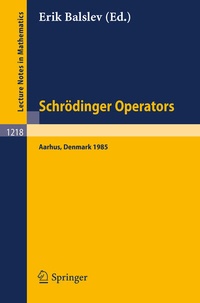
Schrödinger Operators, Aarhus 1985
Lectures given in Aarhus, October 2-4, 1985
Published on 1. October 1986
Book
Paperback/Softback
VI, 226 pages
978-3-540-16826-3 (ISBN)
Description
The schr¿dinger operator for a particle in a solid with deterministic and stochastic point interactions.- Wave operators for dilation-analytic three-body hamiltonians.- to asymptotic observables for multiparticle quantum scattering.- Scattering theory for one-dimensional systems with nontrivial spatial asymptotics.- Classical limit and canonical perturbation theory.- Trace estimates for exterior boundary problems associated with the Schr¿dinger operator.- Commutator methods and asymptotic completeness for one - dimensional Stark effect Hamiltonians.- Lorentz invariant quantum theory.- A characterization of dilation-analytic operators.- Asymptotic and approximate formulas in the inverse scattering problem for the Schr¿dinger operator.- ?-decay and the exponential law.
More details
Series
Edition
1986 ed.
Language
English
Place of publication
Berlin
Germany
Publishing group
Springer Berlin
Target group
Professional and scholarly
Research
Illustrations
VI, 226 p.
Dimensions
Height: 235 mm
Width: 155 mm
Thickness: 13 mm
Weight
353 gr
ISBN-13
978-3-540-16826-3 (9783540168263)
DOI
10.1007/BFb0073041
Schweitzer Classification
Content
The schrödinger operator for a particle in a solid with deterministic and stochastic point interactions.- Wave operators for dilation-analytic three-body hamiltonians.- to asymptotic observables for multiparticle quantum scattering.- Scattering theory for one-dimensional systems with nontrivial spatial asymptotics.- Classical limit and canonical perturbation theory.- Trace estimates for exterior boundary problems associated with the Schrödinger operator.- Commutator methods and asymptotic completeness for one - dimensional Stark effect Hamiltonians.- Lorentz invariant quantum theory.- A characterization of dilation-analytic operators.- Asymptotic and approximate formulas in the inverse scattering problem for the Schrödinger operator.- ?-decay and the exponential law.