

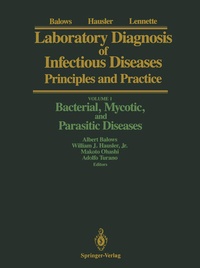
Laboratory Diagnosis of Infectious Diseases
Principles and Practice
Published on 3. October 2011
Book
Paperback/Softback
XXV, 1101 pages
978-1-4612-8393-5 (ISBN)
Description
those who deal with infectious diseases on a daily This two volume work stems from the belief of the Editors that infectious diseases are not only very basis. much with us today but, more importantly, that they There are several excellent textbooks dealing will continue to playa significant global role in mor with medical microbiology, and there are equally well-recognized books devoted to infectious dis bidity and mortality in all people. A continuing need for an informed and knowledgeable community of eases. The Editors of this work, on the other hand, laboratory scientists is fundamental. Data describing were persuaded that there was a need for a publica the global impact of infectious diseases are difficult tion that would bring together the most pertinent and to come by. Fortunately, a recent thoughtful and relevant information on the principles and practice of provocative publication by Bennett et al. (1987) pro the laboratory diagnosis of infectious diseases and vides us with data derived from several consultants include clinical relationships. While this two volume that clearly delineate the impact of infectious dis text is directed toward the role of the laboratory in eases on the United States today.
Reviews / Votes
From the reviews:
"This comprehensive work on the laboratory diagnosis of infectious diseases with its more than 2000 pages in 2 volumes differs from books with similar contents in a number of aspects. . Numerous figures and schematic representations enhance the understanding of the text. - The 180 authors have created a work which will stand the test of practice in the hospital as well as in the laboratory." (W. Köhler, Zentralblatt für Bakteriologie, Mikrobiologie und Hygiene, Vol. 317, May, 1991)
More details
Edition
Softcover reprint of the original 1st ed. 1988
Language
English
Place of publication
New York
United States
Target group
Professional and scholarly
Research
Illustrations
XXV, 1101 p.
Dimensions
Height: 280 mm
Width: 210 mm
Thickness: 61 mm
Weight
2709 gr
ISBN-13
978-1-4612-8393-5 (9781461283935)
DOI
10.1007/978-1-4612-3898-0
Schweitzer Classification
Other editions
Additional editions
Albert Balows | William J. Jr. Hausler | Makoto Ohashi
Laboratory Diagnosis of Infectious Diseases
Principles and Practice
E-Book
12/2012
Springer
€128.39
Available for download

Albert Balows | William J. Jr. Hausler | Makoto Ohashi
Laboratory Diagnosis of Infectious Diseases
Principles and Practice
Book
11/1988
Springer
€85.55
Article exhausted; check different version
Content
Contents: Volume I.- Section I General Principles and Practice.- 1 Good Laboratory Practices: Scope and Purpose.- 2 Quantification Methods in Microbiology.- 3 Immunologic Methods for Detection of Microbial Antigens.- 4 Principles of Antibiotic Testing in the Laboratory.- Section II Bacterial Infections.- 5 Anaerobic Bacterial Infections (Non-Spore-Forming).- 6 Anthrax.- 7 Infections Due to Nonanthrax Bacillus Species, Kurthia, and Rothia.- 8 Bacillus cereus Food Poisoning.- 9 Bacterial Vaginosis.- 10 Bartonellosis.- 11 Borelliosis (Relapsing Fever).- 12 Botulism.- 13 Branhamella catarrhalis and Neisseria Species.- 14 Brucellosis.- 15 Campylobacteriosis.- 16 Cat Scratch Disease.- 17 Chancroid.- 18 Cholera.- 19 Miscellaneous Clostridial Infections.- 20 Clostridial Myonecrosis (Gas Gangrene).- 21 Other Corynebacterioses.- 22 Diphtheria.- 23 Donovanosis.- 24 Enteric Bacteriosis.- 25 Erysipelothrix Infections.- 26 Infectious Diseases Associated with Escherichia coli.- 27 Glucose Nonfermenting Gram-Negative Rods.- 28 Gonorrhea.- 29 Infections Caused by Miscellaneous Gram-Negative Aerobic Bacteria.- 30 Group A Streptococcal Infections.- 31 Haemophilus influenzae Infections.- 32 Infections Due to Haemophilus Species Other than Haemophilus influenzae.- 33 Legionellosis.- 34 Leprosy.- 35 Leptospirosis.- 36 Listeriosis.- 37 Lyme Disease and Related Disorders.- 38 Melioidosis and Glanders.- 39 Meningococcal Infections.- 40 Mycobacterioses Excluding Tuberculosis.- 41 Mycoplasmoses.- 42 Pertussis.- 43 Plague.- 44 Pneumococcal Diseases.- 45 Diseases Caused by Pseudomonas.- 46 Rat-Bite Fever.- 47 Salmonellosis.- 48 Shigellosis.- 49 Staphylococcal Infections.- 50 Streptococcal Infections: Alpha-Hemolytic Streptococci.- 51 Syphilis.- 52 Tuberculosis.- 53 Tularemia.- 54 Typhoid Fever.- 55Vibrioses Other than Cholera.- 56 Yersinioses Other than Plague.- Section III Mycotic Infections.- 57 Actinomycosis.- 58 Aspergillosis.- 59 Blastomycosis.- 60 Candidiasis.- 61 Chromoblastomycosis.- 62 Coccidioidomycosis.- 63 Cryptococcosis.- 64 Dermatophytosis.- 65 Histoplasmosis Capsulati.- 66 Hyalohyphomycosis.- 67 Mycetoma.- 68 Nocardiosis.- 69 Paracoccidioidomycosis.- 70 Phaeohyphomycosis.- 71 Rhinosporidiosis.- 72 Sporotrichosis.- 73 Zygomycosis.- Section IV Parasitic Infections.- 74 Acanthamoebiasis and Naeglerosis.- 75 African Trypanosomiasis.- 76 Amebiasis.- 77 American Trypanosomiasis (Chagas' Disease).- 78 Neurologic Angiostrongyliasis: Parasitic Eosinophilic Meningoencephalitis.- 79 Anisakiasis.- 80 Ascariasis.- 81 Babesiosis.- 82 Balantidiasis.- 83 Capillariasis.- 84 Clonorchiasis.- 85 Cryptosporidiosis.- 86 Diphyllobothriasis.- 87 Dracunculiasis.- 88 Echinococcosis (Hydatid Disease).- 89 Enterobiasis.- 90 Fascioliasis and Fasciolopsiasis.- 91 Filariasis.- 92 Giardiasis.- 93 Hookworm.- 94 Hymenolepiasis.- 95 Isosporiasis.- 96 Leishmaniasis.- 97 Malaria.- 98 Microsporidiosis.- 99 Paragonimiasis.- 100 Pneumocystosis.- 101 Schistosomiasis.- 102 Strongyloidiasis.- 103 Taeniasis and Cysticercosis.- 104 Toxocariasis.- 105 Toxoplasmosis.- 106 Trichinellosis.- 107 Trichomoniasis.- Index to Volume 1.- Index to Volume II.