

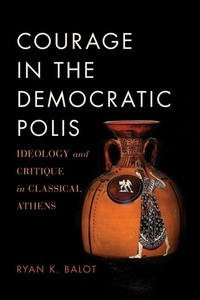
Courage in the Democratic Polis
Ideology and Critique in Classical Athens
Published on 5. July 2018
Book
Paperback/Softback
426 pages
978-0-19-087952-5 (ISBN)
Description
In this careful and compelling study, Ryan K. Balot brings together political theory, classical history, and ancient philosophy in order to reinterpret courage as a specifically democratic virtue. Ranging from Thucydides and Aristophanes to the Greek tragedians and Plato, Balot shows that the ancient Athenians constructed a novel vision of courage that linked this virtue to fundamental democratic ideals such as freedom, equality, and practical rationality. The Athenian ideology of courage had practical implications for the conduct of war, for gender relations, and for the citizens' self-image as democrats. In revising traditional ideals, Balot argues, the Athenians reimagined the emotional and cognitive motivations for courage in ways that will unsettle and transform our contemporary discourses. Without losing sight of political tensions and practical conflicts, Balot illustrates the merits of the Athenian ideal, provocatively explaining its potential to enlarge our contemporary understandings of politics and ethics. The result is a remarkable interdisciplinary work that has significant implications for the theory and practice of democracy, both ancient and modern.
Reviews / Votes
The writing is admirably clear throughout, the level of analysis is consistently high,and the meticulous and thoughtful analysis of the ancient sources is informed by a
wealth of scholarly literature on a number of topics ranging from Greek ethics and social
history to modern political theory and theories of emotion. Balot's book is an important
contribution that deepens our understanding of the workings of courage in democratic
Athens and will therefore be of value to students and scholars in the fields of classics and
ancient history, philosophy, and political theory. * Kleanthis Mantzouranis, Phoenix * In this book Balot explores the notion that the Athenians had a democratic understanding of courage, attainable not only by heroes but by all citizens, based on free debate and seeking an appropriately democratic kind of eudaimonia. ... Balot has teased out an important theme, and has given us a thorough and stimulating exploration of it. * Sehepunkte * This book is an excellent discussion of early theoretical reflections on andreia [courage].... Through a thoughtful analysis of the sources, Ryan Balot allows us to understand the role of this cardinal virtue in the construction of competing values that shaped the antithesis between Athenian democracy and its non-democratic rivals. ...[T]he wealth of sources and the broad range of historical and theoretical questions that Balot raises show the great benefits of interdisciplinary research and point to challenging new ways of reading classical old texts. * Notre Dame Philosophical Review * ...[A] wide-ranging analysis of courage in the ancient Greek world. ... All political theorists interested in ancient politics, the role of the virtues in politics, and democratic theory more broadly will benefit from a serious engagement with his argument. * Perspectives on Politics * Integrating the insights of political theory and classics, Balot offers a refinement of the concept of democratic courage and explains why the concept is important for contemporary political life. ...[A] strong and convincing defense of the need to study the Athenian model of democratic courage.... [T]he book's discussion of the relationship between democracy and courage has many ramifications that deserve to be carefully pondered. * CHOICE * In this carefully argued monograph, Ryan Balot deepens our understanding of ancient democratic thought through an exploration of courage, or andreia. While Balot draws on his earlier work, the book's new material and comprehensive scope are significant developments. ... The book successfully provides a holistic study of the how and why of courage in classical Athens. ... Balot's book is a thoughtful and well-researched contribution to democratic scholarship. * The Classical Journal * ...[A] wide-ranging, ambitious new book.... It is unfailingly courteous, both to other scholars and to Athens. * POLIS: The Journal for Ancient Greek Political Thought * [Balot's] interpretation of Athenian courage nicely balances its connections to two apparently divergent factors: on the one hand, the significance of practical reasoning, deliberation, and free speech as elements that inform the application of courage in specific acts; on the other, the role of emotions such as fear and shame in shaping courage as a motivation. * Greece and Rome * As a classicist and political scientist, Ryan Balot offers a thorough and probing analysis of how democratic Athenians conceptualized courage and how elite critics of the democracy responded to them. Balot draws on a wide range of ancient sources, including oratory, tragedy, comedy, history, and philosophy, as he presents his case, and offers many insightful readings of individual works and authors along the way. This book contributes substantially to our understanding of courage not only in democratic Athens but also in the modern world. * Matthew Christ, Indiana University * Courage in the Democratic Polis is a remarkably wide-ranging exploration of Greek democratic and anti-democratic thinking about the meaning and value of courage for the individual citizen and the political community. Balot argues forcefully that the 'eudaimonism' systematically explored by Plato and Aristotle was implicit in democratic discourse and can be detected in Thucydides, orators, and dramatists. He also argues that a democratic interpretation of the virtue of courage still commends itself to us today. This is a thoroughly readable work of deep scholarship and nuanced reflection. * Richard Kraut, Northwestern University * Ryan Balot's work contributes greatly to deepen our understanding of the working, thinking, and values of Athenian democracy. He investigates a particularly contested issue, the meaning of courage for the democratic polis. His nuanced and penetrating analysis, based on impeccable familiarity with sources, theories, and ancient as well as modern debates, offers a fascinating picture. It illuminates how the most radically democratic society in antiquity grappled with ideals, ambiguities, contradictions between ideology and reality, and its own limitations. More than most books on the ancient world, this one inspires us to read about the past and think about ourselves. * Kurt Raaflaub, Brown University * This is a grand and original achievement. By examining a series of key Athenian texts from the classical period with imagination, care, and insight, Ryan Balot constructs a voice of democratic Athens that we moderns can profitably use as an interlocutor for criticizing and improving our own democratic politics in theory and in practice. * Stephen Salkever, Bryn Mawr College *
More details
Language
English
Place of publication
New York
United States
Target group
College/higher education
Dimensions
Height: 234 mm
Width: 156 mm
Thickness: 25 mm
Weight
721 gr
ISBN-13
978-0-19-087952-5 (9780190879525)
Copyright in bibliographic data and cover images is held by Nielsen Book Services Limited or by the publishers or by their respective licensors: all rights reserved.
Schweitzer Classification
Other editions
Additional editions
Book
04/2014
Oxford University Press Inc
€140.90
Shipment within 15-20 days
E-Book
02/2014
1st Edition
OUP eBook
€28.49
Available for download
Person
Ryan K. Balot is Professor of Political Science and Classics at the University of Toronto. He is the author or editor of three volumes.
Content
Chapter 1 Introduction: A Theory of Democratic Courage
Part I: The Periclean Ideology and Its Critics
Chapter 2 The Periclean Model
Chapter 3 Free Speech, Democratic Deliberation, and Courage
Chapter 4 Writing Courage into Democratic History: Aeschylean and Herodotean Perspectives
Chapter 5 New Faces of Athenian Courage: The Pursuit of Imperialism
Chapter 6 Democratic Courage and the Platonic Laches
Chapter 7 Isocratean Reflections: Athens' Courage, Imperialism, and Eudaimonism
Part II: Equality, Emotion, and Civic Education
Chapter 8 Courage, Equality, and Military Recognition in Democratic Athens
Chapter 9 Revisiting the "Standard Model" of Greek Courage
Chapter 10 The Courageous Passions of Democratic Athens
Chapter 11 Shame, Honor, and the Constitution of Role Models
Chapter 12 Cocky Athenian Men?
Chapter 13 Tragic Explorations of Courage, Freedom, and Self-Knowledge
Part III: Athens' Ideology of Eudaimonism
Chapter 14 Athenian Eudaimonism in Thought and Action
Chapter 15 Eudaimonistic "Paradoxes" and Resolutions
Chapter 16 Conclusion: Three Challenges
Bibliography
Index
Part I: The Periclean Ideology and Its Critics
Chapter 2 The Periclean Model
Chapter 3 Free Speech, Democratic Deliberation, and Courage
Chapter 4 Writing Courage into Democratic History: Aeschylean and Herodotean Perspectives
Chapter 5 New Faces of Athenian Courage: The Pursuit of Imperialism
Chapter 6 Democratic Courage and the Platonic Laches
Chapter 7 Isocratean Reflections: Athens' Courage, Imperialism, and Eudaimonism
Part II: Equality, Emotion, and Civic Education
Chapter 8 Courage, Equality, and Military Recognition in Democratic Athens
Chapter 9 Revisiting the "Standard Model" of Greek Courage
Chapter 10 The Courageous Passions of Democratic Athens
Chapter 11 Shame, Honor, and the Constitution of Role Models
Chapter 12 Cocky Athenian Men?
Chapter 13 Tragic Explorations of Courage, Freedom, and Self-Knowledge
Part III: Athens' Ideology of Eudaimonism
Chapter 14 Athenian Eudaimonism in Thought and Action
Chapter 15 Eudaimonistic "Paradoxes" and Resolutions
Chapter 16 Conclusion: Three Challenges
Bibliography
Index