

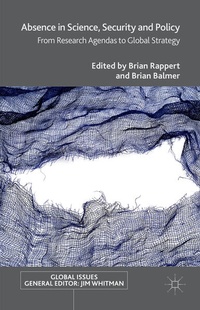
Absence in Science, Security and Policy
From Research Agendas to Global Strategy
Published on 24. August 2015
Book
Hardback
XV, 240 pages
978-1-137-49372-9 (ISBN)
Description
This book explores the absent and missing in debates about science and security. Through varied case studies, including biological and chemical weapons control, science journalism, nanotechnology research and neuroethics, the contributors explore how matters become absent, ignored or forgotten and the implications for ethics, policy and society.The chapter 'Sensing Absence: How to See What Isn't There in the Study of Science and Security' is open access under a CC BY 4.0 license via link.springer.com.
More details
Series
Edition
1st ed. 2015
Language
English
Place of publication
London
United Kingdom
Target group
Professional and scholarly
Product notice
sewn/stitched
Cloth over boards
With dust jacket
Illustrations
XV, 240 p.
Dimensions
Height: 216 mm
Width: 140 mm
Thickness: 16 mm
Weight
445 gr
ISBN-13
978-1-137-49372-9 (9781137493729)
DOI
10.1057/9781137493736
Schweitzer Classification
Other editions
Additional editions
Brian Balmer | Brian Rappert
Absence in Science, Security and Policy
From Research Agendas to Global Strategy
E-Book
02/2016
Palgrave Macmillan
€96.29
Available for download

Brian Rappert | Brian Balmer
Absence in Science, Security and Policy
From Research Agendas to Global Strategy
Book
01/2014
Palgrave Macmillan
€85.59
The article will not be published
Persons
Malcolm Dando, University of Bradford, UK Brett Edwards, University of Bath, UK Sam Weiss Evans, Harvard University, USA Emma Frow, Arizona State University, USA Felicity Mellor, Imperial College London, UK Richard Moyes, Article 36, UK James Revill, University of Sussex, UK Michael Schillmeier, University of Exeter, UK Kathleen M. Vogel, NC State University, USA John R.Walker, Foreign and Commonwealth Office, UK Gerald Walther, University of Manchester, UK
Content
Part I: Ways Of Seeing, Ways Of Not Seeing
1. Sensing Absence: How to See What Isn ' 't There in the Study of Science and Security; Brian Rappert
2. An Open Day for Secrets: Biological Warfare, Stenganography, and Hiding Things in Plain Sight; Brian Balmer
Part II: Practices Of Inattention
3. What ELSA Makes Small in Nanomedicine: Non-Concerns in Current Trends in STS; Michael Schillmeier
4. Missing the Obvious - Coping With Scientific And Technological Change In Chemcial and Biological Weapons Arms
5. Control, 1968-2013; John Walker
6. Non-News Values in Science Journalism; Felicity Mellor
7. Project Jefferson: Technological Surprises and Critical Omissions; Kathleen Vogel
8. Taking Care of Security in Synthetic Biology; Sam Weiss Evans and Emma Frow
Part III: Sights and Sensitivities
9. What Counts as the Hostile Use of Chemicals?; James Revill and Brett Edwards
10. A Phoenix of the Modern World: The Re-Emergence of National Science Advisory Board for Biosecurity and its Implications for Scientific Practitoners; Gerald Walther and Malcolm Dando
11. Causing Problems: Classification Of Humanitarian Concerns Regarding Explosive Weapons; Richard Moyes
12. Concluding Absences; Brian Rappert and Brian Balmer
1. Sensing Absence: How to See What Isn ' 't There in the Study of Science and Security; Brian Rappert
2. An Open Day for Secrets: Biological Warfare, Stenganography, and Hiding Things in Plain Sight; Brian Balmer
Part II: Practices Of Inattention
3. What ELSA Makes Small in Nanomedicine: Non-Concerns in Current Trends in STS; Michael Schillmeier
4. Missing the Obvious - Coping With Scientific And Technological Change In Chemcial and Biological Weapons Arms
5. Control, 1968-2013; John Walker
6. Non-News Values in Science Journalism; Felicity Mellor
7. Project Jefferson: Technological Surprises and Critical Omissions; Kathleen Vogel
8. Taking Care of Security in Synthetic Biology; Sam Weiss Evans and Emma Frow
Part III: Sights and Sensitivities
9. What Counts as the Hostile Use of Chemicals?; James Revill and Brett Edwards
10. A Phoenix of the Modern World: The Re-Emergence of National Science Advisory Board for Biosecurity and its Implications for Scientific Practitoners; Gerald Walther and Malcolm Dando
11. Causing Problems: Classification Of Humanitarian Concerns Regarding Explosive Weapons; Richard Moyes
12. Concluding Absences; Brian Rappert and Brian Balmer