

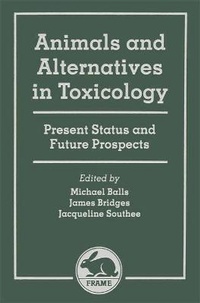
Animals and Alternatives in Toxicity Testing
Present Status and Future Prospects
Published on 10. October 1991
Book
Hardback
404 pages
978-0-333-56428-8 (ISBN)
Description
This volume considers the second report of the FRAME Toxicity Committee presenting reviews and discussions by invited authors and general discussions. It covers developments in toxicology and the use of non-animal methods in toxicity testing since the first report published in 1983. This book highlights the need for rationalization and harmonization of regulatory guidelines for more critical attitudes towards accepted animal tests, for more attention to be foused on non-animal alternatives, for more information to be made available to inform scientists of alternatives to animals and for the development and integration of non-animal alternatives. This book is aimed at assisting the reader in the development, validation and use of non-animal methods and is aimed at toxicologists, pharmacologists and policy-makers in academia, industry and government.
More details
Edition
New edition
Language
English
Place of publication
Basingstoke
United Kingdom
Target group
College/higher education
Professional and scholarly
Edition type
New edition
Illustrations
appendix, index
Dimensions
Height: 240 mm
Width: 159 mm
Weight
813 gr
ISBN-13
978-0-333-56428-8 (9780333564288)
Copyright in bibliographic data and cover images is held by Nielsen Book Services Limited or by the publishers or by their respective licensors: all rights reserved.
Schweitzer Classification
Persons
Content
The future for acute oral toxicity testing, D.G. Clark et al; the current status for non-animal alternative methods in skin and eye irritancy testing, D.W. Swanston et al; chronic toxicity testing - present perspectives and the way toward shorter screening, decreased use of resources and better risk assessment, P.H. Bach; genotoxicity testing, R.C. Garner; alternative methods and their application in Neurotoxicity testing, C.K. Atterwill; immunotoxicology and allergy - options for ex vivo and in vitro experimentation, I. Kimber and P. Botham; the future of alternative approaches in reproductive toxicity testing, P. Duffy et al; toxicity data derived from humans, G. Volans et al; ecotoxicity, C.H. Walker et al; computer modelling and information technology, D. Bawden et al; the development, validation and acceptance of in vitro toxicity tests, M. Balls et al; future developments in in vitro methodology, M. Balls et al; concluding remarks, A. McLean. Appendix - report of the Committee.