

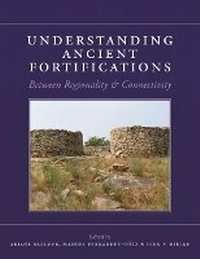
Understanding Ancient Fortifications
Between Regionality and Connectivity
Published on 3. January 2018
Book
Hardback
192 pages
978-1-78570-748-3 (ISBN)
Description
In many regions of Europe and beyond fortifications belong to the most impressive of archaeological remains. Their study has a long tradition and today a multitude of aspects about architecture, function or symbolism has been explored. However, fortifications are generally examined in a temporally, regionally or culturally limited context. Going a step further, this volume aims to bring into focus concepts of fortifications, which can be socially, symbolically or functionally, but also chronologically and supra-regionally aligned. An important question is to determine which fortification elements are culture-specific, and which can be regarded as convergence or even universal phenomena. Adopting a comparative view, the central aim of the volume is to highlight the diversity and the structural similarities of ancient fortifications. The chronological framework goes from the Neolithic to the Late Iron Age, and the geographical scope from the Ural steppes to the Iberian Peninsula.
Reviews / Votes
The volume moves beyond the physical/archaeological remains to a more conceptual consideration of fortifications, socially, symbolically and functionally and the consideration of which aspects are specific to a given 'culture' and which are more universal (albeit with some degree of variation) in a time-frame from the Neolithic to the Late Iron Age between the Near East and the Iberian peninsula. Well illustrated. * Ancient West & East * The wide scope is a great asset to this volume. The phenomenon of fortification is often studied on scales limited by chronological periods or certain regions. The total renunciation of these "borders" limiting most studies opens up a welcome opportunity to compare and investigate fortifications in a new light. [...] These are developments that are most welcome and have long been necessary. * Germania *More details
Language
English
Place of publication
Oxford
United Kingdom
Target group
Professional and scholarly
Illustrations
b/w
Dimensions
Height: 280 mm
Width: 220 mm
ISBN-13
978-1-78570-748-3 (9781785707483)
Copyright in bibliographic data and cover images is held by Nielsen Book Services Limited or by the publishers or by their respective licensors: all rights reserved.
Schweitzer Classification
Other editions
Additional editions
Ballmer Ariane Ballmer | Fernandez-Gotz Manuel Fernandez-Gotz | Mielke Dirk P. Mielke
Understanding Ancient Fortifications
Between Regionality and Connectivity
E-Book
11/2017
Oxbow Books
€40.49
Available for download
Persons
Ariane Ballmer is a scientific staff member and lecturer at the University of Heidelberg where she specialises in European prehistory. Her research interests encompass Alpine Bronze Age, landscape archaeology, ritual practices and Early Iron Age fortifications. She is author of the monograph Topografie bronzezeitlicher Deponierungen: Fallstudie Alpenrheintal (Bonn 2016). Manuel Fernandez-Goetz is Lecturer in Archaeology at the University of Edinburgh, Executive Board Member of the European Association of Archaeologists, and winner of the Philip Leverhulme Prize in Archaeology 2016. His research focuses on Iron Age societies in Central and Western Europe, the archaeology of identities, and the archaeology of the Roman conquest. Dirk Paul Mielke is a pre- and protohistorian and Ancient Near Eastern archaeologist working at the Freie Universitaet Berlin and at the Westfaelische Wilhelms-Universitaet Muenster, Germany. He has excavated in Germany, Spain, Morocco and Turkey, especially as leading member of the long-time excavations in the Hittite cities of Kusakli-Sarissa and Oymaagac Hoeyuek-Nerik. He has authored numerous fundamental articles on Hittite archaeology, archaeometry, Phoenicians in the West and fortifications.
Content
1. Understanding Ancient Fortifications: Between Regionality and Connectivity - An Introduction
Ariane Ballmer, Manuel Fernandez-Goetz and Dirk Paul Mielke
2. Environmental and cultural factors in the development of Chalcolithic fortifications in Bulgaria
Kamen Boyadzhiev
3. Fortifications and violence in the Mediterranean during the 3rd millennium BC
Vicente Lull, Rafael Mico, Cristina Rihuete and Roberto Risch
4. Pharaoh's Mighty Walls - Egypt's fortification system in the third and second millennium BC
Carola Vogel
5. Fortification systems of the Aegean Bronze Age
Walter Gauss
6. Hittite Fortifications between Function and Symbolism
Dirk P. Mielke
7. Protecting Civilisation. Cosmological and Ideological Concepts behind City Walls in Assyria
Simon Halama
8. Greek fortifications before the Persian Wars. An overview
Oliver Huelden
9. Fortifications in and around Rome, 950-300 BC
Albert J. Nijboer
10. The Iron Age Fortifications of Gabii/Latium (Italy)
Sophie Helas
11. The introduction of the 'Pfostenschlitz' concept in the fortification architecture of the north-west Alpine Hallstatt circle
Ariane Ballmer
12. Agency in Architectural Choice: The Heuneburg Hillfort as Monument and Metaphor
Bettina Arnold and Manuel Fernandez-Goetz
13. The purpose of Gallic oppida ramparts: a reappraisal
Pierre Moret
14. Defences or defenders? New interpretations on upright-stone bands in European Late Prehistory
Luis Berrocal-Rangel
Ariane Ballmer, Manuel Fernandez-Goetz and Dirk Paul Mielke
2. Environmental and cultural factors in the development of Chalcolithic fortifications in Bulgaria
Kamen Boyadzhiev
3. Fortifications and violence in the Mediterranean during the 3rd millennium BC
Vicente Lull, Rafael Mico, Cristina Rihuete and Roberto Risch
4. Pharaoh's Mighty Walls - Egypt's fortification system in the third and second millennium BC
Carola Vogel
5. Fortification systems of the Aegean Bronze Age
Walter Gauss
6. Hittite Fortifications between Function and Symbolism
Dirk P. Mielke
7. Protecting Civilisation. Cosmological and Ideological Concepts behind City Walls in Assyria
Simon Halama
8. Greek fortifications before the Persian Wars. An overview
Oliver Huelden
9. Fortifications in and around Rome, 950-300 BC
Albert J. Nijboer
10. The Iron Age Fortifications of Gabii/Latium (Italy)
Sophie Helas
11. The introduction of the 'Pfostenschlitz' concept in the fortification architecture of the north-west Alpine Hallstatt circle
Ariane Ballmer
12. Agency in Architectural Choice: The Heuneburg Hillfort as Monument and Metaphor
Bettina Arnold and Manuel Fernandez-Goetz
13. The purpose of Gallic oppida ramparts: a reappraisal
Pierre Moret
14. Defences or defenders? New interpretations on upright-stone bands in European Late Prehistory
Luis Berrocal-Rangel