

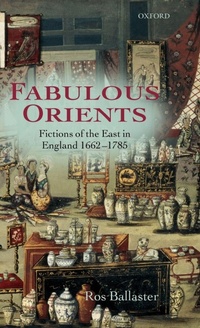
Fabulous Orients
Fictions of the East in England 1662-1785
Published on 20. October 2005
Book
Hardback
422 pages
978-0-19-926733-0 (ISBN)
Description
Narrative moves. Stories migrate from one culture to another, over vast distances sometimes, but their path is often difficult to trace and obscured by time. Fabulous Orients looks at the traffic of narrative between Orient and Occident in the eighteenth century, and challenges the assumption that has dominated since the publication of Edward Said's Orientalism (1978) that such traffic is always one-way. Eighteenth-century readers in the West came to draw their mental maps of oriental territories and distinctions between them from their experience of reading tales 'from' the Orient.
In this proto-colonial period the English encounter with the East was largely mediated through the consumption of material goods such as silks, indigo, muslin, spices, or jewels, imported from the East, together with the more 'moral' traffic of narratives about the East, both imaginary and ethnographic. Through analyses of fictional representations (including travellers' accounts, letter narratives such as Letters Writ by a Turkish Spy, and popular sequences of tales such as the Arabian Nights Entertainments) of four oriental territories (Persia, Turkey, China and India), Ros Ballaster demonstrates the ways in which the East came to be understood as a source of story, a territory of fable and narrative.
Fabulous Orients is structured according to territory rather than genre. Each section opens by re-narrating an oriental story in which a feminine character serves to 'figure' western desire for the territory she represents: the courtesan queen of the Ottoman seraglio Roxolana; the riddling Chinese princess Turandocte; and the illusory sati of India, Canzade. The book goes on to explore the range of fabulous writings relating to each territory in order to illustrate how certain narrative tropes can come to dominate its representation: the conflict between the male look and female speech staged in the seraglio in the case of Turkey and Persia, the inauthenticity and/or dullness associated with China and its products such as porcelain, and the illusory dreams that are woven in the space of India and associated with its textile industries.
This is the first book-length study of the oriental tale to appear for almost a century. Informed by recent historiographical and literary re-assessments of western constructions of the East, it develops an original argument about the use of narrative as a form of sympathetic and imaginative engagement with otherness, a disinvestment of the self rather than a confident expression of colonial or imperial ambition.
In this proto-colonial period the English encounter with the East was largely mediated through the consumption of material goods such as silks, indigo, muslin, spices, or jewels, imported from the East, together with the more 'moral' traffic of narratives about the East, both imaginary and ethnographic. Through analyses of fictional representations (including travellers' accounts, letter narratives such as Letters Writ by a Turkish Spy, and popular sequences of tales such as the Arabian Nights Entertainments) of four oriental territories (Persia, Turkey, China and India), Ros Ballaster demonstrates the ways in which the East came to be understood as a source of story, a territory of fable and narrative.
Fabulous Orients is structured according to territory rather than genre. Each section opens by re-narrating an oriental story in which a feminine character serves to 'figure' western desire for the territory she represents: the courtesan queen of the Ottoman seraglio Roxolana; the riddling Chinese princess Turandocte; and the illusory sati of India, Canzade. The book goes on to explore the range of fabulous writings relating to each territory in order to illustrate how certain narrative tropes can come to dominate its representation: the conflict between the male look and female speech staged in the seraglio in the case of Turkey and Persia, the inauthenticity and/or dullness associated with China and its products such as porcelain, and the illusory dreams that are woven in the space of India and associated with its textile industries.
This is the first book-length study of the oriental tale to appear for almost a century. Informed by recent historiographical and literary re-assessments of western constructions of the East, it develops an original argument about the use of narrative as a form of sympathetic and imaginative engagement with otherness, a disinvestment of the self rather than a confident expression of colonial or imperial ambition.
Reviews / Votes
a very welcome addition to the available scholarship * T.H. Barrett, Bulletin of the School of Oriental and African Studies * rich and wide-ranging account of Restoration and eighteenth-century fictions of the East... Critically adriot and historically nuanced... brilliant discussions * Tom Keymer *More details
Language
English
Place of publication
Oxford
United Kingdom
Target group
Professional and scholarly
Academics, postgraduates, and undergraduates working in English Literature and History of the eighteenth century. General readers interested in travel writing and the Orient.
Illustrations
numerous halftones
Dimensions
Height: 222 mm
Width: 145 mm
Thickness: 28 mm
Weight
726 gr
ISBN-13
978-0-19-926733-0 (9780199267330)
Copyright in bibliographic data and cover images is held by Nielsen Book Services Limited or by the publishers or by their respective licensors: all rights reserved.
Schweitzer Classification
Other editions
Additional editions
Book
11/2007
Oxford University Press
€70.50
Shipment within 15-20 days
Person
Born in Bombay, India, in 1962, Ros Ballaster has had an abiding interest in eastern culture and narrative. She was a visiting Fellow at Harvard University 1988-89; Lecturer in English Literature at University of East Anglia 1989-1993; and Leverhulme Major Research Fellow 2000-2003. She is currently College and University Fellow in English Literature at Mansfield College, Oxford.
Content
1. NARRATIVE MOVES; 2. SHAPE SHIFTING: ORIENTAL TALES; 3. TALES OF THE SERAGLIO: TURKEY AND PERSIA; 4. 'BEARING CONFUCIUS' MORALS TO BRITANNIA'S EARS': CHINA; 5. 'DREAMS OF MEN AWAKE': INDIA; 6. EPILOGUE: ROMANTIC REVISIONS OF THE ORIENT