

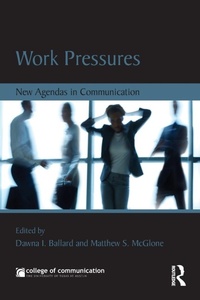
Work Pressures
New Agendas in Communication
1st Edition
Published on 13. December 2016
Book
Paperback/Softback
170 pages
978-1-138-93824-3 (ISBN)
Description
Work Pressures fills the void of research on the nature of pressures on individuals in the workplace. It offers a broad view of how work pressures can compromise the performance and vitality of individuals and their organizations. The contributions to this volume not only confirm communication's centrality to the problems work pressures pose, but also open an interdisciplinary conversation about how to learn from and, ultimately, manage them. Specific topics covered include the proliferation of communication technologies, organizational discourse, work overload, and generational differences in the workplace.
More details
Series
Language
English
Place of publication
London
United Kingdom
Publishing group
Taylor & Francis Ltd
Target group
College/higher education
Illustrations
6 s/w Tabellen
6 Tables, black and white
Dimensions
Height: 229 mm
Width: 152 mm
Thickness: 10 mm
Weight
276 gr
ISBN-13
978-1-138-93824-3 (9781138938243)
Copyright in bibliographic data and cover images is held by Nielsen Book Services Limited or by the publishers or by their respective licensors: all rights reserved.
Schweitzer Classification
Other editions
Additional editions
Book
12/2016
1st Edition
Routledge
€231.30
Shipment within 10-20 days

E-Book
12/2016
Routledge
€65.99
Available for download
Persons
Dawna Ballard is Associate Professor in the Department of Communication Studies at The University of Texas at Austin.
Matthew McGlone is Associate Professor in the Department of Communication Studies at The University of Texas at Austin.
Matthew McGlone is Associate Professor in the Department of Communication Studies at The University of Texas at Austin.
Content
Table of Contents
Preface
Dawna I. Ballard and Matthew S. McGlone
Part I
Chapter 1
Understanding Overload in a Contemporary World
Keri K. Stephens
Chapter 2
24/7: Managing Constant Connectivity
Christina Randle
Chapter 3
Communicating Work-Life Support: Implications for Organizations, Employees, and Families
Jamie Ladge
Chapter 4
Why Do We Blame Information for Our Overload?
Yoram M. Kalman
Part II
Chapter 5
To See Ourselves as Others See Us:
How Perceptions of Generational Diversity Affect the Workplace
Rhetta L. Standifer and Scott W. Lester
Chapter 6
Managing Tensions in Virtual Work Arrangements
Jennifer L. Gibbs
Chapter 7
Modern Times, Modern Spaces: Interaction Genres and Multiminding in Network-Based Work
Dawna I. Ballard, Dina Inman Ramgolam, and Estee Solomon Gray
Part III
Chapter 8
Occupational Burnout and the Case Study of Physicians
Stacey A. Passalacqua
Chapter 9
Time Is Not On Our Side: Temporal Agency and Affective Orientation in the Enron Email Corpus
Matthew S. McGlone, Joseph McGlynn, III, and Nicholas A. Merola
Chapter 10
Multi-methodological Approaches for Studying Emotion in Computer-Mediated Communication
Mark S. Pfaff and Afarin Pirzadeh
Preface
Dawna I. Ballard and Matthew S. McGlone
Part I
Chapter 1
Understanding Overload in a Contemporary World
Keri K. Stephens
Chapter 2
24/7: Managing Constant Connectivity
Christina Randle
Chapter 3
Communicating Work-Life Support: Implications for Organizations, Employees, and Families
Jamie Ladge
Chapter 4
Why Do We Blame Information for Our Overload?
Yoram M. Kalman
Part II
Chapter 5
To See Ourselves as Others See Us:
How Perceptions of Generational Diversity Affect the Workplace
Rhetta L. Standifer and Scott W. Lester
Chapter 6
Managing Tensions in Virtual Work Arrangements
Jennifer L. Gibbs
Chapter 7
Modern Times, Modern Spaces: Interaction Genres and Multiminding in Network-Based Work
Dawna I. Ballard, Dina Inman Ramgolam, and Estee Solomon Gray
Part III
Chapter 8
Occupational Burnout and the Case Study of Physicians
Stacey A. Passalacqua
Chapter 9
Time Is Not On Our Side: Temporal Agency and Affective Orientation in the Enron Email Corpus
Matthew S. McGlone, Joseph McGlynn, III, and Nicholas A. Merola
Chapter 10
Multi-methodological Approaches for Studying Emotion in Computer-Mediated Communication
Mark S. Pfaff and Afarin Pirzadeh