


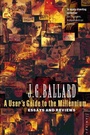
A User's Guide to the Millennium
Published on 1. July 2008
Book
Paperback/Softback
320 pages
978-0-00-729279-0 (ISBN)
Description
The ninety pieces of J. G. Ballard's non-fiction writing collected here for the first time were written between 1962 and 1995. Many touch on themes and obsessions familiar to readers of his fiction; all show the insight, wit and distinctive vision of the modern world that have characterised his work throughout his distinguished career as one of the most important voices in contemporary fiction.
The ninety pieces of J. G. Ballard's non-fiction writing collected here for the first time were written between 1962 and 1995. Many touch on themes and obsessions familiar to readers of his fiction; all show the insight, wit and distinctive vision of the modern world that have characterised his work throughout his distinguished career as one of the most important voices in contemporary fiction.
The ninety pieces of J. G. Ballard's non-fiction writing collected here for the first time were written between 1962 and 1995. Many touch on themes and obsessions familiar to readers of his fiction; all show the insight, wit and distinctive vision of the modern world that have characterised his work throughout his distinguished career as one of the most important voices in contemporary fiction.
Reviews / Votes
Few writers can write with equal facility about Elvis Presley, Norwegian lobsters and Deng Xiaoping. Ballard does so with great flair and energy in this fabulously diverse collection. It crackles with a mandarin diversity of interests, from Winnie-the-Pooh to General Schwarzkopf. As we get closer to the year 2000, Ballard offers an exhilarating account of 20th century mayhem. Ian Thomson, Independent on Sunday Ballard's prescience about technological development seems mostrously acute. Like H. G. Wells talking to an audience of the 1900s, he gives an impression not only knowing what the future will be like, but of actually relishing its arrival. As well as the prescience and the clear autobiographer's eye, we should also value J. G. Ballard for his sense of humour. D J. Taylor, Independent In a shrinking world increasingly bereft of original imaginations, J. G. Ballard stands alone, a bizarre visionary maverick. Cinema, surrealist painting, crime, the future, madness, sf and China - these a Ballard's specialist subjects. Best of all in this eccentric, relaxed, always readable collection are his laconic wartime memories, the treasure house he kept locked for forty years. Eileen Battersby, Irish times. For the reader, pleasure derives largely from coming on the unexpected on every other page, and from randomly discovering new insights into familiar topics, or introductions to unfamiliar ones. Ballard's cool sardonic gaze, eyeing the absurdities of the late twentieth century through the distancing science-fictional viewfinder, renders tragedy almost amusing. Times Literary SupplementFew writers can write with equal facility about Elvis Presley, Norwegian lobsters and Deng Xiaoping. Ballard does so with great flair and energy in this fabulously diverse collection. It crackles with a mandarin diversity of interests, from Winnie-the-Pooh to General Schwarzkopf. As we get closer to the year 2000, Ballard offers an exhilarating account of 20th century mayhem. Ian Thomson, Independent on Sunday Ballard's prescience about technological development seems mostrously acute. Like H. G. Wells talking to an audience of the 1900s, he gives an impression not only knowing what the future will be like, but of actually relishing its arrival. As well as the prescience and the clear autobiographer's eye, we should also value J. G. Ballard for his sense of humour. D J. Taylor, Independent In a shrinking world increasingly bereft of original imaginations, J. G. Ballard stands alone, a bizarre visionary maverick. Cinema, surrealist painting, crime, the future, madness, sf and China - these a Ballard's specialist subjects. Best of all in this eccentric, relaxed, always readable collection are his laconic wartime memories, the treasure house he kept locked for forty years. Eileen Battersby, Irish times. For the reader, pleasure derives largely from coming on the unexpected on every other page, and from randomly discovering new insights into familiar topics, or introductions to unfamiliar ones. Ballard's cool sardonic gaze, eyeing the absurdities of the late twentieth century through the distancing science-fictional viewfinder, renders tragedy almost amusing. Times Literary Supplement
More details
Language
English
Place of publication
London
United Kingdom
Publishing group
HarperCollins Publishers
Product notice
Paperback (UK-B)
Dimensions
Height: 197 mm
Width: 130 mm
Thickness: 17 mm
Weight
350 gr
ISBN-13
978-0-00-729279-0 (9780007292790)
Copyright in bibliographic data is held by Nielsen Book Services Limited or its licensors: all rights reserved.
Schweitzer Classification
Other editions
Previous edition
Person
J.G. Ballard was born in 1930 in Shanghai, where his father was a businessman. After internment in a civilian prison camp, he and his family returned to England in 1946. He published his first novel, The Drowned World, in 1961. His 1984 bestseller Empire of the Sun won the Guardian Fiction Prize and the James Tait Black Memorial Prize, and was shortlisted for the Booker Prize. It was later filmed by Steven Spielberg. His memoir Miracles of Life was published in 2008. J.G. Ballard died in 2009.
J.G. Ballard was born in 1930 in Shanghai, where his father was a businessman. After internment in a civilian prison camp, he and his family returned to England in 1946. He published his first novel, The Drowned World, in 1961. His 1984 bestseller Empire of the Sun won the Guardian Fiction Prize and the James Tait Black Memorial Prize, and was shortlisted for the Booker Prize. It was later filmed by Steven Spielberg. His memoir Miracles of Life was published in 2008. J.G. Ballard died in 2009.
J.G. Ballard was born in 1930 in Shanghai, where his father was a businessman. After internment in a civilian prison camp, he and his family returned to England in 1946. He published his first novel, The Drowned World, in 1961. His 1984 bestseller Empire of the Sun won the Guardian Fiction Prize and the James Tait Black Memorial Prize, and was shortlisted for the Booker Prize. It was later filmed by Steven Spielberg. His memoir Miracles of Life was published in 2008. J.G. Ballard died in 2009.