

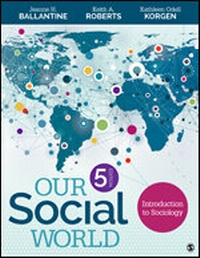
Our Social World
Introduction to Sociology
5th Edition
Published on 17. March 2015
Book
Paperback/Softback
704 pages
978-1-4833-6860-3 (ISBN)
Description
In the new Fifth Edition of Our Social World: Introduction to Sociology, three award-winning authors and teachers of sociology set out to inspire students to develop their sociological imaginations. Readers are encouraged to see the impact of larger social structures and global trends on their personal lives and to actively engage with sociological issues. In each chapter, authors Jeanne H. Ballantine, Keith A. Roberts, and new co-author Kathleen Odell Korgen, relate everything back to the social world model to promote "deep learning" of a fundamental sociological concept: the micro-to-macro organization of society. Above all else, adopters of this unique, easy to read, and innovative text use it because it helps students to learn about sociology and to use sociological tools throughout the course and beyond. At the end of the term, students are able to articulate a coherent thesis about what sociology is and how sociology helps them to make sense of the multi-layered social world in which they live. Can you identify any other introductory text which has a coherent thesis that runs throughout the text?
More details
Edition
5th Revised edition
Language
English
Place of publication
Thousand Oaks
United States
Target group
College/higher education
Edition type
Revised edition
Dimensions
Height: 279 mm
Width: 216 mm
Weight
1230 gr
ISBN-13
978-1-4833-6860-3 (9781483368603)
Copyright in bibliographic data and cover images is held by Nielsen Book Services Limited or by the publishers or by their respective licensors: all rights reserved.
Schweitzer Classification
Other editions
New editions
Jeanne H. Ballantine | Keith A. Roberts | Kathleen Odell Korgen
Our Social World
Introduction to Sociology
Book
2018
6th Edition
SAGE Publications (USA)
€114.24
The article will not be published
Previous edition
Book
05/2013
4th Edition
SAGE Publications Inc
€99.36
Article exhausted; check for reprint
Persons
Jeanne H. Ballantine is Emerita Professor of Sociology at Wright State University, a state university of about 17,000 students in Ohio. She has also taught at several 4-year colleges, including an "alternative" college and a traditionally Black college, and at international programs in universities abroad. She has been teaching introductory sociology for more than 30 years with a mission to introduce the uninitiated to the field and to help students see the usefulness and value in sociology. She has been active in the teaching movement, shaping curriculum, writing and presenting research on teaching, and offering workshops and consulting in regional, national, and international forums. She is a Fulbright Senior Scholar and serves as a Departmental Resources Group consultant and evaluator.
Jeanne has written several textbooks, all with the goal of reaching the student audience. As the original director of the Center for Teaching and Learning at Wright State University, she scoured the literature on student learning and served as a mentor to teachers in a wide variety of disciplines. Local, regional, and national organizations have honored her for her teaching and for her contributions to helping others become effective teachers. In 1986, the American Sociological Association's Section on Undergraduate Education (now called the Section on Teaching and Learning in Sociology) recognized her with the Hans O. Mauksch Award for Distinguished Contributions to Teaching of Sociology. In 2004, she was honored by the American Sociological Association with its Distinguished Contributions to Teaching Award. In 2010, the North Central Sociological Association awarded her the J. Milton Yinger Award for Distinguished Career in Sociology.
Keith A. Roberts (1947-2018) was Professor Emeritus of Sociology at Hanover College in Indiana. In 2000, he received the Hans O. Mauksch Award for Distinguished Contributions to Undergraduate Sociology from the ASA Section on Teaching and Learning, and in 2010, his work in the scholarship of teaching and learning was recognized with the American Sociological Association's Distinguished Contributions to Teaching Award.
Kathleen Odell Korgen is Professor of Sociology at William Paterson University, a comprehensive university in Wayne, New Jersey. Kathleen enjoys teaching her students that sociology is a remarkably useful discipline and highlights how "Sociologists in Action" make a positive impact on society. Her published works on race relations and racial identity include From Black to Biracial, Crossing the Racial Divide, Multiracial Americans and Social Class, Race Policy and Multiracial Americans. Her teaching texts, in addition to Sociology in Action, include Our Social World, The Engaged Sociologist, Sociologists in Action, , and Social Problems in Action. Kathleen is also the editor of The Cambridge Handbook of Sociology.
Kathleen works as a consultant for other sociology departments as a member of the American Sociological Association Departmental Resources Group and received William Paterson University's award for Excellence in Scholarship/Creative Expression in 2006 and the university's award for Excellence in Teaching in 2014.
Jeanne has written several textbooks, all with the goal of reaching the student audience. As the original director of the Center for Teaching and Learning at Wright State University, she scoured the literature on student learning and served as a mentor to teachers in a wide variety of disciplines. Local, regional, and national organizations have honored her for her teaching and for her contributions to helping others become effective teachers. In 1986, the American Sociological Association's Section on Undergraduate Education (now called the Section on Teaching and Learning in Sociology) recognized her with the Hans O. Mauksch Award for Distinguished Contributions to Teaching of Sociology. In 2004, she was honored by the American Sociological Association with its Distinguished Contributions to Teaching Award. In 2010, the North Central Sociological Association awarded her the J. Milton Yinger Award for Distinguished Career in Sociology.
Keith A. Roberts (1947-2018) was Professor Emeritus of Sociology at Hanover College in Indiana. In 2000, he received the Hans O. Mauksch Award for Distinguished Contributions to Undergraduate Sociology from the ASA Section on Teaching and Learning, and in 2010, his work in the scholarship of teaching and learning was recognized with the American Sociological Association's Distinguished Contributions to Teaching Award.
Kathleen Odell Korgen is Professor of Sociology at William Paterson University, a comprehensive university in Wayne, New Jersey. Kathleen enjoys teaching her students that sociology is a remarkably useful discipline and highlights how "Sociologists in Action" make a positive impact on society. Her published works on race relations and racial identity include From Black to Biracial, Crossing the Racial Divide, Multiracial Americans and Social Class, Race Policy and Multiracial Americans. Her teaching texts, in addition to Sociology in Action, include Our Social World, The Engaged Sociologist, Sociologists in Action, , and Social Problems in Action. Kathleen is also the editor of The Cambridge Handbook of Sociology.
Kathleen works as a consultant for other sociology departments as a member of the American Sociological Association Departmental Resources Group and received William Paterson University's award for Excellence in Scholarship/Creative Expression in 2006 and the university's award for Excellence in Teaching in 2014.
Content
PART I Understanding Our Social World: The Scientific Study of Society
Chapter 1: Sociology: A Unique Way to View the World
What Is Sociology?
Why Does Sociology Matter?
The Social World Model
Chapter 2: Examining the Social World: How Do We Know?
The Development of Sociology
Sociology's Major Theoretical Perspectives
Ideas Underlying Science
How Sociologists Study the Social World
PART II Social Structure, Processes, and Control
Chapter 3: Society and Culture: Hardware and Software of Our Social World
Society: The Hardware
Culture: The Software
Society, Culture, and Our Social World
Theories of Culture
The Fit Between Hardware and Software
Chapter 4: Socialization Becoming Human and Humane
Nature Versus Nurture-or Both Working Together?
The Importance of Socialization
Socialization and the Social World
Development of the Self: Micro-Level Analysis
Agents of Socialization: The Micro-Meso Connection
Socialization and Macro-Level Issues
Policy and Practice
Chapter 5: Interaction, Groups, and Organization: Connections That Work
Networks and Connections in Our Social World
The Process of Interaction: Connections at the Micro Level
Groups in Our Social World: The Micro-Meso Connection
Organizations and Bureaucracies: The Meso-Macro Connection
National and Global Networks: The Macro Level
Chapter 6: Deviance and Social Control: Sickos, Weirdos, Freaks, and Folks Like Us
What Is Deviance?
What Causes Deviant Behavior? Theoretical Perspectives
Crime and Individuals: Micro-Level Analysis
Crime and Organizations: Meso-Level Analysis
National and Global Crime: Macro-Level Analysis
Controlling Crime: Social Policy Considerations
PART III Inequality
Chapter 7: Stratification: Rich and Famous- or Rags and Famine?
The Importance of Social Stratification
Theoretical Explanations of Stratification
Individuals' Social Status: The Micro Level
Social Mobility: The Micro-Meso Connection
Major Stratification Systems: Macro-Level Analysis
Poverty and Social Policy
National and Global Digital Divide: Macro-Level Stratification
Chapter 8: Race and Ethnic Group Stratification: Beyond "Us" and "Them"
What Characterizes Racial and Ethnic Groups?
Prejudice: Micro-Level Analysis
Discrimination: Meso-Level Analysis
Dominant and Minority Group Contact: Macro-Level Analysis
Policies Governing Minority and Dominant Group Relations
Chapter 9: Gender Stratification: She/He-Who Goes First?
Sex, Gender, and the Stratification System
Gender Socialization: Micro- to Meso-Level Analyses
Gender Stratification: Meso- and Macro-Level Processes
Gender Stratification: Micro- to Macro-Level Theories
Costs and Consequences of Gender Stratification
Changing Gender Stratification and Social Policy
PART IV Institutions
The Importance of Institutions
The Development of Modern Institutions
The Interconnections Between Institutions
Chapter 10: Family: Partner Taking, People Making, and Contract Breaking
What Is a Family?
Theoretical Perspectives on Family
Family Dynamics: Micro-Level Processes
The Family as an Institution: Meso-Level Analysis
National and Global Family Issues: Macro-Level Analysis
National and Global Family Issues: Macro-Level Analysis
Chapter 11: Education: What Are We Learning?
State of the World's Education: An Overview
The Ins and Outs of Local Schools: Micro-Level Interactions in Educational Organizations
After the School Bell Rings: Meso-Level Analysis of Educational Organizations
Education, Society, and the Road to Opportunity: The Macro Level
Educational and Social Policy Issues
Chapter 12: Religion: The Social Meaning of Sacred Meaning
What Does Religion Do for Us?
Becoming Part of a Faith Community: Micro-Level Analysis
Religion and Modern Life: Meso-Level Analysis
Religion in Society: Macro-Level Analysis
Religion in the Modern World
Social Policy: Same Sex Marriage and Gay/Lesbian Clergy
Chapter 13: Politics and Economics: Penetrating Power and Privilege
What Is Power?
Power and Privilege in the Social World
Theoretical Perspectives on Power and Privilege
Micro-Level Analysis: Individuals, Power, and Participation
Meso-Level Analysis: Distributions of Power and Privilege Within a Nation
Macro-Level Analysis: National and Global Systems of Governance and Power
Chapter 14: Health Care: An Anatomy of Health And Illness
Why Is Health a Social Issue?
Theoretical Perspectives on Health and Illness
The Status and Roles of the Sick Person: Micro-Level Analysis
Modern Health Care Systems: Meso-Level Analysis
Health Care Issues at National And Global Levels: Macro-Level Analysis
PART V: Social Dynamics
Chapter 15: Population and Urbanization: Living on Planet Earth
Macro-Level Patterns in World Population Growth
Meso-Level Institutional Influences on Population Change
Micro-Level Population Patterns
Urbanization: Movement From Rural to Urban Areas
Cities as Micro-Level Living Environments
How Did Cities Evolve? Meso-Level Organizational Structures
The Urban Environment and Social Policy: Macro-Level Perspectives
Chapter 16: The Process of Change: We Can Make a Difference!
The Complexity of Change in Our Social World
Social Change: Process and Theories
Collective Behavior: Micro- to Meso-Level Behavior and Change
Planned Change in Organizations: Meso-Level Change
Social Movements: Macro-Level Change
Technology, Environment, and Change
Chapter 1: Sociology: A Unique Way to View the World
What Is Sociology?
Why Does Sociology Matter?
The Social World Model
Chapter 2: Examining the Social World: How Do We Know?
The Development of Sociology
Sociology's Major Theoretical Perspectives
Ideas Underlying Science
How Sociologists Study the Social World
PART II Social Structure, Processes, and Control
Chapter 3: Society and Culture: Hardware and Software of Our Social World
Society: The Hardware
Culture: The Software
Society, Culture, and Our Social World
Theories of Culture
The Fit Between Hardware and Software
Chapter 4: Socialization Becoming Human and Humane
Nature Versus Nurture-or Both Working Together?
The Importance of Socialization
Socialization and the Social World
Development of the Self: Micro-Level Analysis
Agents of Socialization: The Micro-Meso Connection
Socialization and Macro-Level Issues
Policy and Practice
Chapter 5: Interaction, Groups, and Organization: Connections That Work
Networks and Connections in Our Social World
The Process of Interaction: Connections at the Micro Level
Groups in Our Social World: The Micro-Meso Connection
Organizations and Bureaucracies: The Meso-Macro Connection
National and Global Networks: The Macro Level
Chapter 6: Deviance and Social Control: Sickos, Weirdos, Freaks, and Folks Like Us
What Is Deviance?
What Causes Deviant Behavior? Theoretical Perspectives
Crime and Individuals: Micro-Level Analysis
Crime and Organizations: Meso-Level Analysis
National and Global Crime: Macro-Level Analysis
Controlling Crime: Social Policy Considerations
PART III Inequality
Chapter 7: Stratification: Rich and Famous- or Rags and Famine?
The Importance of Social Stratification
Theoretical Explanations of Stratification
Individuals' Social Status: The Micro Level
Social Mobility: The Micro-Meso Connection
Major Stratification Systems: Macro-Level Analysis
Poverty and Social Policy
National and Global Digital Divide: Macro-Level Stratification
Chapter 8: Race and Ethnic Group Stratification: Beyond "Us" and "Them"
What Characterizes Racial and Ethnic Groups?
Prejudice: Micro-Level Analysis
Discrimination: Meso-Level Analysis
Dominant and Minority Group Contact: Macro-Level Analysis
Policies Governing Minority and Dominant Group Relations
Chapter 9: Gender Stratification: She/He-Who Goes First?
Sex, Gender, and the Stratification System
Gender Socialization: Micro- to Meso-Level Analyses
Gender Stratification: Meso- and Macro-Level Processes
Gender Stratification: Micro- to Macro-Level Theories
Costs and Consequences of Gender Stratification
Changing Gender Stratification and Social Policy
PART IV Institutions
The Importance of Institutions
The Development of Modern Institutions
The Interconnections Between Institutions
Chapter 10: Family: Partner Taking, People Making, and Contract Breaking
What Is a Family?
Theoretical Perspectives on Family
Family Dynamics: Micro-Level Processes
The Family as an Institution: Meso-Level Analysis
National and Global Family Issues: Macro-Level Analysis
National and Global Family Issues: Macro-Level Analysis
Chapter 11: Education: What Are We Learning?
State of the World's Education: An Overview
The Ins and Outs of Local Schools: Micro-Level Interactions in Educational Organizations
After the School Bell Rings: Meso-Level Analysis of Educational Organizations
Education, Society, and the Road to Opportunity: The Macro Level
Educational and Social Policy Issues
Chapter 12: Religion: The Social Meaning of Sacred Meaning
What Does Religion Do for Us?
Becoming Part of a Faith Community: Micro-Level Analysis
Religion and Modern Life: Meso-Level Analysis
Religion in Society: Macro-Level Analysis
Religion in the Modern World
Social Policy: Same Sex Marriage and Gay/Lesbian Clergy
Chapter 13: Politics and Economics: Penetrating Power and Privilege
What Is Power?
Power and Privilege in the Social World
Theoretical Perspectives on Power and Privilege
Micro-Level Analysis: Individuals, Power, and Participation
Meso-Level Analysis: Distributions of Power and Privilege Within a Nation
Macro-Level Analysis: National and Global Systems of Governance and Power
Chapter 14: Health Care: An Anatomy of Health And Illness
Why Is Health a Social Issue?
Theoretical Perspectives on Health and Illness
The Status and Roles of the Sick Person: Micro-Level Analysis
Modern Health Care Systems: Meso-Level Analysis
Health Care Issues at National And Global Levels: Macro-Level Analysis
PART V: Social Dynamics
Chapter 15: Population and Urbanization: Living on Planet Earth
Macro-Level Patterns in World Population Growth
Meso-Level Institutional Influences on Population Change
Micro-Level Population Patterns
Urbanization: Movement From Rural to Urban Areas
Cities as Micro-Level Living Environments
How Did Cities Evolve? Meso-Level Organizational Structures
The Urban Environment and Social Policy: Macro-Level Perspectives
Chapter 16: The Process of Change: We Can Make a Difference!
The Complexity of Change in Our Social World
Social Change: Process and Theories
Collective Behavior: Micro- to Meso-Level Behavior and Change
Planned Change in Organizations: Meso-Level Change
Social Movements: Macro-Level Change
Technology, Environment, and Change