

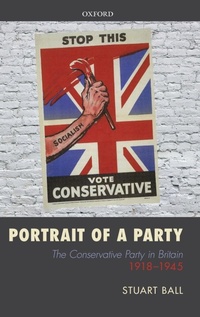
Portrait of a Party
The Conservative Party in Britain 1918-1945
Published on 25. April 2013
Book
Hardback
608 pages
978-0-19-966798-7 (ISBN)
Description
The Conservative Party is the least investigated and understood of British political parties, despite its long record of success. Using an original approach and an unparalleled range of sources, Stuart Ball analyses the nature and working of the Conservative Party during one of the most significant and successful periods in its history. The creation of a democratic franchise in 1918 was followed by nearly three decades of Conservative dominance: it was the largest party in the House of Commons and in government for almost 25 years between 1918 and 1945.
Stuart Ball explores this remarkable record in a different way, by taking a thematic rather than a chronological approach. He begins with the foundations of Conservative principles, attitudes, and identities, and examines the nature of the party's electoral support. He investigates the Conservative Party as an organism, uncovering the composition, roles, and relationships of every level from the constituency grass-roots, through the party machine and the parliamentary ranks, to the Cabinet Ministers and the Party Leader. Portrait of a Party is based upon a wide range of archives - including the personal papers of all five Party Leaders, nearly 50 Cabinet Ministers and 85 backbench MPs, party officials and others - combined with the rich resources of the national and regional records at the Conservative Party Archive, and a major investigation to locate all the significant collections of local Conservative Association records in England, Scotland, and Wales: a total of 215 constituencies, from Truro to Inverness. These sources shed new light on topics which are essential to an understanding of British history in the inter-war period and the development the Conservative Party to the present day.
Stuart Ball explores this remarkable record in a different way, by taking a thematic rather than a chronological approach. He begins with the foundations of Conservative principles, attitudes, and identities, and examines the nature of the party's electoral support. He investigates the Conservative Party as an organism, uncovering the composition, roles, and relationships of every level from the constituency grass-roots, through the party machine and the parliamentary ranks, to the Cabinet Ministers and the Party Leader. Portrait of a Party is based upon a wide range of archives - including the personal papers of all five Party Leaders, nearly 50 Cabinet Ministers and 85 backbench MPs, party officials and others - combined with the rich resources of the national and regional records at the Conservative Party Archive, and a major investigation to locate all the significant collections of local Conservative Association records in England, Scotland, and Wales: a total of 215 constituencies, from Truro to Inverness. These sources shed new light on topics which are essential to an understanding of British history in the inter-war period and the development the Conservative Party to the present day.
Reviews / Votes
the book should inspire historians to do more research on the Partys political culture, identity, and language. * Gary Love, Norwegian University of Science and Technology, Twentieth Century British History * This book should be essential reading for any modern politician, from the humblest constituency envelope-stuffer to the present Prime Minister. * Ian Cawood, The Times Literary Supplement * the fundamental importance of Ball's work ... is to demonstrate beyond all doubt that there is sufficient source material to encourage further and deeper research on the interwar Conservative Party. In fact, the book should inspire historians to do more research on the Partys political culture, identity, and language. * Gary Love, 20th Century British History * the most thorough history thus far of any 20th-century British political party. ... a portrait in the truest sense. It is as much a major contribution to historical method as it is to the history of 20th-century Britain. * Dr Andrew Thorpe, Reviews in History * This is a big and important book. Stuart Ball weaves together a narrative and a thematic approach in order not just to tell the story of the Conservative Party between the wars but to provide a guide to its anatomy and its ecology ... Ball's book can be dipped into with delight or read from start to finish * Averil Cameron, English Historical Review * The highly-nuanced analysis presented in Portrait of a Party is the product of its wealth of detail. * N.C. Fleming, Parliamentary History *More details
Language
English
Place of publication
Oxford
United Kingdom
Target group
College/higher education
Dimensions
Height: 240 mm
Width: 161 mm
Thickness: 37 mm
Weight
1068 gr
ISBN-13
978-0-19-966798-7 (9780199667987)
Copyright in bibliographic data and cover images is held by Nielsen Book Services Limited or by the publishers or by their respective licensors: all rights reserved.
Schweitzer Classification
Other editions
Additional editions
E-Book
04/2013
1st Edition
OUP eBook
€63.49
Available for download
Person
Stuart Ball was educated at Eltham College, London, and the University of St. Andrews. He has published extensively on the history of the Conservative Party and of the British Parliament during the twentieth century, including editing the two volume edition of the diaries of the Conservative MP, Cuthbert Headlam. He is the author of the essay on Stanley Baldwin in the Oxford Dictionary of National Biography, and is Treasurer of the Parliamentary History Trust.
Content
Introduction: the Portrait of a Party ; 1. Conservatism: Principles and Temperament ; 2. The Public: Appeal and Support ; 3. The Constituency Associations: Members and Activities ; 4. The National Union and the Central Office: Representation and Organisation ; 5. The Parliamentary Party: Composition and Dissent ; 6. Ministers: Juniors and the Cabinet ; 7. Leaders: Authority and Crises ; Conclusion: Effectiveness and Nature ; Appendix 1: Conservative Party office-holders 1918-1945 ; Appendix 2: The economic and social analysis of Conservative electoral support ; Appendix 3: The regional analysis of Conservative electoral support ; Appendix 4: Conservative Party national expenditure 1925-1945 ; Bibliography