

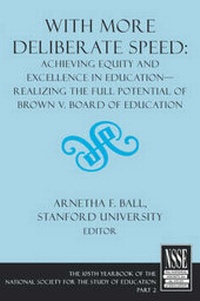
With More Deliberate Speed
Achieving Equity and Excellence in Education-Realizing the Full Potential of Brown v. Board of Education Part II
Published on 11. December 2006
Book
Paperback/Softback
300 pages
978-1-4051-5611-0 (ISBN)
Description
This volume, edited by Arnetha Ball of Stanford University, examines Brown v. Board of Education historically, politically, and culturally from a literacy perspective.
Features primary chapters from senior scholars, and commentaries by junior scholars.
Contributors include Edmund Gordon, Beatrice Bridgall, John Baugh, Kris Gutierrez, Joyce King, Gloria Ladson-Billings, James Anderson, and Guadalupe Valdes.
Features primary chapters from senior scholars, and commentaries by junior scholars.
Contributors include Edmund Gordon, Beatrice Bridgall, John Baugh, Kris Gutierrez, Joyce King, Gloria Ladson-Billings, James Anderson, and Guadalupe Valdes.
More details
Series
Language
English
Place of publication
Hoboken
United Kingdom
Publishing group
John Wiley and Sons Ltd
Target group
Professional and scholarly
Dimensions
Height: 236 mm
Width: 160 mm
Thickness: 25 mm
Weight
676 gr
ISBN-13
978-1-4051-5611-0 (9781405156110)
Copyright in bibliographic data and cover images is held by Nielsen Book Services Limited or by the publishers or by their respective licensors: all rights reserved.
Schweitzer Classification
Person
Content
Introduction. Part One Looking Back: Historical Perspective on Brown v. Board of Education.
Chapter 1. A tale of two Browns: Constitutional and Equality and Unequal Education. (James D. Anderson).
Chapter 2. Response: A Tale of Two Movements: The Power and Consequences of Misremembering. (Joy Ann Williamson).
Chapter 3. The Affirmative Development of Academic Ability: In Pursuit of Social Justice. (Edmund W. Gordon & Beatrice L. Bridglall).
Chapter 4. The Affirmative Development of Academic Ability: A Response to Edmund Gordon. (Carol D. Lee).
Part Two US Implications of Brown v. Board of Education.
Chapter 5. Linguistic Considerations Pertaining to Brown vs. Board: Exposing Racial Fallacies in the New Millennium. (John Baugh).
Chapter 6. Response: Preparation, Pedagogy, Policy, and Power: Brown The King Case, And The Struggle For Equal Language Rights. (Arnetha F. Ball & H. Samy Alim).
Chapter 7. The Linguistic Isolation of Hispanic Students in California's Public Schools: The Challenge of Reintegration. (Bernard R. Gifford & Guadalupe Valdes).
Chapter 8. A Response to "The Linguistic Isolation of Hispanic Students in California's Public Schools. (Robert T. Jimenez).
Chapter 9. Looking for Educational Equity: The Consequences of Relying on Brown. (Kris D. Gutierrez & Nathalia E. Jaramillo).
Chapter 10. A Multivoiced Response to The Call for An Equity-Based Framework. (Yolanda J. Majors & Sana Ansari).
Part Three Comparative Reflections on Brown v. Board of Education.
Chapter 11. The Ties that Bind: Race and Restitution in Education Law and Policy in South Africa and The United Sates of America. (Jonathan D. Jansen).
Chapter 12. The Ties That Bind: A Response to Jonathan Jansen. (Chika Trevor Sehoole).
Chapter 13. Brown v. Board of Education: South Africa Perspective. (Neville Alexander).
Chapter 14. Response: Brown v. Board: With all Deliberate Speed? (Monica Hendricks).
Part Four Looking Forward: Pressing Challenges That Lie Ahead.
Chapter 15. The Meaning of Brown...For Now. (Gloria Ladson-Billings).
Chapter 16. Response: The Premise of Black Inferiority: an Enduring Obstacle Fifty Years Post-Brown. (Carla O'Connor).
Chapter 17. "If justice is Our Objective": Diaspora Literacy, Heritage Knowledge, and the Praxis of Critical Studyin' For Human Freedom. (Joyce E. King).
Chapter 18. Response: Building a Literocracy: Diaspora Literacy and Heritage Knowledge in Participatory Literacy Communities. (Maisha T. Fisher).
Epilogue: The Implications of Brown v. Board of Education in and Increasingly Diverse Society. (Kenji Hakuta).
Subject and Name Index.
Chapter 1. A tale of two Browns: Constitutional and Equality and Unequal Education. (James D. Anderson).
Chapter 2. Response: A Tale of Two Movements: The Power and Consequences of Misremembering. (Joy Ann Williamson).
Chapter 3. The Affirmative Development of Academic Ability: In Pursuit of Social Justice. (Edmund W. Gordon & Beatrice L. Bridglall).
Chapter 4. The Affirmative Development of Academic Ability: A Response to Edmund Gordon. (Carol D. Lee).
Part Two US Implications of Brown v. Board of Education.
Chapter 5. Linguistic Considerations Pertaining to Brown vs. Board: Exposing Racial Fallacies in the New Millennium. (John Baugh).
Chapter 6. Response: Preparation, Pedagogy, Policy, and Power: Brown The King Case, And The Struggle For Equal Language Rights. (Arnetha F. Ball & H. Samy Alim).
Chapter 7. The Linguistic Isolation of Hispanic Students in California's Public Schools: The Challenge of Reintegration. (Bernard R. Gifford & Guadalupe Valdes).
Chapter 8. A Response to "The Linguistic Isolation of Hispanic Students in California's Public Schools. (Robert T. Jimenez).
Chapter 9. Looking for Educational Equity: The Consequences of Relying on Brown. (Kris D. Gutierrez & Nathalia E. Jaramillo).
Chapter 10. A Multivoiced Response to The Call for An Equity-Based Framework. (Yolanda J. Majors & Sana Ansari).
Part Three Comparative Reflections on Brown v. Board of Education.
Chapter 11. The Ties that Bind: Race and Restitution in Education Law and Policy in South Africa and The United Sates of America. (Jonathan D. Jansen).
Chapter 12. The Ties That Bind: A Response to Jonathan Jansen. (Chika Trevor Sehoole).
Chapter 13. Brown v. Board of Education: South Africa Perspective. (Neville Alexander).
Chapter 14. Response: Brown v. Board: With all Deliberate Speed? (Monica Hendricks).
Part Four Looking Forward: Pressing Challenges That Lie Ahead.
Chapter 15. The Meaning of Brown...For Now. (Gloria Ladson-Billings).
Chapter 16. Response: The Premise of Black Inferiority: an Enduring Obstacle Fifty Years Post-Brown. (Carla O'Connor).
Chapter 17. "If justice is Our Objective": Diaspora Literacy, Heritage Knowledge, and the Praxis of Critical Studyin' For Human Freedom. (Joyce E. King).
Chapter 18. Response: Building a Literocracy: Diaspora Literacy and Heritage Knowledge in Participatory Literacy Communities. (Maisha T. Fisher).
Epilogue: The Implications of Brown v. Board of Education in and Increasingly Diverse Society. (Kenji Hakuta).
Subject and Name Index.