

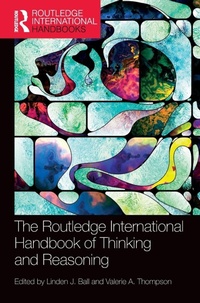
International Handbook of Thinking and Reasoning
1st Edition
Published on 20. November 2017
Book
Hardback
646 pages
978-1-138-84930-3 (ISBN)
Description
The Routledge International Handbook of Thinking and Reasoning is an authoritative reference work providing a balanced overview of current scholarship spanning the full breadth of the rapidly developing and expanding field of thinking and reasoning. It contains 35 chapters written by leading international researchers, covering foundational issues as well as state-of-the-art developments in thinking and reasoning research.
Topics covered range across all sub-areas of thinking and reasoning, including deduction, induction, abduction, judgment, decision making, argumentation, problem solving, expertise, creativity and rationality. The contributors engage with cutting-edge debates such as the status of dual-process theories of thinking, the role of unconscious, intuitive, emotional and metacognitive processes in thinking, and the importance of probabilistic conceptualisations of thinking and reasoning. Authors also examine the importance of neuroscientific findings in informing theoretical developments, and explore the situated nature of thinking and reasoning across a range of real-world contexts such as mathematics, medicine and science.
The Handbook provides a clear sense of the way in which contemporary ideas are challenging traditional viewpoints as "new paradigm of the psychology of reasoning" emerges. This paradigm-shifting research is paving the way toward a richer and more inclusive understanding of thinking and reasoning, where important new questions drive a forward-looking research agenda. It is essential reading for both established researchers in the field of thinking and reasoning as well as advanced students wishing to learn more about both the historical foundations and latest developments in this rapidly growing field.
Topics covered range across all sub-areas of thinking and reasoning, including deduction, induction, abduction, judgment, decision making, argumentation, problem solving, expertise, creativity and rationality. The contributors engage with cutting-edge debates such as the status of dual-process theories of thinking, the role of unconscious, intuitive, emotional and metacognitive processes in thinking, and the importance of probabilistic conceptualisations of thinking and reasoning. Authors also examine the importance of neuroscientific findings in informing theoretical developments, and explore the situated nature of thinking and reasoning across a range of real-world contexts such as mathematics, medicine and science.
The Handbook provides a clear sense of the way in which contemporary ideas are challenging traditional viewpoints as "new paradigm of the psychology of reasoning" emerges. This paradigm-shifting research is paving the way toward a richer and more inclusive understanding of thinking and reasoning, where important new questions drive a forward-looking research agenda. It is essential reading for both established researchers in the field of thinking and reasoning as well as advanced students wishing to learn more about both the historical foundations and latest developments in this rapidly growing field.
Reviews / Votes
"If there is any doubt that the field of thinking and reasoning is central to current psychological science, this Handbook should dispel those doubts. I can't imagine a young scholar in cognitive science who wouldn't find something of interest in this set of up-to-date empirical and theoretical chapters."-- Keith E. Stanovich, University of Toronto, author of The Rationality Quotient"This book offers authoritative overviews of every major topic in reasoning research, written by leading scholars from around the world. Its 35 chapters capture the field's history as well as its exciting cutting edge developments, making this Handbook a valuable resource for years to come."-- Norbert Schwarz, University of Southern California
"The collection of chapters brilliantly demonstrates that the field of thinking and reasoning has attained full maturity. The remarkable diversity in the theoretical approaches and the topics selected make open-mindedness and wideness of scope two hallmarks of this handbook. While the classical fundamental questions are considered, essential new developments that have emerged in the last two decades are widely treated. Also, the specific consideration of factors that affect reasoning such as emotion and culture, development, and a few applied research topics such as mathematical learning and argumentation contribute to the attractiveness of this handbook." --Guy Politzer, Institut Jean Nicod, Paris
"The Routledge International Handbook of Thinking and Reasoning brings together an impressive collection of highly esteemed experts and represents a comprehensive review of the psychology of thought. While it may appeal most to academics working in the field, it also represents a useful resource for anyone interested in the characteristics of the human mind and the underlying cognitive processes that constitute our reasoning."-- Gordon Pennycook, Banting Postdoctoral Fellow, Yale University
More details
Series
Language
English
Place of publication
Hove
United Kingdom
Publishing group
Taylor & Francis Ltd
Target group
College/higher education
Illustrations
75 s/w Abbildungen, 8 s/w Photographien bzw. Rasterbilder, 33 s/w Zeichnungen, 23 s/w Tabellen
23 Tables, black and white; 33 Line drawings, black and white; 8 Halftones, black and white; 75 Illustrations, black and white
Dimensions
Height: 250 mm
Width: 175 mm
Thickness: 40 mm
Weight
1317 gr
ISBN-13
978-1-138-84930-3 (9781138849303)
Copyright in bibliographic data and cover images is held by Nielsen Book Services Limited or by the publishers or by their respective licensors: all rights reserved.
Schweitzer Classification
Other editions
Additional editions
Linden J. Ball | Valerie A. Thompson
International Handbook of Thinking and Reasoning
Book
04/2019
1st Edition
Psychology Press Ltd
€76.20
Shipment within 15-20 days
Linden J. Ball | Valerie A. Thompson
International Handbook of Thinking and Reasoning
E-Book
11/2017
Psychology Press Ltd
€67.49
Available for download
Linden J. Ball | Valerie A. Thompson
International Handbook of Thinking and Reasoning
E-Book
11/2017
Psychology Press Ltd
€67.49
Available for download
Persons
Linden J. Ball is Professor of Cognitive Psychology and Dean of Psychology at the University of Central Lancashire. He is Editor-in-Chief of Journal of Cognitive Psychology, Associate Editor of Thinking & Reasoning and Editor for Routledge's Current Issues in Thinking & Reasoning book series.
Valerie A. Thompson is Professor of Cognitive Psychology at the University of Saskatchewan. She is Past President of the Canadian Society of Brain, Behaviour, and Cognitive Science, and is currently Editor-in-Chief of Thinking & Reasoning.
Valerie A. Thompson is Professor of Cognitive Psychology at the University of Saskatchewan. She is Past President of the Canadian Society of Brain, Behaviour, and Cognitive Science, and is currently Editor-in-Chief of Thinking & Reasoning.
Content
Preface1. Meta-Reasoning: Shedding Meta-Cognitive Light on Reasoning ResearchRakefet Ackerman and Valerie A. Thompson2. Belief Bias and ReasoningLinden J. Ball and Valerie A. Thompson3. Intuitive Thinking Tilmann Betsch and Pablina Roth 4. Emotion and ReasoningIsabelle Blanchette, Serge Caparos and Bastien Tremoliere5. Counterfactual Reasoning and Imagination Ruth M. J. Byrne 6. Fallacies of ArgumentationPeter J. Collins and Ulrike Hahn 7. Medical Decision MakingPat Croskerry8. The New Paradigm in Psychology of ReasoningShira Elqayam 9. Dual-Process TheoriesJonathan St. B. T. Evans10. Forty Years of Progress on Category-Based Inductive ReasoningAidan Feeney11. Analogical ReasoningDedre Gentner and Francisco Maravilla12. Incubation, Problem Solving and CreativityKenneth J. Gilhooly 13. Inductive and Deductive Reasoning: Integrating Insights from Philosophy, Psychology and NeuroscienceVinod Goel and Randy Waechter 14. Scientific ThinkingMichael E. Gorman?15. Working Memory, Thinking and ExpertiseZach Z. Hambrick, Alex Burgoyne, Guillermo Campitelli and Brooke N. Macnamara16. Expert Decision Making: A Fuzzy-Trace Theory PerspectiveRebecca K. Helm, Michael J. McCormick and Valerie F. Reyna17. Conversational Inference and Human ReasoningDenis J. Hilton, Bart Geurts and Peter Sedlmeier18. The Fast-and-Frugal Heuristics ProgramUlrich Hoffrage, Sebastian Hafenbraedl and Julian N. Marewski19. Mental Models and ReasoningPhilip N. Johnson-Laird, Geoffrey P. Goodwin and Sangeet S. Khemlani20. Abductive Reasoning and ExplanationBarbara Koslowski21. The Development of Logical ReasoningHenry Markovits22. Reasoning and ArgumentationHugo Mercier23. Probabilities and Bayesian RationalityMike Oaksford and Nick Chater24. Probabilistic Accounts of Conditional ReasoningDavid E. Over and Nicole Cruz25. Judgment HeuristicsTimothy Rakow and William J. Skylark26. Creative ThinkingMark A. Runco 27. Naturalistic Decision MakingJan Maarten Schraagen28. Decision Making under Risk and UncertaintyChristin Schulze and Ben R. Newell29. Several Logics for the Many Things that People do in ReasoningKeith Stenning and Alexandra Varga30. The Development of Rational Thinking: Insights from the Heuristics and Biases Literature and Dual Process ModelsMaggie E. Toplak 31. The Sense of Coherence: How Intuition Guides Reasoning and ThinkingSascha Topolinski 32. Reasoning and Moral Judgment: A Common Experimental ToolboxBastien Tremoliere, Wim De Neys and Jean-Francois Bonnefon33. Contemporary Perspectives on Mathematical Thinking and LearningKeith Weber and Kevin Moore34. Prob