

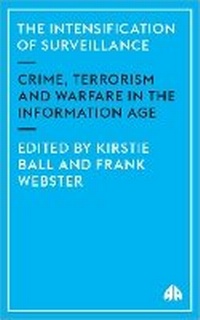
The Intensification of Surveillance
Crime, Terrorism and Warfare in the Information Age
Published on 20. September 2003
Book
Hardback
192 pages
978-0-7453-1995-7 (ISBN)
Description
Our public and private lives are under surveillance as never before. Whether we are shopping with a credit card, walking down the street or emailing a colleague at work, our activities are closely monitored.
Since September 11th 2001, surveillance has intensified further. Yet although individuals, groups, governments and states are more closely monitored, our security is not assured.
This book explores the vast range of issues related to increased surveillance. What is going on in an area clouded by secrecy from the state and complacent reassurances from corporations? How do we track suspects and combat crime without also eroding our civil liberties and sacrificing our rights to privacy? Does electronic tagging of prisoners work? What are retailers up to with 'lifestyle profiling'?
Focusing on these and other issues such as paedophilia, money-laundering, information warfare, cybercrime, and related legislation, this book spotlights benefits and costs of surveillance, and suggests how it is likely to develop in the future.
Since September 11th 2001, surveillance has intensified further. Yet although individuals, groups, governments and states are more closely monitored, our security is not assured.
This book explores the vast range of issues related to increased surveillance. What is going on in an area clouded by secrecy from the state and complacent reassurances from corporations? How do we track suspects and combat crime without also eroding our civil liberties and sacrificing our rights to privacy? Does electronic tagging of prisoners work? What are retailers up to with 'lifestyle profiling'?
Focusing on these and other issues such as paedophilia, money-laundering, information warfare, cybercrime, and related legislation, this book spotlights benefits and costs of surveillance, and suggests how it is likely to develop in the future.
More details
Language
English
Place of publication
London
United Kingdom
Target group
College/higher education
Professional and scholarly
Product notice
Library binding
Dimensions
Height: 215 mm
Width: 135 mm
Weight
388 gr
ISBN-13
978-0-7453-1995-7 (9780745319957)
Copyright in bibliographic data and cover images is held by Nielsen Book Services Limited or by the publishers or by their respective licensors: all rights reserved.
Schweitzer Classification
Other editions
Additional editions
Kirstie Ball | Frank Webster
The Intensification of Surveillance
Crime, Terrorism and Warfare in the Information Age
E-Book
09/2003
1st Edition
Pluto Press
€122.99
Available for download
Persons
Kirstie Ball is professor of management at the School of Management at University of St. Andrews. She is co-director and founder of Centre for Research into Information, Surveillance and Privacy (CRISP, co-founder of the journal Surveillance and Society and the charitable company Surveillance Studies Network. She is the co-editor with Frank Webster of The Intensification of Surveillance (Pluto Press, 2003).
Frank Webster is Professor of Sociology at City University, London. He is co-editor of The Intensification of Surveillance (Pluto Press, 2003).
Frank Webster is Professor of Sociology at City University, London. He is co-editor of The Intensification of Surveillance (Pluto Press, 2003).
Content
1. The intensification of surveillance
Kirstie Ball (Lecturer in Organizational Management, University of Birmingham) and Frank Webster (Professor of Sociology, University of Birmingham)
2. Surveillance after September 11th
David Lyon (Professor of Sociology, Queen's University, Canada)
3. Data - mining and surveillance in the post 9-11 environment
Oscar Gandy (Annenberg School of Communication, University of Pennsylvania)
4. Joined - up surveillance?
Charles Raab (Professor of Government, University of Edinburgh)
5. 'They Don't Even Know We're There':
The Electronic Monitoring of Offenders In England and Wales
Mike Nellis (Senior Lecturer in Probation Studies, University of Birmingham)
6. Information warfare, surveillance and human rights by Frank Webster
7. Mapping out Cybercrimes in a Cyberspatial Surveillant Assemblage
David Wall (Director of the Centre for Criminal Justice Studies, University of Leeds)
8. The constant state of emergency? Surveillance after 9/11
David Wood (Earl Grey Postdoctoral Research Fellow, Newcastle University), Eli Konvitz (PhD) and Kirstie Ball
Bibliography
Index
Kirstie Ball (Lecturer in Organizational Management, University of Birmingham) and Frank Webster (Professor of Sociology, University of Birmingham)
2. Surveillance after September 11th
David Lyon (Professor of Sociology, Queen's University, Canada)
3. Data - mining and surveillance in the post 9-11 environment
Oscar Gandy (Annenberg School of Communication, University of Pennsylvania)
4. Joined - up surveillance?
Charles Raab (Professor of Government, University of Edinburgh)
5. 'They Don't Even Know We're There':
The Electronic Monitoring of Offenders In England and Wales
Mike Nellis (Senior Lecturer in Probation Studies, University of Birmingham)
6. Information warfare, surveillance and human rights by Frank Webster
7. Mapping out Cybercrimes in a Cyberspatial Surveillant Assemblage
David Wall (Director of the Centre for Criminal Justice Studies, University of Leeds)
8. The constant state of emergency? Surveillance after 9/11
David Wood (Earl Grey Postdoctoral Research Fellow, Newcastle University), Eli Konvitz (PhD) and Kirstie Ball
Bibliography
Index