

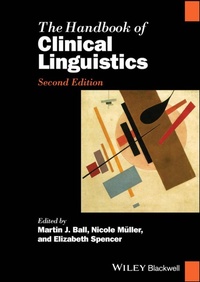
Handbook of Clinical Linguistics
Description
The Handbook of Clinical Linguistics, Second Edition provides a timely and authoritative survey of this interdisciplinary field, exploring the application of linguistic theory and method to the study of speech and language disorders. Containing 42 in-depth chapters by an international panel of established and rising scholars, this classic volume addresses a wide range of pathologies while offering valuable insights into key theory and research, multilingual and cross-linguistics factors, analysis and assessment methods, and more.
Now in its second edition, The Handbook of Clinical Linguistics features nine entirely new chapters on clinical corpus linguistics, multimodal analysis, cognition and language, the linguistics of sign languages, clinical phonotactics, typical and nontypical phonological development, clinical phonology and phonological assessment, and two chapters on instrumental analysis of voice and speech production. Revised and expanded chapters incorporate new research in clinical linguistics and place greater emphasis on specific speech disorders, connections to literacy, and multilingualism. This invaluable reference works:
Reflects the latest developments in new research and data, as well as changing perspectives about the priorities and future of the field
Features new and revised chapters throughout, many with new authors or authorial teams
Offers well-rounded coverage of the major areas of the speech sciences in the study of communication disorders
Discusses how mainstream theories and descriptions of language are influenced by clinical research
Building on the success of the first edition, The Handbook of Clinical Linguistics, Second Edition, is an indispensable resource for researchers and advanced students across all areas of speech-language sciences, including speech disorders, speech pathology, speech therapy, communication disorders, cognitive linguistics, and neurolinguistics.
<b>The new edition of the leading reference work on Clinical Linguistics, fully updated with new research and developments in the field</b>
<i>The Handbook of Clinical Linguistics, Second Edition </i>provides a timely and authoritative survey of this interdisciplinary field, exploring the application of linguistic theory and method to the study of speech and language disorders. Containing 42 in-depth chapters by an international panel of established and rising scholars, this classic volume addresses a wide range of pathologies while offering valuable insights into key theory and research, multilingual and cross-linguistics factors, analysis and assessment methods, and more.
Now in its second edition, <i>The</i> <i>Handbook</i> <i>of Clinical Linguistics </i>features nine entirely new chapters on clinical corpus linguistics, multimodal analysis, cognition and language, the linguistics of sign languages, clinical phonotactics, typical and nontypical phonological development, clinical phonology and phonological assessment, and two chapters on instrumental analysis of voice and speech production. Revised and expanded chapters incorporate new research in clinical linguistics and place greater emphasis on specific speech disorders, connections to literacy, and multilingualism. This invaluable reference works:
<ul><li>Reflects the latest developments in new research and data, as well as changing perspectives about the priorities and future of the field</li><li>Features new and revised chapters throughout, many with new authors or authorial teams</li><li>Offers well-rounded coverage of the major areas of the speech sciences in the study of communication disorders</li><li> Discusses how mainstream theories and descriptions of language are influenced by clinical research</li></ul>Building on the success of the first edition, <i>The Handbook of Clinical Linguistics, Second Edition, </i>is an indispensable resource for researchers and advanced students across all areas of speech-language sciences, including speech disorders, speech pathology, speech therapy, communication disorders, cognitive linguistics, and neurolinguistics.
More details
Other editions
Additional editions
Previous edition
Persons
Nicole Mueller is Professor of Speech and Hearing Sciences in the School of Clinical Therapies at University College Cork, Ireland. She has published widely in the fields of clinical linguistics and speech and language pathology.
Elizabeth Spencer is Senior Lecturer of Speech Pathology at the University of Newcastle, Australia. She currently studies the effects of aging on language and performs discourse analysis within the field of speech pathology.
<b>Martin J. Ball </b>is Honorary Professor at Prifysgol Bangor University, Wales, and former Professor of Speech-Language Pathology at Linkoeping University, Sweden. He has published many field-defining works and is a renowned scholar of clinical linguistics and Celtic languages.
<b>Nicole Mueller </b>is Professor of Speech and Hearing Sciences in the School of Clinical Therapies at University College Cork, Ireland. She has published widely in the fields of clinical linguistics and speech and language pathology.
<b>Elizabeth Spencer </b>is Senior Lecturer of Speech Pathology at the University of Newcastle, Australia. She currently studies the effects of aging on language and performs discourse analysis within the field of speech pathology.
Content
List of Figures
Notes on Contributors
Introduction
<i>The Editors</i>
<b>Part I Pragmatics, Discourse, and Sociolinguistics</b>
1. Discourse Analysis and Communication Disorders
Louise Keegan, Jacqueline A. Guendouzi & Nicole Mueller
2. Conversational Implicature and Communication Disorders
Francesca Foppolo & Greta Mazzaggio
3. Relevance Theory and Communication Atypicalities
Elly Ifantidou & Tim Wharton
4. Neuropragmatics
Valentina Bambini, Luca Bischetti & Federico Frau
5. Pragmatic Impairment as an Emergent Phenomenon
Michael R. Perkins & Jamie Azios
6. Conversation Analysis and Communication Disorders
Ray Wilkinson
7. Clinical Sociolinguistics
<i> Brent Archer, Eleanor Gulick, Jack Damico & Martin J. Ball, </i>
8. Systemic Functional Linguistics and Communication Disorder
Liz Spencer & Alison Ferguson
9. Multimodal Analysis of Interaction
<i>Scott Barnes & Francesco Possemato</i>
10. Cross-Linguistic and Multilingual Perspectives on Communicative Competence and Communication Impairment: Pragmatics, Discourse, and Sociolinguistics
<i> Zhu Hua & Li Wei</i>
11. Clinical Corpus Linguistics
<i>Davida Fromm & Brian MacWhinney</i>
<b> </b>
<b>Part II Syntax and Semantics</b>
12. Generative Syntactic Theory and Language Disorders
<i>Martina Penke and Eva Wimmer</i>
13. Formulaic Sequences and Language Disorder
<i>Alison Wray</i>
14. Syntactic Processing in Developmental and Acquired Language Disorders
<i>Theodoros Marinis </i>
15. Inflectional Morphology and Language Disorder
<i>Martina Penke</i>
16. Normal and Impaired Semantic Processing of Words
<i>Yves Joanette, Maximiliano Wilson & Marilyne Joyal</i>
17. Neural Correlates of Neurotypical and Pathological Language Processing
<i>Sonja A. Kotz, Stefan Frisch, & Angela D. Friederici</i>
18. Developmental Language Disorder in a Bilingual Context
<i>Jan de Jong</i>
19. Cross-Linguistic Perspectives on Morphosyntax in Child Language Disorders
<i> Stanislava Antonijevic-Elliott</i> <i>& Natalia Meir </i>
20. The complex relationship between cognition & language: illustrations from acquired
aphasia
<i>Lyndsey Nickels, Bruna Tessaro, Solene Hameau, & Christos Salis</i>
21. Linguistic and Motoric Disorders in the Sign Modality
<i>Martha Tyrone </i>
<b>Part III Phonology </b>
22. Phonology and Clinical Phonology
<i> Elena Even-Simkin </i>
23. Constraints-Based Nonlinear Phonological Theoriesin Clinical Phonology<i> </i>
<i> Joseph P. Stemberger, Barbara M. H. Bernhardt, Glenda Mason & Daniel Berube </i>
24. Articulatory Phonology and Speech Impairment
<i> Christina Hagedorn & Aravind Namasivayam</i>
25. Government Phonology and Speech Impairment
<i>Martin J. Ball & Ben Rutter</i>
26. A Usage-based Approach to Clinical Phonology
<i>Anna V. Sosa & Joan L. Bybee</i>
27. Typical and Nontypical Phonological Development
<i>Michelle Pascoe</i>
28. Vowel Development and Disorders
<i>Karen Pollock & Carol Stoel-Gammon </i>
29. Cross-Linguistic Phonological Acquisition
<i>David Ingram & Elena Babatsouli</i>
30. Cross-linguistic aspects of system and structure in clinical phonology
<i>Mehmet Yavas & </i><i>Margaret Kehoe</i>
31. Connected Speech
<i>Caroline Newton, Sara Howard, Bill Wells & John Local</i>
32. Clinical Phonology and Phonological Assessment
<i>Barbara Dodd, Alison Holm & Sharon Crosbie</i>
<b> </b>
<b>Part IV Phonetics</b>
33. Phonetic Transcription in Clinical Practice
<i> Sally Bates, Jocelynne Watson, Barry Heselwood & Sara Howard </i>
34. Instrumental Analysis of Speech Production
<i> Lucie Menard and Mark Tiede</i>
35. Instrumental Analysis of Articulation
<i> Yunjung Kim, Raymond D. Kent & Austin Thompson</i>
36. Instrumental Analysis of Voice
<i> Meike Brockmann-Bauser </i>
37. Measures of Speech Perception
<i>Jan Wouters, Robin Gransier & Astrid van Wieringen </i>
38. Neurophonetics
<i>Wolfram Ziegler, Ingrid Aichert, Theresa Schoelderle & Anja Staiger </i>
39. Coarticulation and Speech Impairment
<i>Ivana <b>Didirkova</b></i>
40. Prosodic Impairments
<i>Bill Wells & Traci Walker</i>
41. Speech Intelligibility
<i>Julie Liss</i>
42. Sociophonetics and Clinical Linguistics
<i>Gerard Docherty & Ghada Khattab</i>
Index