

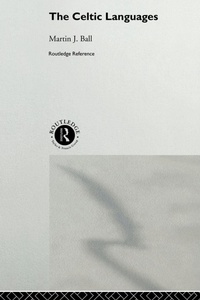
The Celtic Languages
Published on 23. May 2002
Book
Paperback/Softback
704 pages
978-0-415-28080-8 (ISBN)
Description
This comprehensive volume describes in depth all the Celtic languages from historical, structural and sociolinguistic perspectives, with individual chapters on Irish, Scottish, Gaelic, Manx, Welsh, Breton and Cornish.
Organized for ease of reference, The Celtic Languages is arranged in four parts.
The first, Historical Aspects, covers the origin and history of the Celtic languages, their spread and retreat, present-day distribution and a sketch of the extant and recently extant languages.
Parts II and III describe the structural detail of each language, including phonology, mutation, morphology, syntax, dialectology and lexis.
The final part provides wide-ranging sociolinguistic detail, such as areas of usage (in government, church, media, education, business), maintenance (institutional support offered), and prospects for survival (examination of demographic changes and how they affect these languages).
Special Features:
* Presents the first modern, comprehensive linguistic description of this important language family
* Provides a full discussion of the likely progress of Irish, Welsh and Breton
* Includes the most recent research on newly discovered Continental Celtic inscriptions
Organized for ease of reference, The Celtic Languages is arranged in four parts.
The first, Historical Aspects, covers the origin and history of the Celtic languages, their spread and retreat, present-day distribution and a sketch of the extant and recently extant languages.
Parts II and III describe the structural detail of each language, including phonology, mutation, morphology, syntax, dialectology and lexis.
The final part provides wide-ranging sociolinguistic detail, such as areas of usage (in government, church, media, education, business), maintenance (institutional support offered), and prospects for survival (examination of demographic changes and how they affect these languages).
Special Features:
* Presents the first modern, comprehensive linguistic description of this important language family
* Provides a full discussion of the likely progress of Irish, Welsh and Breton
* Includes the most recent research on newly discovered Continental Celtic inscriptions
Reviews / Votes
'A very substantial work indeed ... produced to a high standard of scholarship.''... provides a very useful and convenient overview of the linguistic features of the whole range of the Celtic languages. The book is very well produced. Each chapter is accompanied by a substantial bibliography and there is a good index of names and subjects.' - Reference Reviews
'This is an excellent book. Detailed but lucid, it is exactly the book to recommend to enquirers on anything from inscriptions in Gaulish to videos in Manx. In short, the authors of [The Celtic Languages] deserve congratulations for a job well done. The work of the team [Martin Ball] has directed will be of value for years to come.' - Notes and Queries
More details
Series
Language
English
Place of publication
London
United Kingdom
Publishing group
Taylor & Francis Ltd
Target group
College/higher education
Professional and scholarly
Dimensions
Height: 234 mm
Width: 156 mm
Thickness: 37 mm
Weight
1039 gr
ISBN-13
978-0-415-28080-8 (9780415280808)
Copyright in bibliographic data and cover images is held by Nielsen Book Services Limited or by the publishers or by their respective licensors: all rights reserved.
Schweitzer Classification
Other editions
New editions
Martin J. Ball | Nicole Muller
The Celtic Languages
Book
11/2015
2nd Edition
Routledge
€76.30
Shipment within 10-20 days
Additional editions
Martin Ball | Nicole Muller
The Celtic Languages
Book
06/1993
Routledge
€334.26
Article exhausted; check for reprint
Persons
Martin J. Ball is Hawthorne-BORSF Endowed Professor, and Head of the Department of Communicative Disorders, and Director of the Doris B. Hawthorne Center for Special Education and Communication Disorders at the University of Louisiana at Lafayette. He is an Honorary Fellow of the Royal College of Speech and Language Therapists (London). Dr Ball has authored and edited twenty books, over 20 contributions to collections and over thirty refereed articles in academic journals. He is co-editor of the journal Clinical Linguistics and Phonetics. His main research interests include clinical phonetics and phonology, and the linguistics of Welsh. He is currently President of the International Clinical Phonetics and Linguistics Association.
Nicole Mueller is Associate Professor in Communicative Disorders at the University of Louisiana at Lafayette, and also holds a Hawthorne- BORSF professorship. Dr Mueller has published widely in both book and journal form in various areas of language disorders, as well the syntax and semantics of natural language. Particular areas of interest include historical and comparative Celtic linguistics, clinical discourse studies and pragmatics, specifically as applied to Alzheimer's Disease, communication disorders and multilingualism, and professional voice use in university professors.
Nicole Mueller is Associate Professor in Communicative Disorders at the University of Louisiana at Lafayette, and also holds a Hawthorne- BORSF professorship. Dr Mueller has published widely in both book and journal form in various areas of language disorders, as well the syntax and semantics of natural language. Particular areas of interest include historical and comparative Celtic linguistics, clinical discourse studies and pragmatics, specifically as applied to Alzheimer's Disease, communication disorders and multilingualism, and professional voice use in university professors.
Content
Part I Historical Aspects
Part II The Goidelic Languages
Part III The Brythonic Languages
Part IV The Sociolinguistics of the Celtic Languages
Part II The Goidelic Languages
Part III The Brythonic Languages
Part IV The Sociolinguistics of the Celtic Languages