

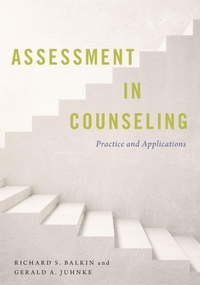
Assessment in Counseling
Practice and Applications
Published on 22. February 2018
Book
Paperback/Softback
296 pages
978-0-19-067275-1 (ISBN)
Description
Students often experience assessment courses, and subsequently the textbooks used for the course, as a statistics-heavy class accompanied by an encyclopedia of a variety of assessments. Assessment in Counseling alternatively emphasizes the skills used in assessment, thereby enabling students to apply these skills across a broad range of assessment instruments and strategies. Assessment, like most core areas of counseling, has a theoretical basis and a pertinent, practical component. However, this practical component often gets lost in the application of the skills and use of instruments that heavily rely on psychometric properties.
Written in an accessible, conversational tone, this text focuses on the application of the theoretical and measurement concepts of assessment in counseling and introduces three case studies that are followed throughout the text. Additionally, instead of introducing readers to a plethora of instruments, the authors select seminal measures that students are likely to approach and use in the profession. Through the use of this text and course content, one will acquire the skills to search, select, and administer the type of assessment instruments that he/she deems helpful for their practice as a professional counselor, regardless of specialization. Ultimately, this textbook serves as an invaluable guide for administering, scoring, interpreting, and communicating assessment results.
Written in an accessible, conversational tone, this text focuses on the application of the theoretical and measurement concepts of assessment in counseling and introduces three case studies that are followed throughout the text. Additionally, instead of introducing readers to a plethora of instruments, the authors select seminal measures that students are likely to approach and use in the profession. Through the use of this text and course content, one will acquire the skills to search, select, and administer the type of assessment instruments that he/she deems helpful for their practice as a professional counselor, regardless of specialization. Ultimately, this textbook serves as an invaluable guide for administering, scoring, interpreting, and communicating assessment results.
Reviews / Votes
"Assessment in Counseling: Practice and Applications has a casual narrative and provides key information to readers about assessment processes in counseling. The chapters are laid out effectively and include realistic clinical case studies that are consistently applied throughout the book. Furthermore, it is clear the authors' wealth of knowledge and experience inform the content included in this book." * Measurement and Evaluation in Counseling and Development *More details
Language
English
Place of publication
New York
United States
Target group
Professional and scholarly
College/higher education
Dimensions
Height: 254 mm
Width: 178 mm
Thickness: 16 mm
Weight
554 gr
ISBN-13
978-0-19-067275-1 (9780190672751)
Copyright in bibliographic data and cover images is held by Nielsen Book Services Limited or by the publishers or by their respective licensors: all rights reserved.
Schweitzer Classification
Other editions
Additional editions
E-Book
12/2017
1st Edition
Oxford University Press
€80.52
Available for download
Persons
Richard S. Balkin, PhD, MEd, is a Professor and Doctoral Program Coordinator at the University of Louisville. Dr. Balkin is a Fellow of the American Counseling Association; the editor for the Journal of Counseling and Development, the flagship journal for the American Counseling Association; and former President for the Association for Assessment and Research in Counseling. He serves on numerous committees for ACA. Dr. Balkin has over 70 publications, which include text books on assessment in counseling and soon-to-be published textbooks on research, published tests and technical manuals, peer-reviewed manuscripts, book chapters, and conference proceedings. His counseling experience with at-risk youth was formative to his research agenda, which includes understanding the role of counseling and relevant goals for adolescents in crisis and counseling outcomes. This led to numerous published articles and one published measure through Mindgarden (Crisis Stabilization Scale).
Gerald A. Juhnke, DEd, MA, is a Professor and the former founding Doctoral Program Director in the Department of Counseling at The University of Texas at San Antonio (UTSA) who has authored more than 55-refereed articles, 14 assessment instruments, and presented over 150 professional presentations. Jerry is an American Counseling Association Fellow, former president of seven professional associations, Associate Editor for the Journal of Counseling and Development, former Editor in Chief of The Journal of Addictions and Offender Counseling, and former Co-Chair of the American Counseling Association's Council of Journal Editors. He has received numerous counseling and teaching awards including the American Counseling Association's David K. Brooks' Distinguished Mentor Award, the American Counseling Association's Ralph F. Berdie Research Award, and the International Association for Addictions and Offender Counseling Addictions Educator Excellence Award
Gerald A. Juhnke, DEd, MA, is a Professor and the former founding Doctoral Program Director in the Department of Counseling at The University of Texas at San Antonio (UTSA) who has authored more than 55-refereed articles, 14 assessment instruments, and presented over 150 professional presentations. Jerry is an American Counseling Association Fellow, former president of seven professional associations, Associate Editor for the Journal of Counseling and Development, former Editor in Chief of The Journal of Addictions and Offender Counseling, and former Co-Chair of the American Counseling Association's Council of Journal Editors. He has received numerous counseling and teaching awards including the American Counseling Association's David K. Brooks' Distinguished Mentor Award, the American Counseling Association's Ralph F. Berdie Research Award, and the International Association for Addictions and Offender Counseling Addictions Educator Excellence Award
Content
Chapter 1: The Role of Assessment in Counseling
Chapter 2: Case Studies Progress Notes: Classification Systems
Chapter 3: Fundamentals of Assessment
Chapter 4: Current Standards for Validity
Chapter 5: Current Standards for Reliability
Chapter 6: How to Choose an Assessment Instrument
Chapter 7: Conducting an Initial Interview
Chapter 8: Multicultural and Special Population Assessment Issues in Counseling
Chapter 9: Fundamentals of Ability Assessment
Chapter 10: Fundamentals of Career Assessment
Chapter 11: Marriage, Substance Abuse, and Suicide Assessment
Chapter 12: Fundamentals of Interpretation Assessment
Chapter 13: Assessment of Accountability in Counseling
Appendix A
Appendix B
Index
Chapter 2: Case Studies Progress Notes: Classification Systems
Chapter 3: Fundamentals of Assessment
Chapter 4: Current Standards for Validity
Chapter 5: Current Standards for Reliability
Chapter 6: How to Choose an Assessment Instrument
Chapter 7: Conducting an Initial Interview
Chapter 8: Multicultural and Special Population Assessment Issues in Counseling
Chapter 9: Fundamentals of Ability Assessment
Chapter 10: Fundamentals of Career Assessment
Chapter 11: Marriage, Substance Abuse, and Suicide Assessment
Chapter 12: Fundamentals of Interpretation Assessment
Chapter 13: Assessment of Accountability in Counseling
Appendix A
Appendix B
Index