

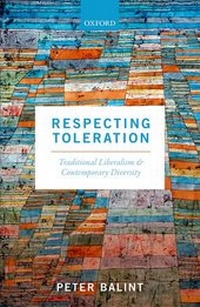
Respecting Toleration
Traditional Liberalism and Contemporary Diversity
Published on 12. January 2017
Book
Hardback
176 pages
978-0-19-875859-4 (ISBN)
Description
The question of toleration matters more than ever. The politics of the twenty-first century is replete with both the successes and, all too often, the failures of toleration. Yet a growing number of thinkers and practitioners have argued against toleration. Some believe that liberal democracies are better served by different principles, such as respect of, or recognition for, people's ways of life. Others argue that because the liberal state should be entirely neutral or indifferent towards people's ways of life, it can no longer be tolerant - it has no grounds on which it can object, and so there is nothing left to tolerate.
Respecting Toleration provides a new, original, and provocative take on the question of toleration and its application to the politics of contemporary diversity. Peter Balint argues for both the conceptual coherence and normative desirability of toleration and neutrality. He argues that it is these principles which best realise the basic liberal good of people living their lives as they see fit, rather than appealing to principles of recognition or respect for difference. While those who criticised liberalism's failings in dealing with the claims of diversity had justification, it is the tenets of traditional liberalism that hold the answer. Respecting Toleration argues that if one cares about people living divergent lives, then it is liberal toleration that should be respected by legislators and policy makers, and not people's differences.
Respecting Toleration provides a new, original, and provocative take on the question of toleration and its application to the politics of contemporary diversity. Peter Balint argues for both the conceptual coherence and normative desirability of toleration and neutrality. He argues that it is these principles which best realise the basic liberal good of people living their lives as they see fit, rather than appealing to principles of recognition or respect for difference. While those who criticised liberalism's failings in dealing with the claims of diversity had justification, it is the tenets of traditional liberalism that hold the answer. Respecting Toleration argues that if one cares about people living divergent lives, then it is liberal toleration that should be respected by legislators and policy makers, and not people's differences.
Reviews / Votes
This short book makes many important points lucidly and concisely. Without going into the intricate details of theory, it is theoretically well-informed, and discusses many real-life examples instructively. It does not require forbearance-tolerance, but deserves great respect, even if this involves accommodating differences. * C.L. Ten, National University of Singapore, Australasian Journal of Philosophy * The very idea of toleration is now under attack from some who applaud cultural diversity as well as those who seek to erase it. In this timely and compelling treatment, Peter Balint explains exactly why we need toleration more than ever. Respecting Toleration is essential reading for those who care about how to navigate troubled times while remaining true to basic liberal principles. * John S. Dryzek, Centenary Professor and ARC Laureate Fellow, University of Canberra * Respecting Toleration is both thoughtful and provocative. It claims that liberal toleration well understood is capacious enough to accommodate a wide range of value- and identity-based differences. It invites scholars like myself to restrain from conferring too much normative weight to culture and conscience but calls in the same breath for more tolerant public norms and institutions. Those who disagree with Balint's claims but who understand the importance of engaging with the best counterarguments will definitely want to read his book. * Jocelyn Maclure, Chaire La philosophie dans le monde actuel, Laval University * Peter Balint's new book is admirably clear-sighted about the political valency of toleration, as well as about the distinct agency of citizens and the state in relation to it. Balint successfully avoids the rival lures of Machtpolitik and moralism as approaches to toleration. Aspects of the book will excite controversy, particularly regarding his view that toleration can encompass indifference. At the same time, Balint recognises that in practice indifference may often be the best we can realistically hope for, and be markedly less bad than any alternative.' * Glen Newey - Professor of Practical Philosophy, University of Leiden *More details
Language
English
Place of publication
Oxford
United Kingdom
Target group
College/higher education
Professional and scholarly
Dimensions
Height: 240 mm
Width: 162 mm
Thickness: 18 mm
Weight
400 gr
ISBN-13
978-0-19-875859-4 (9780198758594)
Copyright in bibliographic data and cover images is held by Nielsen Book Services Limited or by the publishers or by their respective licensors: all rights reserved.
Schweitzer Classification
Other editions
Additional editions
E-Book
12/2016
1st Edition
OUP eBook
€39.49
Available for download
E-Book
12/2016
1st Edition
OUP eBook
€46.99
Available for download
Person
Peter Balint is a Senior Lecturer and Head of International and Political Studies at the University of New South Wales in Canberra. He is a political theorist, and his current research focuses on the issues of diversity, inclusing toleration, respect, neutrality, and national identity. His previous works include Multiculturalism and the Fair Terms of Integration (co-edted with Sophie Guerard de Latour, Palgrave MacMillan, 2013).
Content
1: A Tolerant Society
2: Understanding Political Toleration
3: Active Indifference: A Neutral and Accomodating State
4: Tolerance and the Citizen
5: Against Respecting Each Others' Differences
6: Practising Toleration
Conclusion
2: Understanding Political Toleration
3: Active Indifference: A Neutral and Accomodating State
4: Tolerance and the Citizen
5: Against Respecting Each Others' Differences
6: Practising Toleration
Conclusion