

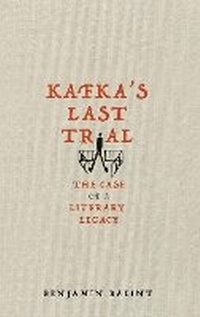
Kafka's Last Trial
The Case of a Literary Legacy
Published on 10. January 2019
Book
Hardback
304 pages
978-1-5098-3671-0 (ISBN)
Description
When Franz Kafka died in 1924, his loyal friend and champion Max Brod could not bring himself to fulfil Kafka's last instruction: to burn his remaining manuscripts. Instead, Brod devoted the rest of his life to canonizing Kafka as the most prescient chronicler of the twentieth century. By betraying Kafka's last wish, Brod twice rescued his legacy - first from physical destruction, and then from obscurity. But that betrayal was also eventually to lead to an international legal battle over Kafka's legacy: as a writer in German, should his papers come to rest with those of the other great German writers, in the country where his three sisters died as victims of the Holocaust? Or, as Kafka was also a great Jewish writer, should they be considered part of the cultural inheritance of Israel, a state that did not exist at the time he died in 1924?
Alongside an acutely observed portrait of Kafka and Brod and the influential group of writers and intellectuals known as the Prague Circle, Kafka's Last Trial also provides a gripping account of the recent series of Israeli court cases - cases that addressed dilemmas legal, ethical, and political - that determined the final fate of the manuscripts Brod had rescued when he fled from Prague to Palestine in 1939. It tells of a wrenching escape from Nazi invaders as the gates of Europe closed to Jews; of a love affair between exiles stranded in Tel Aviv; and of two countries whose national obsessions with overcoming the traumas of the past came to a head in the Israeli courts. Ultimately, Benjamin Balint invites us to question not only whether Kafka's legacy belongs by right to the country of his language, that of his birth, or that of his cultural and religious affinities - but also whether any nation state can lay claim to writers who belong more naturally to the international republic of letters.
Alongside an acutely observed portrait of Kafka and Brod and the influential group of writers and intellectuals known as the Prague Circle, Kafka's Last Trial also provides a gripping account of the recent series of Israeli court cases - cases that addressed dilemmas legal, ethical, and political - that determined the final fate of the manuscripts Brod had rescued when he fled from Prague to Palestine in 1939. It tells of a wrenching escape from Nazi invaders as the gates of Europe closed to Jews; of a love affair between exiles stranded in Tel Aviv; and of two countries whose national obsessions with overcoming the traumas of the past came to a head in the Israeli courts. Ultimately, Benjamin Balint invites us to question not only whether Kafka's legacy belongs by right to the country of his language, that of his birth, or that of his cultural and religious affinities - but also whether any nation state can lay claim to writers who belong more naturally to the international republic of letters.
Reviews / Votes
A literary battle that became Kafkaesque . . . remarkable . . . I warmly recommend this deeply absorbing book. * Daily Telegraph * [A] fascinating and forensically scrupulous account of the history of Kafka's papers. -- John Banville * Guardian * Balint fascinatingly examines how much was at stake for Germany and Israel in claiming Kafka as their man . . . [He] has minutely researched every twist and turn of this politico-legal saga, and tells it with even-handed seriousness. * Sunday Times * Balint's account of this saga is both a fine journalistic telling of that half century of courtroom drama, and a revealing examination of the writer and the relationships at its heart . . . Balint brings all of these forces and arguments to vivid life. * Observer * Absorbing . . . Not only does Mr Balint ask, "Who owns Kafka?" He explores the meaning of a writer's legacy in an age that, like Kafka's disorienting stories, puts identity and belonging in doubt. * The Economist * Dramatic and illuminating . . . raises momentous questions about nationality, religion, literature, and even the Holocaust. * The Atlantic * Kafka's Last Trial is a legal and philosophical black comedy of the first order, complete, like all the best adventure stories, with a physical treasure to be won or lost . . . : the absurdity of our modern obsession with 'authenticity' and 'ownership' * Spectator * The question of who owns Kafka is at the heart of Benjamin Balint's thought-provoking and assiduously researched Kafka's Last Trial. * Literary Review * Gripping and knotty. * New Statesman * Balint handles these complicated claims and counter-claims with great care. He has read widely in the literature about Kafka and provides a fascinating account of the Jewish world of early 20th century Prague, which formed Kafka and Brod . . . Above all, he brings Brod to life . . . Balint is an extremely interesting writer and critic. * Standpoint * Fascinating . . . Balint uses the three-way tug-of-literary-love to pose a series of philosophical questions about Kafka and the way culture is often conscripted to a cause. * Big Issue * The absurd and thrilling tale . . . Balint weaves the story together artfully * Prospect * A tale pitting two Goliaths against one octogenarian David, untangled in exacting, riveting detail . . . A must-read. * Slate * Thoughtful and provocative. * Wall Street Journal * Thrilling and profound, Kafka's Last Trial shines new light not only on the greatest writer of the twentieth century and the fate of his work, but also on the larger question of who owns art or has a right to claim guardianship of it . . . [Balint's] research and lively intelligence deliver insights on every page. -- Nicole Krauss Who should inherit Kafka? . . . Searing questions of language, of personal bequest, of friendship, of biographical evidence, of national pride, of justice, of deceit and betrayal, even of metaphysical allegiance, burn through Balint's scrupulous trackings of Kafka's final standing before the law. -- Cynthia Ozick, Orange prize-shortlisted author of <i>Foreign Bodies</i>More details
Language
English
Place of publication
London
United Kingdom
Publishing group
Pan Macmillan
Target group
Interest Age: From 18 years
Dimensions
Height: 216 mm
Width: 135 mm
Thickness: 26 mm
Weight
438 gr
ISBN-13
978-1-5098-3671-0 (9781509836710)
Copyright in bibliographic data and cover images is held by Nielsen Book Services Limited or by the publishers or by their respective licensors: all rights reserved.
Schweitzer Classification
Other editions
Additional editions
E-Book
09/2018
Picador
€14.49
Available for download
Person
Benjamin Balint taught literature, including Kafka, at the Bard College humanities program at Al-Quds University in Jerusalem for the last three years. His first book, Running Commentary, was published by PublicAffairs in 2010. His second book, Jerusalem: City of the Book (co-authored with Merav Mack), was released in 2017. His reviews and essays regularly appear in the Wall Street Journal, Die Zeit, Haaretz, the Weekly Standard, and the Claremont Review of Books. His translations of Hebrew poetry have appeared in the New Yorker and in Poetry International. His study of Kafka's tangled literary legacy, Kafka's Last Trial, draws on his extensive knowledge of this elusive author, and which country can lay claim to him.
Content
Chapter - 1: The Last Appeal Chapter - 2: "Fanatical Veneration": The First to Fall under Kafka's Spell Chapter - 3: The First Trial Chapter - 4: Flirting with the Promised Land Chapter - 5: First and Second Judgments Chapter - 6: Last Son of the Diaspora: Kafka's Jewish Afterlife Chapter - 7: The Last Ingathering: Kafka in Israel Chapter - 8: Kafka's Last Wish, Brod's First Betrayal Chapter - 9: Kafka's Creator Chapter - 10: The Last Train: From Prague to Palestine Chapter - 11: The Last Tightrope Dancer: Kafka in Germany Chapter - 12: Laurel & Hardy Chapter - 13: Brod's Last Love Chapter - 14: The Last Heiress: Selling Kafka Chapter - 15: The Last Heiress: Selling Kafka